
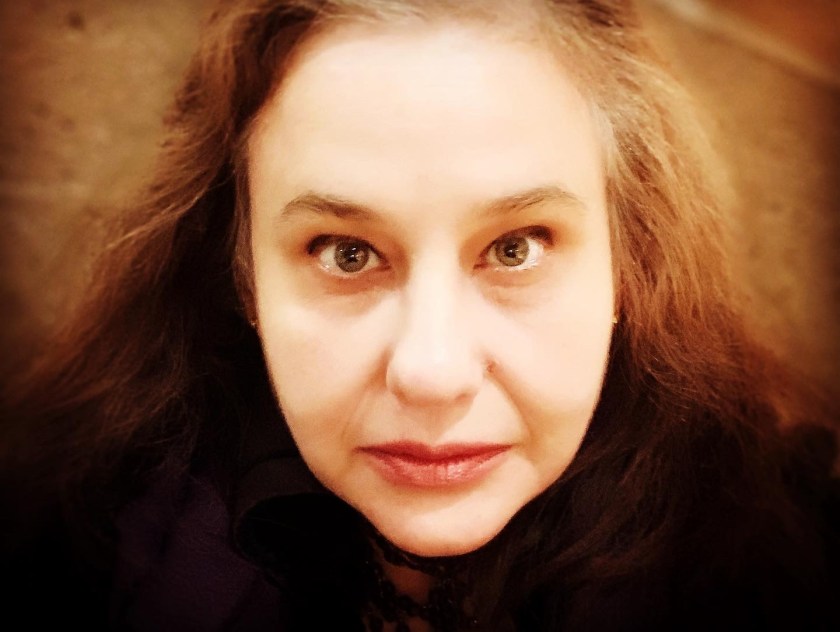
Learn more about author Jen Frankel in this interview where we discuss a range of topics, from the ethical questions that inform her work, to the co-writing process, to what she would do with a Star Trek replicator. Check out her story “Nebulous Negotiation,” co-written with James Dick, in our [July/August issue, on sale now!]
Analog Editor: How did this story germinate? Was there a spark of inspiration, or did it come to you slowly?
Jen Frankel: James and I have been talking about writing together since we met. He brought a universe and some really wonderful exoterran species, and a through-line we could explore. I’d say I’ve been a refiner rather than an originator through the process, adding my own insights and the occasional important piece of the puzzle. James wrote an outline for the story that wove the perspectives of the two main characters, Tensiken and Cassandra, and he primarily wrote from the former’s perspective while I took on the latter. Of course, in an organic collaboration, there’s lots of wiggle room in the boundaries.
AE: Do you particularly relate to any of the characters in this story?
JF: I really relate to Cassandra’s desire to help her species without wanting to be the kind of leader Ten is pushing her to become. She sees accepting leadership as a sure path to alienating herself from the rest of the human beings on the ship, because she’ll be forced to make unpopular decisions. She’ll be placed in the unenviable role of trying to please the Rilicor while placating her own people. I really feel for her, having spent enough time in my life caught between two interest groups where the only way to come to terms is for everyone to be a little unhappy.
AE: Is this piece part of a greater universe of stories?
JF: Yes, and James and I have already written a second and have a third planned. James has a lot of arcs in play that he wants to explore. I have a partially mapped out idea for bridging the FTL barrier, but I’m not sure if it’s going to make it into this shared universe or another story altogether.
AE: How much or little do current events impact your writing?
JF: A lot, and a little, to be perfectly contrary. I’m an embarrassingly avid consumer of American politics (despite being Canadian) and I can’t help finding inspiration in the ridiculous, or the scary, or the just plain bizarre news on my feeds. I’ve been political since I was far too young to vote, and I always layer some elements of my observations on the human condition into my work.
AE: Are there any themes that you find yourself returning to throughout your writing? If yes, what and why?
JF: One of my primary themes is “what does it take to be a good person?” In the same way that we don’t always know what we believe until we actually have to act on those beliefs, I find that writing my characters through difficult decisions allows me to explore what it takes to be ethical when faced with either others who have a different idea of what being decent is, or who eschew entirely the concept of doing the right thing. I also like to dig into how individuals survive against obstacles, especially personal ones like mental illness, trauma, or physical limitations.
AE: What other projects are you currently working on?
JF: I just finished editing a hilarious, raucous collection of feminist science fiction by Marleen S. Barr, and am working on a series of four poetry books of my own work that represent the four elements.
AE: What is the weirdest research rabbit-hole that working on a story has led you down?
JF: When I started looking for a deep backstory for my “Blood & Magic” series, I dove way, way down into “artificial moon” conspiracy theory. I was looking for an explanation for the strain of DNA that allowed some humans in my world to manipulate matter and energy, something that seemed to be magic but needed to have a scientific basis. After discovering the earliest depictions of the moon in human art is less than 10,000 years old, I drowned myself in legends of the Nephilim, and the Younger Dryas period, finally deciding that the moon isn’t artificial, but WAS transported through another dimension from a distant star when its inhabitants needed to flee an enemy. Instead of leaving their world, they brought it with them into Earth’s orbit, causing an ice age and global catastrophe.
I find that writing my characters through difficult decisions allows me to explore what it takes to be ethical when faced with either others who have a different idea of what being decent is, or who eschew entirely the concept of doing the right thing.
AE: What SFnal prediction would you like to see come true?
JF: It’s more a SFnal invention I really, really want to see IRL: the Star Trek replicator. I do love to cook, but to be able to just call up a fresh coffee and pastry when I get a craving? A complicated pasta dish ready in seconds when I’m on deadline and need to carb-load? Heaven. Absolute heaven.
AE: What is something we should know about you that we haven’t thought to ask?
JF: I’m grateful not to have to answer any “desert island” questions! Probably the most important thing to know about me is that I am a bit of a polymath, with serious sidelines in origami, music composition, painting, psychology, and ancient history, and am really good at Trivial Pursuit, unless I get asked too many sports questions! I also wrote to Isaac Asimov as a child after reading the Foundation series, and got a postcard back from him that remains one of my most prized possessions.
AE: Many of our Analog authors are interested in science. Do you have any scientific background, and does it impact your fiction?
JF: I grew up reading Richard Feynman, and books like Chaos, Godel Escher Bach and Dewdney’s visionary Planiverse. It was clear that I loved science through an artist’s lens: Abstract math was never going to come easily, or I could have ended up in theoretical physics. Instead, I’ve been an avid amateur scientist in the truest sense of the word, and collect oddities and curiosities that feed my imagination.
AE: What careers have you had and how do they affect your writing?
JF: It would have been lovely to start making my living as a writer earlier, but instead, I’ve collected a vast array of unusual jobs and professions that all have had an impact both on the situations I come up with for my stories and the characters that inhabit them. Just for a few: software distributor, small press publisher, Shakespeare teacher, screenplay doctor, assistant parrot breeder, background film performer, science toy shop clerk, life model, and child actor wrangler.
AE: How can our readers follow you and your writing? (IE: Social media handles, website URL . . .)
JF: My website is www.jenfrankel.com — I’m on Twitter occasionally @jenfrankel and more frequently on Instagram @jenfrankelauthor. My books are available on Amazon and through individual publishers like Dark Helix, Eerie River, and Dark Dragon Publishing. I run a weekly literary open mic in Toronto called Write On! Write Now and appear frequently at comic book, literary, and genre festivals and conventions.
 The Astounding Analog Companion