
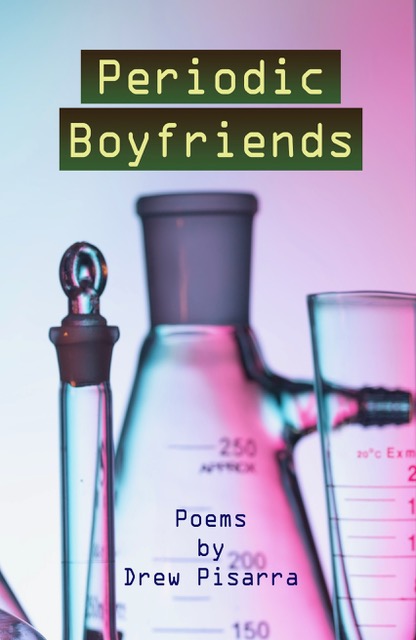
To write his new poetry collection, Drew Pisarra took stock of his love life, encompassing all of his past partners, lusts, and “unrealized liaisons,” assigning each one to an element on the periodic table. Read Periodic Boyfriends, [on sale now], as well as his poem “Moscovium,” which will appear in [our upcoming issue, on sale August 15]
Emily Hockaday: Drew—you mentioned to me that this book was “decades in the making,” but I’m wondering about the origin of the project as a whole: Did you plan on writing these poems as a collection from the start, or did you find yourself amassing poems and realize you had a collection brewing?
Drew Pisarra: I started writing Periodic Boyfriends with the germ of an idea. How do I get over the guy who inspired my last poetry collection, Infinity Standing Up? That earlier book was like a fever chart documenting the highs and lows of my own incurable lovesickness. I knew he didn’t love me, not like how I loved him. He was in a long-term relationship with another man, after all. Yet here I was, struggling to get free. The sonnets in that book alternated between courtship and curses, and I assumed that when I was done, when that book was finally done, that our relationship would be done, too. And mostly it was. But not entirely. Because afterwards, I felt as though the sonnet as a form were haunted by his very being. I needed to counteract that and so . . . Hello, Periodic Boyfriends!
EH: Since we’re talking about the origins of the book: What gave you the idea to write your way through the periodic chart—and with exes?
DP: To be honest, I thought the best way to diminish this aforementioned ex’s stature was to equate him with all the other men I’d slept with. A man assumes less importance when he’s just one of 118. A little reflection on my own carnal history clued me into the fact that I’d definitely done the bedside research. I guess subconsciously, I was drawn to the periodic table because numbers are so central to its organization. Each element’s location in the chart is tied to its atomic number (i.e., the number of protons). And I liked the idea of each of these men sharing properties with their titular element. Who’ll remind me of Copper? of Radium? of Neon? I was ready to find out.
EH: Our readers at Analog are science lovers. What kind of knowledge of the periodic chart did you have going into this project, and how much research would you say you had to do while writing these poems?
DP: I knew of the noble gasses, that Hydrogen came first in the lineup, that there were metals and non-metals (although I had no idea what “non-metal” meant). I also knew that the chart resembled a lopsided sandcastle with a moat in front. From an AP Chemistry perspective, I would say my knowledge was basic at best. Luckily, early on, I stumbled upon a pair of highly entertaining podcasts: The Royal Society of Chemistry’s Chemistry in Its Element and Radio New Zealand’s Elemental. Together these two resources have made me idiosyncratically informed. Did you know, for instance, that selenium is used in dandruff shampoo and barium in rat poisoning?
EH: Are there any moments in which you fit research into the poems that you are most proud of? (Feel free to quote or include a poem!)
DP: I do enjoy how “Lithium” acknowledges both the medication and the Nirvana song while “Arsenic” nods to its smell (garlick-like), its color (often yellow), and that it was once a cure for syphilis and is still used in some insecticides. But I’m not expecting readers to come to the poems with encyclopedic knowledge. If anyone notices that the Agatha Christie name-drop in “Thallium” is due to the poisoning method used in her mystery The Pale Horse, well, hats off to them. Ultimately, as the opening poem points out, these sonnets are really about viscerally felt associations as much as any scientifically related ones: “In Love, we need not always seek for Gold. / Much may be made of Silver, less of Tin.”
EH: What were the most difficult elements to incorporate into love poems?
DP: May I take this moment to speak about “Lead”? I suppose it’s a love poem if you’re willing to entertain the idea that the lover is Death. That was the last sonnet I composed for this series. I believe I wrote it fairly quickly but its subject—who was the last guy I slept with before I got sober —was one I had trouble confronting. It took me 117 other sonnets to get there.
EH: Why sonnets? (I mean, why not, but we’re curious!)
DP: Form gets overlooked as an opportunity. Structure forces me to consider ideas I would not have entertained if given free rein. When you’re working with end-rhymes, you’re led to associations you probably wouldn’t have considered otherwise. Writing sonnets—or dizaines or villanelles for that matter—helps me to think outside my own natural borders.
What was it like going back and rethinking these relationships with the lens of the periodic chart? Did you find that the distance helped (or hurt)?
Initially, I wanted each poem to be inspired by a different sex partner but early on, I felt like something was missing. Desire and love encompass so much more than mere fornication! And so I expanded my parameters to include lusts and unrealized liaisons as well. “The Lanthanides,” a subsection devoted entirely to dead gay men, was the most surprising to me as I revisited relationships that were over, permanently and irretrievably. Or so I thought until I discovered that nothing is ever lost or disappears completely. The land of the dead, like the realm of the microscopic, may be invisible to the naked eye, but it’s still there.
EH: Drop a link for folks to buy your book!
DP: https://bookshop.org/p/books/periodic-boyfriends-drew-pisarra/20095019
https://www.amazon.com/Periodic-Boyfriends-Drew-Pisarra/dp/1732875960/
 The Astounding Analog Companion