
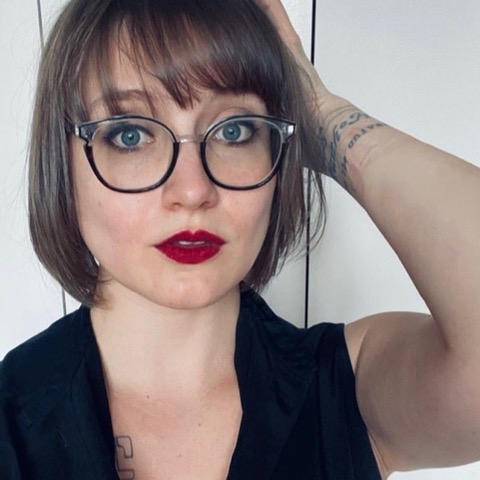
In the conversation below, Aleksandra Hill discusses her interest in current events, how she overcame the expectations of others to become a successful writer, and more. Check out her latest story, “Secondhand Music,” in our [September/October issue, on sale now!]
Analog Editor: How did this story germinate? Was there a spark of inspiration, or did it come to you slowly?
Aleksandra Hill: I stumbled upon an anthology featuring sci-fi stories where technology is explicitly a force for good, and that got me thinking about machine learning (ML). I did my Ph.D. in computational biology; my thesis used ML to develop genetic models to identify potential drug combination therapies. Without wading too deeply into the current conversation about writing and AI, except to say that training models on art without the permission of the artists is theft, I do also fundamentally believe that good can come out of this technology if it’s used ethically. That’s where the rub is. In this story, the arm that Ava gets is something that can change her life for the better, even if it comes with its own issues: eventually, given time and patience, the models would’ve adjusted to suit her own playstyle. But it’s human greed that sets up the ultimate choice that Ava must make: the insurance companies who deny her a new prosthetic, and the benefactor who ensures that her “generosity” always comes with strings attached. Humans are really good at making beautiful things, and just as good at ruining them.
AE: How did the title for this piece come to you?
AH: Titles are the hardest thing for me, and I’m still not entirely satisfied with this one! I’ve always worried it comes off punny at first glance, which wasn’t my intention. I usually try to take titles from the lines of a piece, but this was a lot of brainstorming until this one just stuck.
AE: How much or little do current events impact your writing?
AH: I’d be shocked to learn that current events don’t impact an author’s writing, especially in speculative fiction! How can you think of what the future might look like if you’re not paying attention to what the world looks like now? I started writing a few years after I started truly paying attention to stuff outside my little bubble of existence, and current events—the ways in which our world is broken, and the ways in which we make life better for one another—are always in the back of my mind.
AE: Are there any themes that you find yourself returning to throughout your writing? If yes, what and why?
AH: I’m really interested in families that are fundamentally broken but love each other very deeply. This story is, I guess, a different side of the same coin: Mrs. DuVerne has her little flock of protégés and, from the outside looking in, it might seem like she has their best interest at heart, like she kind of takes folks in and has made a found family for them. But love requires selflessness, and Mrs. DuVerne is only in it for what she can get for herself. One core of the story is Ava grappling with the idea that not all help is actually helpful.
How can you think of what the future might look like if you’re not paying attention to what the world looks like now?
AE: What is your process?
AH: I’m a verbal diarrhea first drafter: I think of the general arc of the story I want to tell, and then I just . . . write. It’s messy and it’s ugly and it goes off track a lot, but by the time I’m done, I see the story that I’m trying to tell—and it’s usually not the one I started with. After that, I do several rounds of editing, including lopping off whole chunks of story—it’s not uncommon for my first draft to be twice as long as what the story ends up as. In college, I took a class with James Shapiro where he’d assign us an essay a week with a topic that could be a thesis dissertation and give us only 600 words to write with; if you had an essay worth an A but you handed in 601 words, then sorry, you get an A- now and the word you could’ve cut scratched out in red ink. 602 words? B+. It was brutal, but I’ve held the lessons from that class close to heart for all of my stories (and any other writing I’ve ever done!).
AE: What inspired you to start writing?
AH: I started writing in middle/high school, but it was mainly roleplaying and fanfiction of The Wheel of Time; my parents dissuaded me from it because it wasn’t “real” writing and thus a waste of time (something I fervently disagree with in hindsight!). By the time I was finishing up my PhD, I realized a lot of people will tell you very loudly about what you should be doing when they haven’t the faintest idea about your work, so I just decided to jump back into writing what I wanted to write without worrying about what others think. That was in 2017—I haven’t looked back since!
AE: What other projects are you currently working on?
AH: I’m about to go on submission with a generational horror novel about the things mothers tell their daughters to keep them safe—and what happens when those things aren’t true. I’ve also got a solid draft of a YA-ish historical dark fantasy book that I’ll pick back up in the fall, as well as a family drama set on a spaceship (that one’s short fiction, thankfully!).
AE: Do you have any advice for up-and-coming writers?
AH: The biggest thing that I had to learn was what feedback to take to heart and what to let fall away. Ultimately, you know what story you want to tell best—if the advice someone is giving you makes you feel squicky, it’s probably because they’re trying to get you to tell their story and not really looking at yours. That’s not to say that you don’t need feedback—find a writing community, ask them to read your stuff, ask for what you need. And: read their stuff and listen to what they are asking for, too. Clarifying to others where you think a story is and isn’t working is going to give you a better critical eye for your own writing, and it’s a brutal world out there for writers—having a few friends on the journey will make it a little easier.
AE: What is something we should know about you that we haven’t thought to ask?
AH: I have to plug my non-writing work! In 2020, I founded a magazine called khōréō. We publish speculative fiction by immigrant and diaspora authors, including a good amount of science fiction. Our stories are available via quarterly subscription, and also become available for free to read and listen to online at www.khoreomag.com and all the major podcast platforms.
AE: What careers have you had and how do they affect your writing?
AH: I got a PhD in computational biology, then shifted to management consulting, then to product management in a pharmaceutical company, and now I’m trying to shift over to the startup world from the more technical side of things (brushing up on backend engineering). The PhD taught me how to think deeply about a problem; consulting taught me how to move fast and get things done, even if the answer isn’t 100% correct. I’d like to thing that consulting helped me become a better writer because I can draft much more efficiently; I’ve become more comfortable making a decision and seeing it through, and then scrapping it and doing something else if it’s not working (I’m a firm believer that there’s no such thing as wasted words). My PhD has been great for the editing phase—really looking at the Frankenstein mess I put together in my first draft and seeing what to lop off and what to add to make it into a proper story.
AE: How can our readers follow you and your writing?
AH: I’m active on Twitter (while it hasn’t burned to the ground) at @_aleksandrahill and BlueSky at @aleksandrahill. You can also find more about me at http://www.aleksandrahill.com.
 The Astounding Analog Companion