
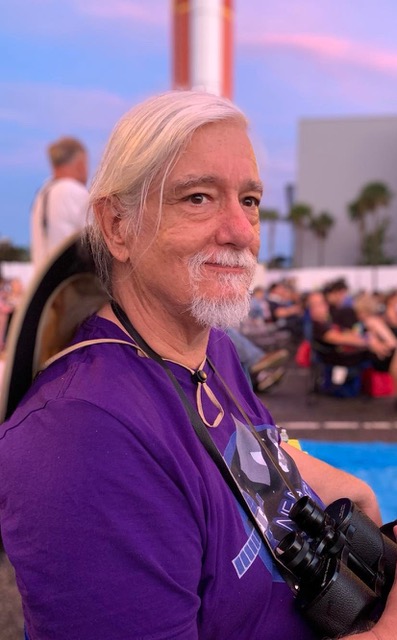
We’re thrilled to introduce our readers to Michael Capobianco, an amateur astronomer with a keen interest in planetary flybys. His first Analog story, “Hippolyta Flyby,” appears in our [November/December issue, on sale now!].
Asimov’s Editor: How did this story germinate? Was there a spark of inspiration, or did it come to you slowly?
Michael Capobianco: There were a couple of sparks, but they coalesced into this story very slowly. The first spark was the stories I was reading about the Breakthrough Starshot Initiative that got me wondering about whether it was technologically feasible and, if so, what it would look like given some reasonable advances in technology over the next twenty-five years. Could we communicate with such a spacecraft and could it send meaningful information back to us? The other was the discovery of Proxima Centauri b in 2016, which I anticipated might create a rush of new interest in nearby exoplanets, which would generate funding for better technologies. Taken in the context of my long-standing interest in planetary flybys, the idea of a mostly autonomous spacecraft flying by a planet of interest in the Alpha Centauri B system seemed like a natural. The rest of the story and Ippy2’s dilemma came after, and I’m not sure where it came from, exactly, but I knew every spacecraft should have redundant systems.
AE: Is this piece part of a greater universe of stories?
MC: No, it’s a stand-alone unless readers clamor for the further adventures of Ippy2.
AE: What is your history with Analog?
MC: I have a long, long history with Analog/Astounding, going back to when my Cousin Val gave me his collection of Astoundings from the fifties. At about the same time, I was buying and reading the large-format issues of Analog that contained installments of Dune (I still have them). Over the years, I’ve occasionally lost touch with Analog, but it’s still the touchstone for the kind of sf I enjoy most. “Hippolyta Flyby” is my first sale to Analog, and I’m pleased to say that I’ve recently sold Analog a second story, a novelette. I hope they live up to that tradition.
AE: Are there any themes that you find yourself returning to throughout your writing? If yes, what and why?
MC: Yes. Many of my protagonists start out alone, either literally, separated physically from the other characters, or within their own head, psychologically isolated. The theme is often finding a way to break through that barrier. Of course, Exploration of inhospitable but beautiful worlds is an ongoing obsession of mine, and it can be a perfect setting for that kind of story. For me, a primary sense of wonder comes from understanding the natural processes that create worlds. This started for me, without warning, in the early Spring of 1979 when I saw the Voyager 1 images of Ganymede. I was hooked.
AE: What inspired you to start writing?
MC: My gateway to sf was a slightly tattered Grossett & Dunlap copy of The Gods of Mars, by Edgar Rice Burroughs, that I found in my elementary school library. At that point, in 1963, ERB books had been mostly out of print and were pretty rare, but it wasn’t long before Ace books started doling a few of them out every month as paperbacks. Walking down to my local Drug Fair to search the paperback spinner racks became part of my Saturday routine. Meanwhile, I found another kid who also loved ERB, William Barton, and we started making up our own ERB-esque worlds as we tramped through the local woods. That turned into trying to write a book about one of them, alternating chapters.
AE: How did you break into writing?
MC: Assuming you mean publishing, during college Bill and I were still trying to finish the much-mutated book we had started as pre-teens. I was primarily reading fantasy at that point, but Bill had always been much more widely read in sf, and submitted a short novel to Ace over the transom, Hunting on Kunderer, which was published as half of the last Ace Double Book in 1973. It suddenly became clear to me that it actually was possible to get published, and, after an unsuccessful attempt to sell a sword and planet collaboration, Voyager and Ganymede happened. The result was the hard sf collaboration Iris, which takes place on the icy moons of a rogue ice giant at the outer edge of the solar system. After years of submitting, it was eventually bought by Bantam Doubleday Dell.
AE: What is something we should know about you that we haven’t thought to ask?
MC: For the last 30+ years, I’ve been volunteering for SFWA (formerly Science Fiction and Fantasy Writers of America, now Science Fiction and Fantasy Writers Association.) It’s been an interesting and, in many ways, rewarding ride. Way back on the Genie SFRT, Joe Haldeman was trying to find someone to serve as Treasurer of the organization, and I foolishly stepped forward, not knowing what I was in for. And I was hooked again, this time trying to figure out how to fix SFWA (mostly by shoring up its infrastructure and institutional memory). Over the years I’ve done stints as President and VP as well as Treasurer, and have served as SFWA’s Authors Coalition Commissioner since the Coalition was formed in 1993. Oh, I chair a few committees, too.
AE: Do you have any scientific background?
MC: As you can probably tell from my previous answers, I am intensely interested in the physical sciences, but aside from majoring in Linguistics, I have no formal scientific background. Math has never been my forte. I am an amateur astronomer and member of the International Occultation Timing Association (IOTA).
AE: Do you have any advice for up-and-coming writers?
MC: My advice to anyone who is just breaking in is to use SFWA’s resources, especially Writer Beware (https://www.sfwa.org/other-resources/for-authors/writer-beware/). Writer Beware, run by author Victoria Strauss, is dedicated to shining a light on the literary schemes, scams, and pitfalls threatening writers and presenting the most current information on what they can do to protect themselves. These resources are available to anyone, not just SFWA members.
AE: What’s your favorite moon?
MC: Iapetus. There are many candidates, but for me Iapetus is the most mysterious and beautiful. I wondered about its two-tone surface for decades between the tantalizing Voyager images and the slow high-resolution reveal from Cassini. Eventually, the black of the black and white surface was understood as a thin coating of dark dust from Phoebe and other Saturnian satellites deposited on the leading edge of the moon plus increased solar absorption of dark particles and sublimation of bright ices. Cassini also discovered a spectacular massive equatorial ridge unlike anything else in the solar system. And there are still some features not explained, at least to my satisfaction. All in all, a beautiful oddball.
AE: How can our readers follow you and your writing? (IE: Social media handles, website URL . . .)
MC: I’m on Facebook (Michael.Capobianco.90) and X (@michaelcapobian), as well as the SFWA Discord. My website, https://capobian.com, is currently being rebuilt but should be back by the time this is published.
 The Astounding Analog Companion