
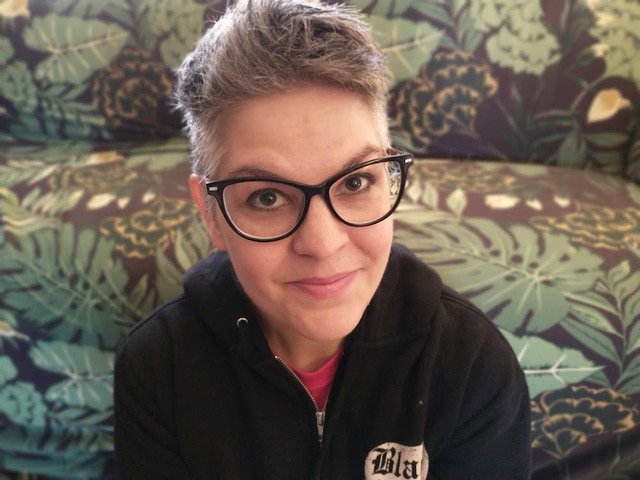
Wendy N. Wagner is a writer and editor who has just made her Analog debut. In our Q&A with Wendy, learn more about her background, her inspirations, and her deep-dive into the history of skin care. You can read her latest story, “An Infestation of Blue” in our [November/December issue, on sale now!].
Analog Editor: What is the story behind this piece?
Wendy N. Wagner: A couple of years ago, Cat Rambo and Jennifer Brozek announced they were editing an anthology about science fictional detectives. I loved the idea—I’m a mystery junkie—but I was really busy struggling with the first draft of a horror novel. The book missing its spark, that certain something setting a story apart from the monster-of-the-week films Shudder and SyFy churn out. One day, I was out walking my dog when I was hit by the notion what my book needed were chapters from the point of view of the aliens (spoiler: there are aliens in my next horror novel).
I was immediately worried that I wouldn’t do a good job writing from the perspective of another being who didn’t have senses or ways of thinking like mine. My favorite class in college was philosophy of minds, so I really wanted these chapters to be successful. I figured the best way to get the hang of it would be to practice, and my favorite writing practice has always been writing short stories.
Since I have a dog and lots of dog books readily available, I thought I’d try my hand at writing a short story from the point of view of a dog. The call for detective stories must have stuck in my mind, because I decided I really wanted my dog to be pressed into service solving a mystery.
Once I had those parameters in mind, I sat down to try to create a voice for my story. Because of the importance of smell in a dog’s life, I knew it would need to be at the center of the piece, and that led me to write the first paragraph. Once I read that paragraph, I knew I was onto something.
AE: How did the title for this piece come to you?
WNW: I love learning about the way other creatures experience the world. Animals’ senses evolve to help them better fill their ecological niches, so their senses vary as much as their habitats and body plans do. Some animals utilize a perception of electrical impulses to navigate or hunt. Different kinds of eyes see different kinds of colors. Bees and birds see into the ultraviolet spectrum. Mosquitoes and vampire bats see into the infrared spectrum. And both cats and dogs have very different experiences of color than humans—dogs only have two cones in their retinas, so they see the world in a range of colors from yellow to blue (and it’s not green in between them, but rather a range of browns).
In the story, the scientists attempt to communicate with our dog narrator using a touch screen with a yellow “yes” button and a blue “no” button. The dog begins to associate blue with negative emotions and feelings, which gave the color an important emotional resonance. I knew I had to use it in the title!
AE: What made you think of Analog for this story?
WNW: Analog has been a dream market since I first started writing short fiction. It’s such a legend in the field! I didn’t expect this story to be an Analog story, but I decided to take the risk and submit it anyway. Getting accepted was an absolute dream come true.
AE: Are there any themes that you find yourself returning to throughout your writing? If yes, what and why?
WNW: Perhaps because I’ve always wanted to be a writer, I’ve always been fascinated by our relationship to language. Humanity takes for granted that while language is vitally important to our species, it might not play as big a role in the experiences of other beings. There’s a terrific book by Dutch primatologist Frans de Waal called Are We Smart Enough to Know How Smart Animals Are? that spends a lot of time examining the way our human biases, especially our language bias, has kept us from understanding animals.
An examination of that myopia appears in my work quite often, from “An Infestation of Blue” to my SF novel An Oath of Dogs all the way through my forthcoming horror novel with aliens (The Creek Girl). Of course it’s not easy to use language to talk about ways of knowing that don’t include language! Maybe it’s the difficulty that I find so appealing.
My other big topic is our relationship to our environments. Landscape tends to play an enormous role in my fiction. I don’t think that shows up in this particular story, but it’s the dominant tone of all my novels.
AE: You’re also an editor of short fiction. How do you think that’s impacted your writing?
WNW: When I first got into editing—I started out as an editorial assistant for some anthologies by John Joseph Adams, and then he brought me on as the assistant editor of Fantasy Magazine back in 2011 or so—reading lots and lots of submissions really helped solidify my understanding of how stories worked. I learned a lot about making an attention-getting opening and how to unfold events logically but with enjoyable tension. When you’re scrutinizing a lot of fiction to see how it does and doesn’t have impact, you learn very quickly.
After I started working more seriously as an editor (I’ve been editing at Lightspeed and Nightmare for almost ten years now), I started to feel very exhausted by my reflexive analysis of fiction. I really pulled away from reading speculative fiction, because I was so inundated with it at work, and I craved a different kind of flavor in my reading. I love reading, and I’ve always been a big fan of science fiction and fantasy, so it was a strange feeling! So I started reading a lot more nonfiction, because it just feels so very different from the speculative short fiction I work with all the time.
I think reading more nonfiction has had a tremendous impact on my work. It’s been like flipping open my head and pouring in massive quantities of raw material for my brain to reassemble into stories. For me, the reason I write is to better understand my world and to make sense of my experiences. It’s really driven by curiosity, and that curiosity is so well-nourished by reading nonfiction.
It’s hilarious to say that editing SFF has helped me by making me pay less attention to SFF, but that’s been the route for me!
Perhaps because I’ve always wanted to be a writer, I’ve always been fascinated by our relationship to language. Humanity takes for granted that while language is vitally important to our species, it might not play as big a role in the experiences of other beings.
AE: Who or what are your greatest influences and inspirations?
WNW: Stephen King has had a massive impact on me, both through his creations and his career. There’s a time in his work where he really wrestles with his relationship with his work—his novella The Mist is a great example of this, because the main character is an illustrator who really looks down at what he’s created. But eventually he became a huge advocate for those of us writing in genre fiction, and I think his pride in his work has really helped me enjoy my own creations much more.
Other than that: Daphne du Maurier, Shirley Jackson, Octavia Butler, Jeff VanderMeer, John Langan, H.P. Lovecraft (it’s embarrassing to admit, but true), Adrian Tchaikovsky, Pamela Dean, Terri Windling, and Frank Herbert are some writers who have left incredible impressions on me and my work.
AE: What inspired you to start writing?
WNW: My journey to writing has taken some false turns over the years. I first knew I wanted to be a writer at age seven or eight, when I discovered the book Alanna: The First Adventure by Tamora Pearce. It was the first book I’d ever read using multiple POV characters, and it was such an enormous change from the more straightforward children’s books I’d been reading up until then. That was the first moment I realized that stories weren’t just magical creatures someone captured in a butterfly net, but rather something shaped by an actual person’s decisions and taste. I got so excited! Who wouldn’t want to do that?
I kept trying to write novels all through childhood, although I never finished anything. When I went to college, a lot of my love for writing was crushed out of me by the slog of writing papers, but more importantly, from the constant emphasis on “Great Fiction.” I just knew I’d never write anything “great.” I got very depressed for several years. I couldn’t write at all. Then a friend gave me a copy of Stephen King’s On Writing (at that time a new release!). His warm and friendly advice, combined with his insistence that you can only write the kind of fiction that you want to write, felt like a permission slip to be myself and not Wendy N. Faulkner or Ernestina Wagnerway.
AE: What is the weirdest research rabbit-hole that working on a story has led you down?
WNW: The best thing about being a writer is having an excuse to become a mini-expert in some topic you’d never normally encounter. I really enjoy writing historical fiction, which requires lots and lots of research. A lot of times, those stories actually start with the museums and displays I stumble into in my own normal life—for example, I wound up going to The Museum of the Oregon Territory with my family, where a display on turn of the century pharmacies led me to explore historical skin care in my novella The Secret Skin. The world of really terrible beauty products is a fascinating one! I lost a lot of time learning about how arsenic was added to women’s skin powders to encourage a paler complexion and nasty stuff like that.
But most of the time, I can’t really describe my research projects as “weird,” because they’re usually about absolutely normal things that I just need to better understand to flesh out the world of my fiction. Do I now know far more about Scandinavian lichens and the history of plywood than most people currently living in the United States? Probably. But I enjoy it a lot.
AE: What careers have you had and how do they affect your writing?
WNW: Writing and editing is really the only “career” I’ve ever had! I’ve had a handful of oddball jobs that have helped me pay the bills, though. I worked in food service a couple of times, including a spell as a pizza and salad cook where I learned how to toss pizza dough. I did a lot of secretarial things in college, including a year working in a law office, where I learned a bit about estate planning, escrow, and elder law. I was a stay-at-home mom for a while. I did odd jobs for a teacher, including laundry and grading papers. I sold choral sheet music for a few years, before the internet killed sheet music stores. And I spent seven years working at the Portland Children’s Museum, where I worked at the front desk, taught a children’s yoga class, led storytime, helped in the clay studio, and showed kids how to use a drill.
My brain is a hodgepodge of skills and interests, and I think that really helps me create a wide variety of characters. Or at least I hope so!
AE: What are you reading right now?
WNW: At any one time I’m usually reading a novel and a couple of nonfiction works. Some recent novels I’ve devoured were Victor LaValle’s The Changeling, Kelly McWilliams’ Your Plantation Prom Is Not Okay, and Paul Jessup’s Glass House. Recent nonfiction loves include Andre Agassi’s autobiography Open (I know nothing about tennis, but it was one heck of a read!) and Kara Goucher’s The Longest Race.
AE: What other projects are you currently working on?
WNW: I’m currently working on my next horror novel, which is about a fire lookout in rural Oregon!
AE: How can our readers follow you and your writing? (IE: Social media handles, website URL…) WNW: People can check out my website at winniewoohoo.com or hit my Linktree for all my social media handles: linktr.ee/wendynwagner.
 The Astounding Analog Companion