
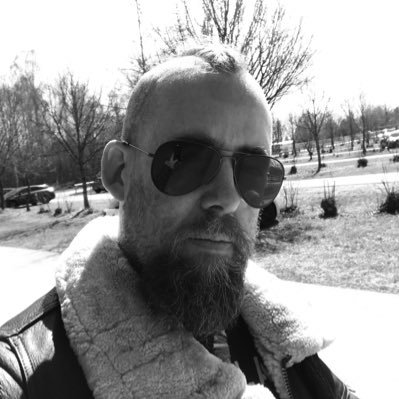
Steve Toase is a landscape archaeologist, motorbike enthusiast, and writer whose work has previously appeared in Analog and many other places. In our Q&A with Toase, learn more about his writing tips for aspiring authors, and read about his research interests in peculiar organisms that inhabit dead whales. Be sure to check out his interview with professor of regenerative architecture Dr. Rachel Armstrong in [January/February issue, on sale now!]
Analog Editor: What is the story behind this piece?
Steve Toase: I’ve long admired the work of Dr Rachel Armstrong. We’ve spoken a bit in the past and I really wanted to have an in depth chat about her work. This interview is the result of that conversation.
AE: What is your history with Analog?
ST: Previously Analog has published two of my stories. The first “Dendrochromatic Data Recovery Report 45-27” is about using the growth rings of trees as an organic data storage system (that story has a few little hidden easter eggs if you translate the Hex code into text). My second story for Analog was called “The Taste of Sound.” This was inspired by an article I wrote for Fortean Times about Emergency Population Warning Systems, which in turn was inspired by the EPWS vans driven around the city where I was living during Covid.
AE: What is your process?
ST: I’m very lucky to have three workdays a week to write. Last year I started dividing that time up, so I spend one day on short stories, one day on articles and one day on longer projects such as novels or novellas. This means when I sit down to work I (in theory) don’t get distracted by another project. Also, I keep the days flexible, so if I’m working on an article on Friday I can pick it up again on Monday.
AE: How do you deal with writers’ block?
ST: As mentioned in the last answer I normally have several projects ongoing. Normally, I’m rarely blocked on everything, so if I’m not making progress on a short story, I’ll work on an article. If the novel isn’t working, I’ll write some flash fiction, and if all else fails I’ll go and read a book I have to review. For me, it’s normally a specific sticking point and by distracting myself with other writing I can get going again.
AE: How did you break into writing?
ST: I started writing for BSH Custom Motorbike Magazine. I’m still an avid biker and a lot of time is focussed on this. At the time I’d picked up a correspondence course about How to Be a Writer. One of the first exercises was to write a book review. I showed it to Blue, a friend who was the editor of BSH at the time. They ran the review, I started writing little bits and pieces, then moved on to event write ups and a bike feature. After that I began reviewing for Fortean Times, and now write a regular comics review column for them, as well as features on subjects as diverse as the occult in biker fiction, Faust, and the above mentioned EPWS.
If you’re writing, you’re making progress. Doesn’t matter if it’s ten words a week or ten thousand. If words are going down on the page then the work is progressing.
AE: What is the weirdest research rabbit-hole that working on a story has led you down?
ST: There have been many, but one was during the research for “Flow to the Sea” (Published in SYNTH #1) I wanted to identify a type of organism that lived on dead whales which might be used to manage data storage in bone. Osedax bone worms in case you were wondering.
Another more recent one was asking some friends who are early medieval specialists for help with a nine word old English phrase, which generated a lot of discussion while I just sat back and marveled at their knowledge.
AE: What are you reading right now?
ST: Uzumaki by Junji Ito. I’ve been a huge fan of Junji Ito’s style of cosmic horror for a long time, and I think The Enigma of Amigara Fault is a modern classic. Because I live in Germany I’ve struggled to get an English language hard copy of Uzumaki. I was just in England so picked one up from the excellent OK Comics in Leeds, and am now enjoying disappearing into the spiral!
AE: Do you have any advice for up-and-coming writers?
ST: 1) Everyone says write what you know, and there is some truth to that. However, I would recommend that you write what you enjoy writing. There will always be parts of any project that drag, but if you genuinely love the story you’re writing you will be willing to sit there and work on it.
2) If you’re writing, you’re making progress. Doesn’t matter if it’s ten words a week or ten thousand. If words are going down on the page then the work is progressing.
3) If you hit a block, find a prompt. There are lots online you can use like postcards, or what3words codes (a personal favourite of mine), but a prompt can often get you thinking in different ways.
AE: Many of our Analog authors are interested in science. Do you have any scientific background, and does it impact your fiction?
ST: I have a BSc in Archaeological Sciences, and an MA in Landscape Archaeology. My particular research was looking at the embodiment of Iron Age landscapes. This appears in my work in two ways. Firstly, I’ve written a lot of stories featuring archaeology as a profession (including “Terminus Post Quem,” a story structured as an archaeological site report). Secondly the idea of embodiment means thinking about the physicality of how we experience landscapes (inspired by Lackoff and Johnson’s Philosophy of the Flesh, and Embodied Geographies edited by Elizabeth Teather). This means when I’m writing I’m thinking about the sensorial experience of the world I’m writing, so scents, physical sensations, sound, as well sight.
AE: What careers have you had and how do they affect your writing?
ST: I worked in commercial archaeology for several years and this has provided me with a lot of material, for example “Terminus Post Quem” mentioned above, and “The Ercildoun Accord,” a story about a commercial archaeological excavation in Faerie.
To paraphrase James D Nicoll, archaeology is the discipline that follows other scientific disciplines down alleyways to beat them unconscious to rifle their pockets for methodologies. Archaeology uses methods from geology, philosophy, biology, chemistry, physics, and sociology. There’s also the physical act of digging, especially in commercial archaeology where you will often be working on building sites and have to work fast. This means you become very comfortable with combining approaches and disciplines to achieve the best results.
AE: How can our readers follow you and your writing? (IE: Social media handles, website URL…) ST: http://www.stevetoase.co.uk Bluesky @stevetoase.bsky.social FB: https://www.facebook.com/stevetoase1, Twitter; @stevetoase
 The Astounding Analog Companion