
by Kelly Lagor
Learn how an adventure in meal-kit cookery and a Neil Gaiman poem inspired Kelly Lagor’s latest Analog story, “Making Gnocchi at the End of the World,” now available in our [May/June issue, on sale now!]
Stories often come together in surprising ways, and “Making Gnocchi at the End of the World” was no exception.
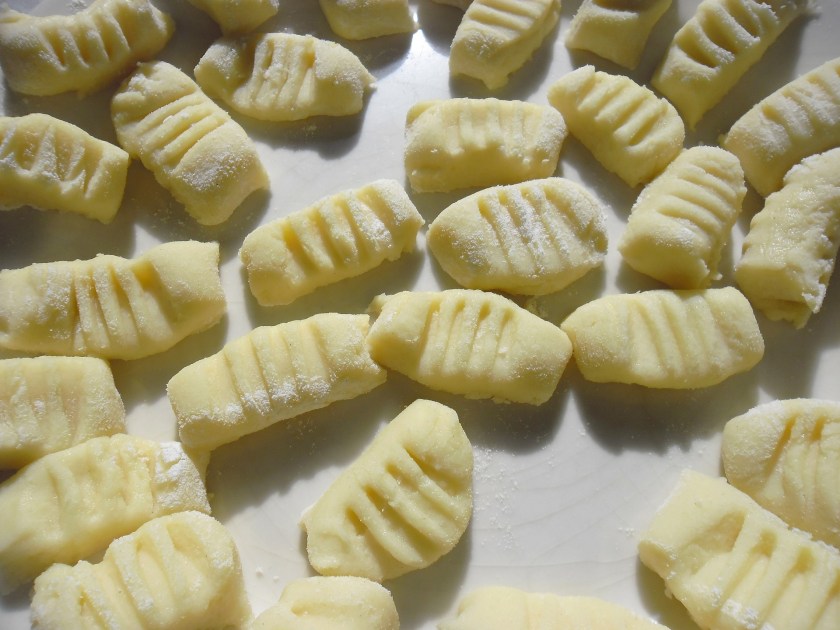
The story’s heart really evolved out of a particular image I got stuck in my head. The first half came from an experience I had, a decade ago now, with my very first delivery meal kit. I’d placed an order so a friend of mine could get a free box for her family, but since it was still early in the evolution of such things, they only had one vegetarian option, and I wound up with two orders of ricotta gnudi with mint and peas. Much to my confusion upon opening the box, instead of bags of pre-made gnudi (gnocchi-like dumplings made with ricotta instead of potato) I found containers of ricotta and what appeared to be an impossibly small amount of flour. Fast forward three hours, I’m surrounded by sheet pans on the floor covered in cooked and uncooked gnudi, there’s flour everywhere, and I’m standing over a pot of boiling water with a slotted spoon, fishing out individual, badly-form dumplings. Of course they were terrible. I’d added too much extra flour because they never got to the consistency the recipe described, and I way over-kneaded them, so they were chewy and flavorless. Even so, I stubbornly ate every single one over the next week in a series of increasingly unfortunate lunches.
The second half came from Neil Gaiman’s poem, “The Day the Saucers Came,” which relates the events of an escalating Ur-apocalypse of every kind imagined in human history, except at the end, we zoom way back in on the narrator who’s barely noticed all the hullabaloo as they’re “waiting for you to call.” I’ve always loved that final image of someone so completely wrapped up in someone else, they don’t even notice the end of the world.
At some point, these two things got stuck together as two people struggling to make homemade pasta while the world is ending around them, which I thought was really funny and sweet.
It took a few more years to find the rest of the pieces.
First, I needed a setting. If I wanted to tell a story where the penultimate scene is two people struggling to make gnocchi (I settled on gnocchi instead of gnudi as they meant my characters could have a garden), the story was essentially a cozy catastrophe and could be set pretty much anywhere. I decided on the Scottish Highlands, specifically the shores of Loch Ness, after taking a trip to Scotland with a good friend of mine in 2019. Driving around the Highlands, with all its gorgeous scrub and sky, it felt like we’d stumbled into the end of the world (in the geographic sense). One of the things I’d wanted to do while we were there was see Loch Ness (I personally love a cryptid myth), so we took a speed boat tour of the Loch; after all, if we were going to be disappointed to not see the Loch Ness monster, at least we’d be disappointed at high speeds. Out on in such deep (755 ft at its deepest) and murky waters, I suddenly understood why such a myth arose there. It felt like the perfect setting for the story.
I’m surrounded by sheet pans on the floor covered in cooked and uncooked gnudi, there’s flour everywhere, and I’m standing over a pot of boiling water with a slotted spoon, fishing out individual, badly-form dumplings. Of course they were terrible.
Next, I needed an apocalypse. It’s hard to write a story about the end of the world without making you think about the pandemic. The pandemic, of course, gave us all a front row seat to the diversity of human responses to a profound mortality scare, and thanks to the way the coronavirus infections worked, with you becoming contagious before you even knew you were sick, the resulting paranoia was unlike anything I’d previously experienced. It brought out the best in a lot of us – highlighting the altruism, empathy, creativity, and ingenuity we’re capable of. For some, however, it brought out our most atavistic tendencies, like we’d suddenly been thrust into a J.G. Ballard disaster novel.
I wanted my apocalypse to be more Ballardian: one that’s biologically unexplainable and completely unavoidable, with a kind of intimacy to the fear it evoked. Inspired in part by a Rik and Morty episode involving characters spontaneously turning inside out (“Cronenberging”), and in part by the thoughtful body horror of director David Cronenberg (who adapted Ballard’s novel Crash into a 1996 movie), I decided on spontaneous chimerization as the driving force behind the end of the world, in which the genomes in some of our cells suddenly decide to crawl back in evolutionary time to recall some last common ancestor, then progress forward again down a different branch. It became a way to not only sew a deep sense of paranoia into my characters due to its spontaneous nature and monstrous results, but also how I could make the mythical inspiration behind the Loch Ness monster, the kelpie, into a real character in the story.
The last thing I had to decide was who my two characters were. Since the world was falling apart in a way that science and logic couldn’t touch, one character I became a folklorist (because of the story’s connection to Loch Ness and Scottish folklore), and the other would be a biologist. The folklorist copes a bit better as there’s a certain amount of magic baked into her perspective on humanity’s story, and she’s able to better ignore things. To the biologist, on the other hand, nothing makes sense anymore, and her understanding of humanity’s story has been broken. She instead copes by trying to regain some sense of control of her life. I then plonked them down in the folklorist’s childhood home on the shores of Loch Ness, gave them a garden full of potatoes, and set them to the task of making some gnocchi to see what would happen.
I really enjoyed how this story came together in the end. It’s absolutely an homage to Ballard and Cronenberg, who’s films and writing I deeply love, just as it’s an homage to Gaiman’s deftness at blending together myth and the mundane, except with my own biological twist.
Thanks for reading!
 The Astounding Analog Companion
One comment