
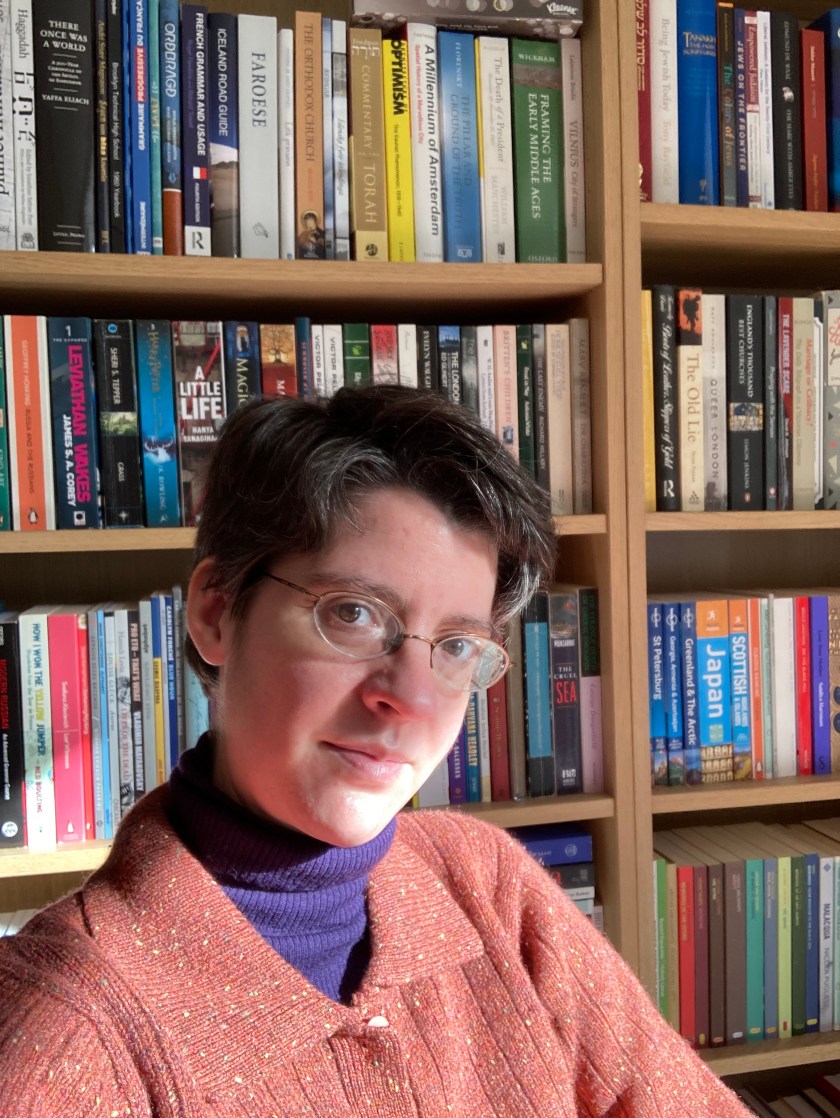
Zohar Jacobs discusses the role of religion in science fiction—and how its portrayal can be improved—while outlining the origins of “Tohu Bohu,” her latest story, found in our [May/June issue, on sale now!]
Analog Editor: What is the story behind this piece?
Zohar Jacobs: I can’t say I wrote it voluntarily! At Viable Paradise in 2022, we were expected to produce a 2,000 word story during the workshop. I’m a perfectionist, a slow writer, and don’t enjoy writing to prompts, so I was pondering how to approach “The Horror That Is Thursday” even before I arrived. I adopted the philosophy that got me through many undergraduate essay crises: “they can make me write something, but they can’t make me write something good.” (Spoiler: the result was usually good anyway.)
A couple of months after the workshop, I re-read this piece and discovered that it was a lot better than I’d thought at the time. Because I had been desperate to produce a finished story on schedule, my style became much more terse and telegraphic than usual, and I really think it works here. The piece as published is about 700 words longer than my hurriedly written original draft, but other than that, very little has changed. Maybe the moral is that I should write to a prompt—and a deadline—more often.
AE: How did this story germinate? Was there a spark of inspiration, or did it come to you slowly?
ZJ: My assignment combined a theme (“metamorphosis”) and an object (a “Bride” badge illustrated with a diamond ring). My initial idea was to write about the wife of an early NASA engineer coming into her own, but it seemed to me that Mary Robinette Kowal had already cornered the market on that one. While I was writing in my journal that I had no idea what to write, I found myself thinking of the carbon in asteroids and a woman’s diaspora from Earth. It came together very quickly after that.
AE: How did the title for this piece come to you?
ZJ: The story of creation in Genesis starts with an image of primeval chaos, saying that the Earth was “without form, and void” (“tohu va vohu” in Hebrew). I used the English expression “tohu bohu” to emphasize the meaning of confusion and disorder. The title hearkens back to the primordial grains in interstellar dust and to the theme of new beginnings arising from chaos.
AE: Who or what are your greatest influences and inspirations?
ZJ: Star Trek: The Next Generation premiered when I was five years old, and made a major impression on me as a child! Eight years later, the movie Apollo 13 fanned my interest in the reality of space exploration—and Mission Control in particular. If my writing manages to capture a tenth of the excitement and psychological drama of the Apollo program, I’ll be thrilled.
Diane Duane was my favorite speculative fiction writer when I was young, and Ursula le Guin is still my ideal. Overall my influences as a writer are literary as much as speculative, but that may be a subject for a different Q&A.
AE: Are there any themes that you find yourself returning to throughout your writing? If yes, what and why?
ZJ: Religion fascinates me because it’s one of the most complex social and intellectual structures that humanity has created, and yet in speculative fiction it’s too often flattened, caricatured or ignored altogether. You could say that my writing carries on a decades-long argument with Gene Roddenberry. For me, there’s something inherently radical about showing Jewish people, in particular, living and thriving in the future. Writing about Judaism also allows me to explore the theme of diaspora, which resonates for me as an immigrant and descendant of immigrants. Being a diasporist is integral to the way I approach science fiction.
AE: How do you deal with writers’ block?
ZJ: M. John Harrison (and/or his friend Beatrice) has a very wise thing to say about writers’ block: “the maddeningly slow solution of difficult problems in the context of specific pieces of work is part of the process of writing.” Unless you have a deadline, the easiest way to deal with writers block is by not writing. No one is making you write. So I like to tell myself, anyway.
With “Enceladus South Pole Base,” which was recently published in Clarkesworld, I waited over a month for my subconscious to figure out how to bridge the gap between the middle of the story and its final paragraph, which I had written already, as I often do. Things usually become clear eventually.
Religion fascinates me because it’s one of the most complex social and intellectual structures that humanity has created, and yet in speculative fiction it’s too often flattened, caricatured or ignored altogether.
AE: How did you break into writing?
ZJ: I’ve been writing for as long as I can remember, but for a long time I was very shy about sharing my work with others. I started posting fanfic when I was in my mid-twenties, and when people asked me whether I was trying to get published, my answer was always “when I write something that I want to publish, I’ll know.”
When I was on furlough during the early months of the pandemic, I started two novels that suddenly made me think about publication. One of those novels got me into Viable Paradise in 2022, the year I turned forty, and being involved with that community and with Codex persuaded me to experiment with the possibilities of short story writing. For about six months it felt as if I wasn’t getting any traction. Then this piece got accepted by Analog on the same day that I had my first-ever acceptance from the Sunday Morning Transport. Acceptances from Small Wonders, Asimov’s and Clarkesworld followed within the next three months, so it feels as if I’ve gone from 0 to 60 relatively quickly. I guess the time was right.
AE: What are you reading right now?
ZJ: Recently I’ve been on a run with twentieth-century literary short story authors: Bette Howland, Mavis Gallant, Annie Proulx, Alice Munro, all of whom are excellent. I’m reading Alasdair Gray’s Poor Things at the moment. And my to-read pile includes a couple of relatively new books by veterans of the Apollo program: Tough and Competent by Gene Kranz and Apollo Mission Control by Manfred “Dutch” von Ehrenfried.
AE: Do you have any advice for up-and-coming writers?
ZJ: Back when I was still wondering whether I would ever get a story accepted, I was skeptical of advice from published writers because of the obvious survivorship bias: when you know that your own story ended in success, it’s easy to think that “don’t give up” is always the right advice.
So, by way of balance, I’m here to tell you that you can give up multiple times in one day without the satisfaction getting old. Go on and do it! It’s a reversible decision. You’ll know when to come back again. Don’t let anyone rush you.
Everyone finds their own approach to craft and process. Reading advice from other writers is mostly an exercise in discovering what resonates with your own experience. The only universal I can discern (and even then, someone will probably argue with me) is that you should write what you want to write—and write because you want to write. If that’s true for you, then you don’t have to worry so much about external validation: it’s only a bonus.
AE: What is something we should know about you that we haven’t thought to ask?
ZJ: Climate change is the ghost at the banquet when it comes to science fiction. A few years ago I read Amitav Ghosh’s The Great Derangement: Climate Change and the Unthinkable, in which he argues that modern fiction (the book was written in 2016) struggles to address the issue. Since then things have changed, and climate change features not just in explictly genre novels like Kim Stanley Robinson’s The Ministry for the Future, but also in mainstream near-future novels like Bruce Holsinger’s The Displacements and Lydia Kiesling’s Mobility. This isn’t because writers have become more far-sighted: it’s just that climate change is moving from science fiction to reality.
I don’t consider myself a cli-fi writer, and my writing about climate change is neither hopepunk nor (post)apocalyptic. Being more a realist than anything else, I simply find it impossible to ignore. The future depicted in Tohu Bohu is not farfetched at all—sadly, the least believable thing about it is the idea that life in space will be a realistic refuge from climate breakdown on Earth.
AE: How can our readers follow you and your writing? (IE: Social media handles, website URL…)
ZJ: Right now on I’m Twitter as @zoharjacobs and Bluesky as
@zoharjacobs.bsky.social. Watch those spaces to find out when I launch my new website, which I hope will be coming soon.
 The Astounding Analog Companion
One statement at the start of the story jarred me a bit, namely:
It was one of the ironies of history that their new home was named after a Russian shtetl.
the city in question, Vitebsk, is [1] in Belarus, nor Russia, [2] is founded centuries before 1343 when the Jews are invited to Poland by King Casimir the Great (and before Poland united with Lithuania in 1569. Vitebsk was in the Grand Duchy of Lithuania lands). The Jews were presented before, but not local Jewish towns or shtelts. It is like saying NY, an English shtetl 🙂
LikeLike