
by Sakinah Hofler
Sakinah Hofler is the winner of the 2024 Analog Award for Emerging Black Voices. In this essay, discover how science fiction, especially Octavia Butler’s, opened Hofler’s mind to new possibilities in her writing. Check out Hofler’s story “Second Chance,” in our [January/February issue, on sale now!]
During my first semester of graduate school in a creative writing program, I enrolled in a class examining the theory of plays. I had an undergraduate degree in chemical engineering, five years of engineering experience, and not a clue what theory was (or who Bertolt Brecht or Friedrich Nietzsche or Jacques Derrida were for that matter). I had naively signed up for the course because I assumed we would spend each class reading Samuel Beckett’s plays out loud. Instead, we were assigned a theoretical book to read each week and, in each class, people who understood theory, debated theory. I spent a lot of time hiding behind those debaters, hoping I’d never be called on. By the time we reached the end of the semester and we had to write a cumulative research paper, I was overwhelmed, stressed, and clueless.
The weekend before the paper was due, I sat down with my laptop and notes, petrified of failing. When I wandered over to my bookshelf to get out those theoretical texts, my eyes landed on Octavia Butler’s Patternist series, Seed to Harvest. It had been sitting on my bookshelf for several months waiting to be read. The only book I’d read by Butler prior to that point was Kindred, which had not excited me. I’d attended a pan-African elementary school, devoured slave narratives, watched every American-made documentary and movie about slavery, and by the time I picked up Kindred, though the time travel aspect fascinated me, I needed a break from the topic. I figured I’d read a few pages of Seed to Harvest and then dive back into Brecht.
I picked up the series on Friday and did not put it down until I finished it on Sunday.
In a standard anecdote, the next part would be that I somehow linked Butler’s supernatural beings to Nitzsche’s arguments on tragedy and wrote a phenomenal paper. I did not. In fact, there’s still a post from me on Facebook that compared writing that paper with my disastrous high school research paper on the impacts of Y2K. Rather, I remember this as a pivotal moment when science fiction changed everything I thought I knew about what I wanted to write as well as what I thought writing could do.
The first book in the Patternist series, Wild Seed, mainly takes place in West Africa and America. There are elements of slavery in it, but we are also introduced to two evolved humans—Doro, an immortal spirit who can travel from body to body, and Anwanyu, a shape-shifter and healer—characters who, over the centuries, fluctuate between being allies and enemies. During the height of the slave trade, both of them, separately, wind up starting their own colonies of superhumans. What drew me in and what made this novel feel different and refreshing was Butler’s ability to make the familiar unfamiliar, or, as dubbed by Darko Suvin, evoke a feeling of “cognitive estrangement.” She created a world familiar enough for me to recognize, yet, by injecting supernatural elements had destabilized my understanding of reality, thwarted my expectations, and offered an alternative, complicated, hopeful history and future.
I remember this as a pivotal moment when science fiction changed everything I thought I knew about what I wanted to write as well as what I thought writing could do.
I’ve always been interested in science fiction. Lois Lowry’s questionable utopia The Giver was my favorite novel for about twenty years. The Matrix has been my favorite movie ever since its 1999 release. I religiously watch The Twilight Zone series every New Year’s Eve and New Year’s Day (I know it’s available via streaming, but I enjoy the ritual). Still Butler’s Patternist series allowed me to finally realize I can write whatever I imagine. Prior to reading her book, I had been writing functional, boring stories: A new family moves onto the block and the neighbors treat them with suspicion. A woman has an out-of-body experience as she sits in the waiting room at the gynecologist office. A little girl bakes a cake for her father who has just been released from jail.
After handing in my disastrous research paper, I created new versions of my stories. The new people on the block were now 100% descended from Neanderthals and they have to battle neighbors trying to set them on fire (this allowed me to explore the idea of the “other” I’d been exploring in my original story but with more directness about the violent inclinations of humans). The waiting room story became a waiting room for the afterlife, complete with the mundaneness of going to the doctor’s office and the fear of the fate of a soul. My religious upbringing, at the time, had limited my view of the afterlife as the binary heaven or hell. Now, I played, imagined, reimagined, what comes next? Alternative worlds? Different dimensions? Evolution? A shared consciousness? I allowed myself to speculate. I tossed out the cake story and returned to a little note I had scribbled in my journal: “What if a prophet came to Newark to fix Newark’s problems?” This story allowed me to revisit my home city but through the eyes of a newly designated prophet who never signed up for the job and, in fact, hates the job. In his landmark essay on race and science fiction, Samuel Delany states he viewed the depiction of race in Baldwin’s early essays as “wonderful as science fiction” while he saw Richard Wright’s Black Boy and Chester Himes’s If He Hollers Let Him Go depictions of race as “history” (28)—the latter description highlighting how realism can sometimes reinforce preexisting ideas, whereas science fiction offers hope and possibility. That’s what I see in Butler’s work. That’s what I see in Bradbury’s work (and so many more; if I list them all, this essay will never end).
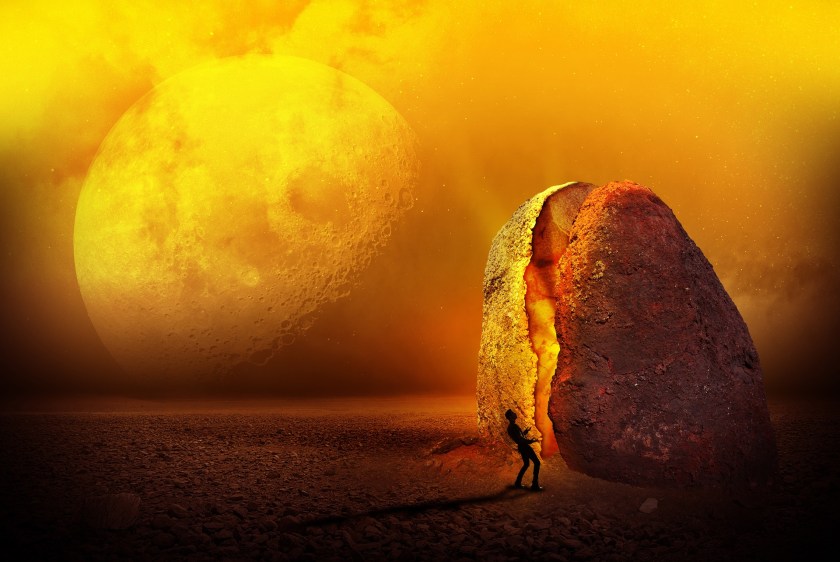
For me, science fiction is a portal. It gives me the space to question and imagine. If we always write reality as in this is what the world is, we will continue to keep the world as it is. Science fiction is the destabilizer that allows us to relook at reality or, as Ursula K. Le Guin posits, “realism is perhaps the least adequate means of understanding or portraying the incredible realities of our existence” (58).
Science fiction gives me hope.
For example, Kim Stanley Robinson’s The Ministry for the Future starts off with an earth so hot people trying to cool off in water slowly boil to death. Despite its bleak opening and radical acts committed by the novel’s activists, Robinson thoroughly explores what it might take to get people to take climate change more seriously. Through examining different technologies, Robinson explores what works, what problems can arise with other suggestions, and, essentially, he offers a number of different solutions worth thinking about as we think discuss and combat climate change.
Science fiction gives me freedom.
It allows me to explore the world we live in while not being bound by the rules or the history of this world. It makes the seemingly impossible possible. Whenever I sit down with my pen, I question: Who are we? Why are we? What can we become?
Prior to becoming a writer, I worked on armaments in a tiny cubicle for the United States Department of Defense during the height of the “War on Terror.” I kept asking myself over and over, why can’t we live in a world without war? Why must humans continuously and determinedly look for ways to destroy one another? I posted a quote on my office desk by Robert H. Schuller: “What great thing would you attempt if you knew you could not fail?” I’ve now adapted that question for my writing: “What would I attempt to create if anything and everything was possible?”
Works Referenced
- Butler, Octavia. Seed to Harvest. Hatchett Book Group, 2007. (Wild Seed, 1980).
- Delaney, Samuel. “The Necessity of Tomorrows.” Starboard Wine: more notes on the language of science fiction. Dragon Press, 1984 pp. 23-35.
- Le Guin, Ursula. The Language of the Night: Essays on Fantasy and Science. Putnam, 1979.
- Robinson, Kim Stanley. The Ministry for the Future. Hatchett, 2020.
- Suvin, Darko. “Estrangement and Cognition.” Republished on Strange Horizons, 2014.
 The Astounding Analog Companion
One comment