
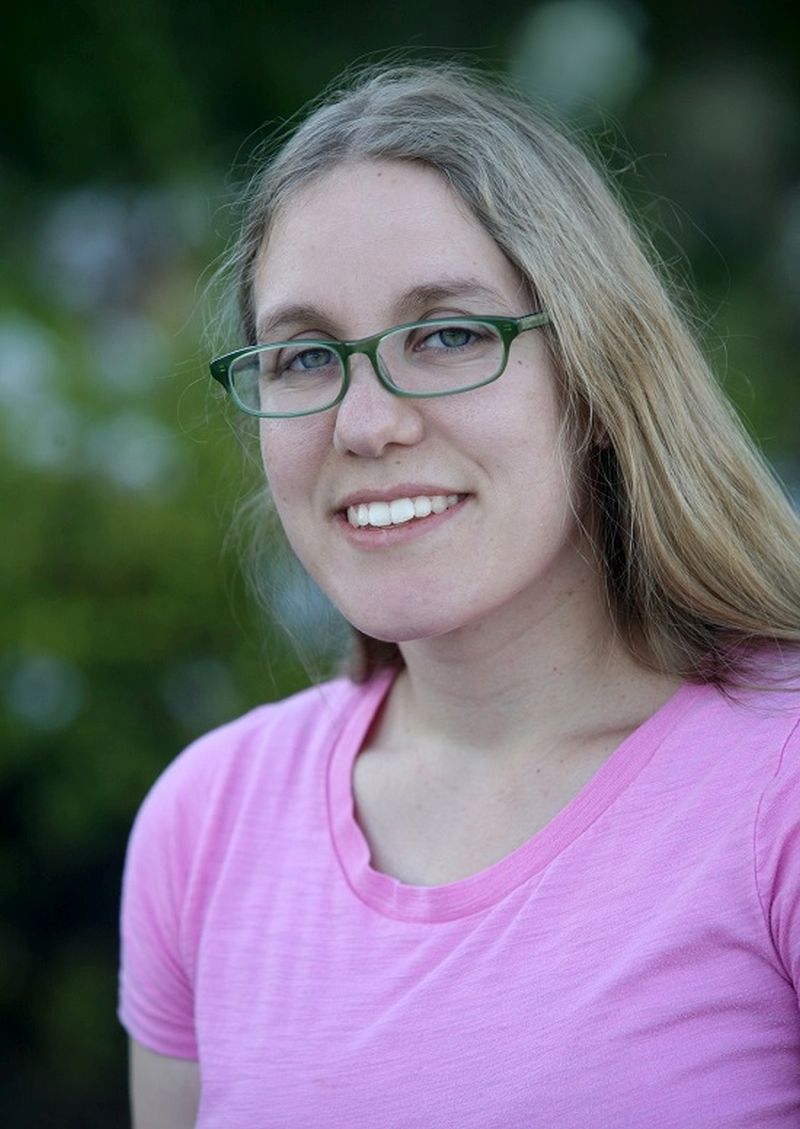
Beth Goder participated in a writing group contest and ended up with “Murder on the Eris Express,” her second story for Analog which is available in our [March/April issue, on sale now!]. Hear more from Beth in this wide-ranging Q&A, where Beth discusses her dream of a world without car ownership and encourages new writers to never forget joy.
Analog Editor: How did this story germinate? Was there a spark of inspiration, or did it come to you slowly?
Beth Goder: I wrote the first draft of “Murder on the Eris Express” as part of a contest held by my writing group, Codex. The goal was to write a complete draft in six weeks. The day before the contest, I knew that I wanted to participate, but I only had a vague idea of what I wanted to write—a murder mystery in space. I was lamenting to my husband Andy that I didn’t have an outline prepared, and he made some comments that opened things up for me. Suddenly, the plot started falling into place, almost faster than I could write the outline. Although the story went through several revisions, much of the final draft stayed true to my original outline.
AE: Do you particularly relate to any of the characters in this story?
BG: Both of the POV characters are bots, so yes.
AE: What is your process?
BG: I get ideas for stories everywhere. Often from incredibly unlikely places. (I once saw a pineapple on the side of the road and wondered how it got there, and then I wrote a story about it.) I will get the glimmer of an idea, which is often an image, a sentence, a setting, a speculative fiction premise, or even just a narrative tone. I’ll noodle and brainstorm, trying to figure out what it is I really want to write about. Once I understand the focus of the story, I’ll create a detailed outline. While I’m writing, the outline always changes, but often not by much.
It can go a little differently with flash fiction, which I’ll sometimes “discovery write.” It’s fun to surprise myself with what I’m writing. I wrote a story called, “The Giant’s Dream,” with an ending that re-contextualized the entire story, and I didn’t know what the ending would be until two paragraphs before I wrote it.
AE: How do you deal with writers’ block?
BG: For me, an inability to write can be caused by a variety of factors, like lacking time, motivation, or energy. Since I outline before I write, I usually have a good idea of where a story is going. I don’t often get blocked because I’m trying to figure out the plot. (Although there have been instances where the problem was that my outline wasn’t correct, and I needed to go back to the drawing board and re-work the plot.)
I use a writing journal as a brainstorming space, where I jot down everything in my writing life in what is almost a stream-of-consciousness way. This helps me to understand why I’m not writing–if it’s because the story has major structural issues and needs to be re-outlined, or if I’ve just had a busy week and need some time to relax. Other common causes include avoidance, lack of confidence, an abundance of work (if I have too many projects going on at once), and unrealistic goals. If I get really stuck, I find it helpful to sit down at the computer and open my document. I’ll make space for writing even if I think I’ll get nothing done. When I open the document, some writing always happens.
AE: What other projects are you currently working on?
BG: I always have a couple of short stories going. Currently, I’m working on a YA cozy horror story that takes place at a bowling alley, a science fiction story with hermit crab aliens and weird gods, and a fantasy story about being trapped in photographs at an art gallery.
I’m also writing my first novel.
AE: Do you have any advice for up-and-coming writers?
BG: Advice is such a tricky thing, because what’s good advice for one person ends up being terrible advice for another. The most important thing I want to say about writing advice is that you can discard anything that doesn’t work for you. My advice is to write that weird little story that’s been residing in your heart. Keep going; be prepared for things to go wrong; don’t forget joy. No one ever gets to the top of the mountain.
AE: What SFnal prediction would you like to see come true?
BG: My dream is to see self-driving cars become a major method of transportation. I envision that no one will own a car. Instead, everyone will ride around in “pods,” which will work kind of like a self-driving Uber. Since the pods will always be circling, we won’t need as many parking lots. And if all the cars on the road are part of the same self-driving system, they should be able to talk to each other, which will help avoid collisions and manage traffic. This would require a major infrastructure change, but I hope to see this happening in my lifetime.
My advice is to write that weird little story that’s been residing in your heart. Keep going; be prepared for things to go wrong; don’t forget joy. No one ever gets to the top of the mountain.
AE: What are you reading right now?
BG: I recently finished Ray Nayler’s The Mountain In the Sea, an excellent book on conscious (and octopuses) that I think readers of Analog would enjoy. Another great octopus book is Remarkably Bright Creatures, which I read earlier this year. I’m also making my way through the Delicious in Dungeon manga series—these books are great fun, and they always make me hungry. And I have to recommend The Bridge: How the Roeblings Connected Brooklyn to New York. It’s a non-fiction graphic novel I picked up from the library on a whim. You’d think a book about building a bridge would be boring, but this one is intense and super interesting, and I learned a lot about caissons.
AE: Many of our Analog authors are interested in science. Do you have any scientific background, and does it impact your fiction?
BG: Although I have a love of science, I do not have a traditional science background. I doubled majored in English/Anthropology, and most of my anthropology classes focused on culture. Despite lacking a formal science education or job, I’ve been published here at Analog and also in Nature (for fiction, of course!)
To write hard science fiction, one doesn’t need to have a science background, although it can certainty help. I think we can all feel wonder at the natural world, be curious, and continue a habit of life-long learning. I love to read non-fiction books about plants, the ocean, physics, and medicine. (I have a book about sea turtles on my nightstand at the moment.) What I read often comes out in my stories. (I read the excellent Entangled Life by Merlin Sheldrake, then wrote a fantasy story about mushrooms.)
It also helps that I have friends in the sciences, so if I ever need to figure out some tricky physics thing, I can always turn to my panel of experts.
AE: What careers have you had and how do they affect your writing?
BG: As an archivist, I get to work with historical documents like correspondence, photographs, diaries, and many other types of records, arranging and describing the papers of interesting folks. (Or at least I did, back when I worked in person. Right now, I’m working on metadata management stuff.) I’ve cataloged the letters of Theodore Roosevlet and processed the papers of Edward Teller. Getting paid to read other peoples’ diaries is pretty great.
As for how this has influenced my writing, archivists turn up quite a bit in my stories. (There’s even one in “Murder on the Eris Express.”) Mostly, I would say that being an archivist changes how I think about time. I refer often to that Faulkner quote: “The past is never dead. It’s not even past.” A constant theme in my work is how we understand collective memory and the passage of time.
AE: How can our readers follow you and your writing?
BG: My website is https://bethgoder.com. This is the best place to find links to my stories. I’m also on Bluesky @bethgoder.bsky.social and Instagram at beth_goder.
 The Astounding Analog Companion
I enjoyed the novella, it is a good light fun, not exactly what I expect from Analog, but I’d say print more like this one!
LikeLike