
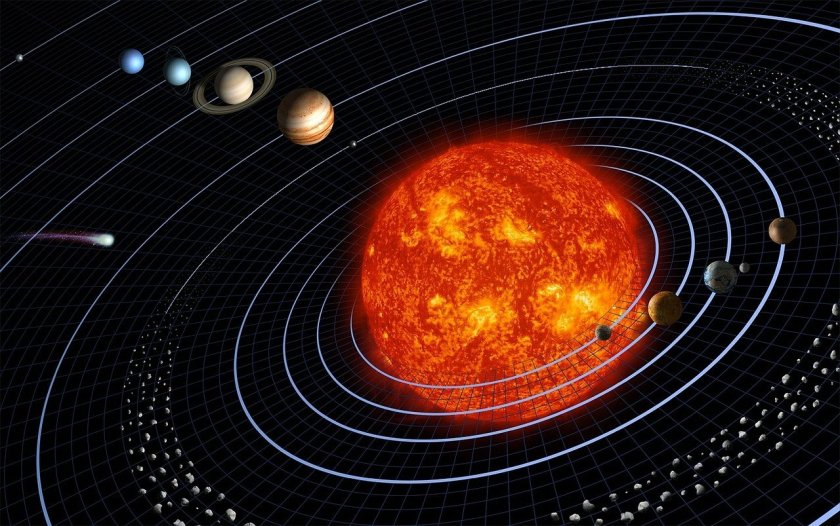
Raymund Eich returns to Analog with a new story about the real potential—and cost—of nuclear fusion in “Outside the Robles Line” from our [May/June issue, on sale now!]. In this special essay, Eich discusses the novel ideas that inspired his concept of a “Robles Line”
On one level, my new story “Outside the Robles Line” is the hardest science fiction story I’ve ever written. It includes charts to illustrate a couple of points! Plus plenty of other math I did while drafting doesn’t appear in the manuscript.
But first, you probably have a question.
What is the Robles Line?
At some point, technological development will yield two things: a maximally efficient fusion reactor, and a maximally efficient solar panel. Nanotechnology would spit out flawless copies of both that would represent the maximum refinement possible for those two technologies.
Even with nanotechnology, there are a finite number of atoms in the universe and a finite amount of energy to arrange atoms into desired forms. So even if it’s very low, everything will still have a cost.
For the cost, the ultimate fusion reactor would give you a maximum generation capacity. Accordingly, the price per kilowatt of energy production would be the same. The location of the fusion reactor wouldn’t matter. As a character in the story says, the price per kilowatt of energy from a fusion reactor would be the same anywhere from Mercury (about 0.4 AU from the Sun) to Makemake (about 40 AU from the Sun).
In other words, a graph of the cost to build the ultimate fusion reactor as a function of distance from the Sun is a straight line.
The ultimate solar panel would have a certain cost per unit area of photoreceptors. However, the energy generated by a solar panel doesn’t vary based on the size of the solar panel. The amount of energy absorbed by a solar panel depends on how close the solar panel is to the Sun. Given the inverse square law, to generate the same amount of energy at Mars (about 1.5 AU from the Sun) as at Earth orbit, you’ll need about 1.5^2 = 2.25 times as many solar panels. Since the cost to build the ultimate solar panel is the same per unit area, the cost per kilowatt of energy from the solar panel goes up with the square of distance from the Sun.
The graph of the cost to build the ultimate solar panel as a function of distance from the Sun is a parabola.
From these semi-quantitative conclusions, it occurred to me that the straight line of the cost per kilowatt of fusion energy and the parabola of the cost per kilowatt of solar energy could cross at a certain distance from the Sun. (And as a science fiction writer, I decided they would cross, and at what distance). Inside that distance, solar panels would be cheaper to build than fusion reactors, so space settlements would build solar panels. Outside that distance, solar panels would be more expensive to build, so space settlements would build fusion reactors.
That distance—the dividing line between solar-powered settlements and fusion-powered ones—is the Robles Line.
Who is Robles?
To my knowledge, I’m the first person to publicly articulate this concept. If someone beat me to it, I would love to give that person credit—email me at raymund@raymundeich.com.
If not, while I’m happy to claim credit for the concept, it breaks the fourth wall for a science fiction writer to name himself in one of his own stories.
Luckily, my family name “Eich” comes from the German word for oak. Numerous languages have cognate family names. For example, there’s Carvalho in Portuguese, Ozols in Latvian . . . and Robles in Spanish.
What’s the Spanish translation of self-Tuckerization?
The rest of the story
The economic factors embodied in the concept of the Robles Line are important, but they aren’t really what the story is about. The hard science content is less important than the human conflicts taking place in the heart of Rubblepile, the mined asteroid supporting the tens of thousands of people in Barin’s community.
On the surface, there’s conflict between generations. More importantly, there are conflicts between tradition and innovation; between economics and spiritual matters; between the bottom line and human values.
Look for “Outside the Robles Line” in the May/June 2025 issue. You can learn more about my many and varied worlds at https://raymundeich.com.
Happy reading!
 The Astounding Analog Companion