
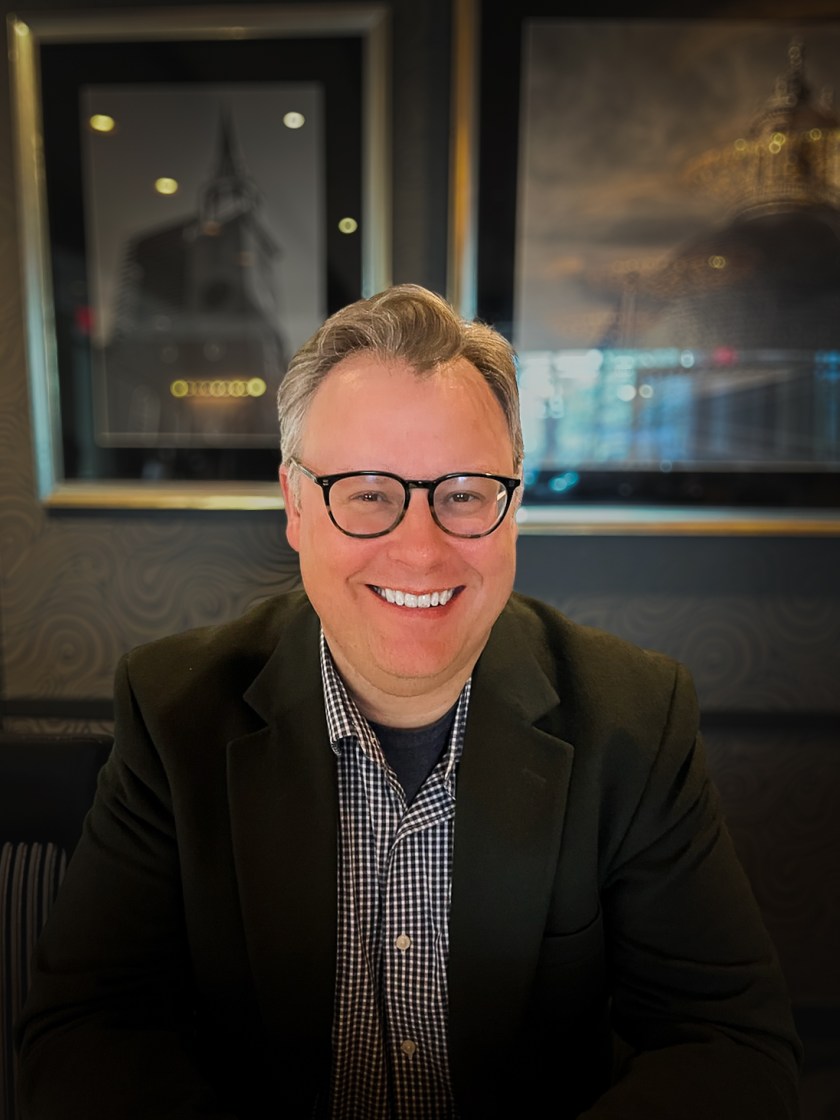
by Auston Habershaw
Auston Habershaw’s latest novelette, “In a Desolate Garden” from our [Sept/Oct issue, on sale now!], explores a unique twist on the Ship of Theseus paradox: “how much of a thing can be stripped away and not replaced before it ceases to be the thing it was originally?” Read on to discover how Habershaw extends this question to the nature of human identity
The Ship of Theseus is an ancient paradox with which probably most readers of Analog are familiar, but just to review, it goes like this: suppose Theseus travels around the ancient world on his ship and as he goes, the ship suffers the standard wear and tear that ships are prone to. Being a good sailor, Theseus replaces the rotted planks and the frayed ropes and the torn sails and so on and so forth so that, eventually, he has replaced every single part of the ship. Now, the philosopher asks, is it the same ship? Theseus has, in a sense, been sailing in it this entire time, but the physical matter that made up the original ship is gone entirely. You see the existential conundrum, here.
Now, if you want to dive into that particular paradox, the internet is ready and willing to oblige you, but it is not the specific topic I’m here to discuss. I’m interested in approaching the paradox from the other direction: how much of a thing can be stripped away and not replaced before it ceases to be the thing it was originally? This has a simple answer for simple tools—a knife without a blade is not a knife, a hook without a bend is not a hook, and so on. The more complex the object becomes, however, the less clear it is. Can you call something an “automobile” if it doesn’t have a steering wheel? At what point is a road no longer a road—when it is blocked? When nobody uses it? When it doesn’t go anywhere?
Among the many things I toy with in my story “In a Desolate Garden” is this idea but applied to a person. How much of a person can be stripped away before they cease to count as that person? How much of Claudia can be edited out of her engram before the engram is no longer Claudia? The answer, I think, varies quite a bit from person to person, depending on how they define themselves. Our identities—what we think we are—is malleable and multifaceted. Excise from a mother the love of her children (by whatever nefarious means), is she still a mother? Is she still herself?
I think of myself as a writer, above all other things. Say it was taken from me, somehow. What am I then? I think of myself as a father. Steal away my children and what am I (besides heartbroken)? You get the idea. Strip away the layers of what makes me, all the way to the bone, and as some point “Auston” does not exist.
Or does he? Is there some essential nugget of our being? A soul? Our mind? Medical science has pretty firmly suggested that there is not. Do enough brain damage and the person you knew is gone, even if they are demonstrably still here. Head injuries have broken up a lot of marriages and ended a lot of friendships, because the person who was left was not the same person who was there beforehand.
The reason I’m thinking about all this lately is that it seems to me that we are collectively, culturally in the process of defining as irrelevant or obsolete vast swathes of what previous generations associated as central to our concept of self. Work, in other words. Vocation. Hobby. Technology wants to make it so we no longer have to labor for anything, no longer want for anything—it will be handed to us. You don’t have to go into the office, you don’t have to write your own resume, you don’t have to learn an instrument or write a book or compose a poem. There is a gadget out there that will do it for you. And you? You just sit there and . . . exist?
At what point do human beings just cease to exist? The post-human world is coming, and it will sneak up on us in ways we don’t expect. Let me tell you a story to illustrate my point: in 2021, a student taking an online course at a university discovered her professor—whose lectures she had been watching and whose assignments she had been completing—had died in 2019. How? Well, the professor had taught this course for years and had recorded and uploaded all his lectures and had uploaded all of his assignments through the university LMS (learning management system) and, via the professor’s contract, everything he uploaded there was the property of the university. So, when he died, they didn’t hire a new prof or anything, they just tasked a TA to grade his assignments and answer student questions and then had his ghost teach the online course.
Our identities—what we think we are—is malleable and multifaceted. Excise from a mother the love of her children (by whatever nefarious means), is she still a mother? Is she still herself?
Now the fun part: can that student be said to have taken a class with that professor? I mean, if he had been alive, how different would it have been? His body, his mind, his being is deceased, but his ideas still “live,” after a fashion. That, friends, is the true post-human world. You aren’t going to be given your ticket to the Magic Nanite Fair where you will be granted immortality and permanent good health and then go jet-skiing into the sunset. Instead, a recording of your consciousness will get uploaded to the Cloud and you—the “real” you, the you you think of when I say “you”—won’t. Some student in the future will be having conversations with the chatbot based on your correspondence for centuries to come, and you’ll be dust.
These days, I often get the nagging sense that the Luddites were right all along and that we should be throwing our bodies into the machines that would replace us and choke their gears on our very human gristle. But I look around, and instead I see people take their hands off the steering wheel and saying “yes, it is better to let the machine do it instead.” Drivers—just one more thing we aren’t.
In our pursuit of ease, I fear we have forgotten ourselves. Or, at least, the things that make us who we think we are—vocation, love, faith, community—and that we forget that the hard things and the times when we hurt the worst are also the times were the core of ourselves is most clearly observed. We must embrace the whole of our experiences; we are messy creatures, complex and beautiful. I think you can strip an awful lot of what we are away and still retain the potential for growth and change and reinvention. But there is a line in there, somewhere—a line we should not cross, where we no longer count as a person. Don’t cross that line and, what’s more, don’t let someone else cross it for you.
 The Astounding Analog Companion
One comment