
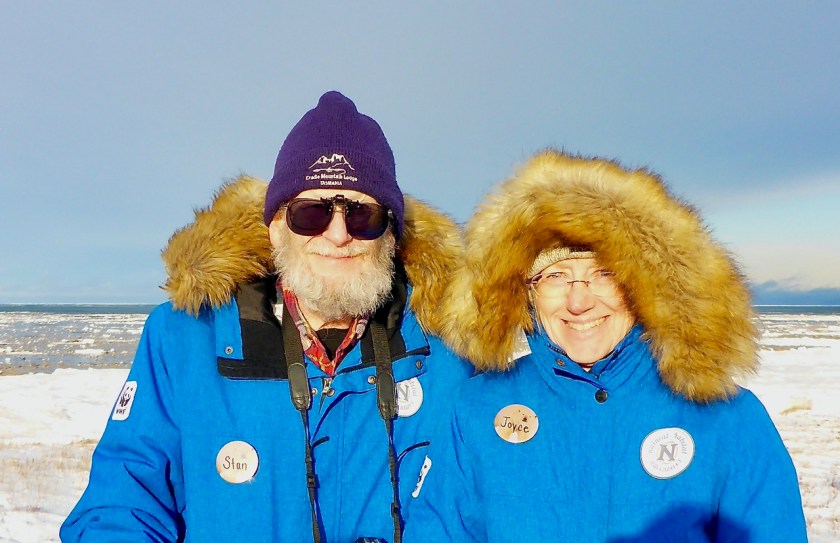
by Stanley and Joyce Schmidt
Our former editor Stanley Schmidt has been spending a bit of time traveling the world since his retirement in 2012. Learn all about the trip to a remote Arctic town that inspires “The Dancing Bear,” his latest story co-written with his wife, Joyce, in our [November/December issue, on sale now!]
In our continuing quest to explore as much as possible of what Inspector Clouseau called “life’s rich pageant,” one area with which we had little personal experience was the Arctic. Beings who live there must deal with conditions very different from those in tropical and temperate regions (with which we had lots of experience), and the ways they find necessarily differ dramatically from those that work in other places.
Two of those species are humans and polar bears, and a place that had long intrigued us was Churchill, Manitoba, on the western shore of Hudson Bay in northern Canada. It’s a real place, and we hope the story will give you some of the feeling of being there. It’s a tiny town, with only a few hundred human residents. It’s hundreds of miles from the nearest settlement of comparable size, and no roads connect them. Polar bears really do congregate there toward the end of the year, waiting for the sea to freeze over enough so they can get back out on the ice to hunt seals—and by “there,” we mean not only near the town, but in the town.
So for a few months every year, polar bears and humans coexist in close proximity. In general, the residents are comfortable with that, but it’s an uneasy truce. The bears aren’t aggressive toward humans, but an animal that big doesn’t have to feel malice toward you to hurt you. The Bear Patrol, the bear hotline, and the custom of leaving cars unlocked in case somebody suddenly needs to take shelter in one, are all real and much as portrayed in our story. They’re ways of coexisting more or less peacefully, but are they the best ways—especially when climate change is making it ever harder for the bears to make a living?
The bears aren’t aggressive toward humans, but an animal that big doesn’t have to feel malice toward you to hurt you.
We wanted to see for ourselves. For most of our lives, we’ve done most of our exploring independently, but sometimes there’s a big advantage to traveling with somebody who has special expertise and equipment. That happens, for example, when the logistics of getting to and from a place are formidably complicated for an individual, but not for a tour company that has spent years developing knowledge and connections to deal with the difficulties, which may involve infrastructure, language and cultural differences, dangerous politics and bureaucratic red tape, or any combination of those things. Or safety and practicality may require expensive special equipment no individual is likely to own or be in a position to buy and use.
Several of those conditions apply to visiting the polar bears. Doing that safely requires, for example, the use of special vehicles enabling visitors to get close (meaning inches, sometimes) without either humans or bears endangering the other. And it requires some knowledge of polar bear psychology, behavior, and needs beyond what any visitor is likely to acquire just by reading.
Fortunately there are a few companies that have specialized in developing all those resources for visitors to places like Churchill. The one in our story is not the one we used; Worldwind Expeditions exists only in our story and our imaginations. But the one we did use, and the local people and bears we met, were very helpful in learning enough about the area and its charms and problems to write the story.
As for our question: Are there better ways for humans and polar bears to thrive together? It occurred to us that a new combination of not-quite-new technologies might provide a possible answer—but neither the question nor the answer is as simple as it may seem.
We hope you’ll give it some thought—and enjoy your vicarious visit to one of the most fascinating places on this planet.
 The Astounding Analog Companion