
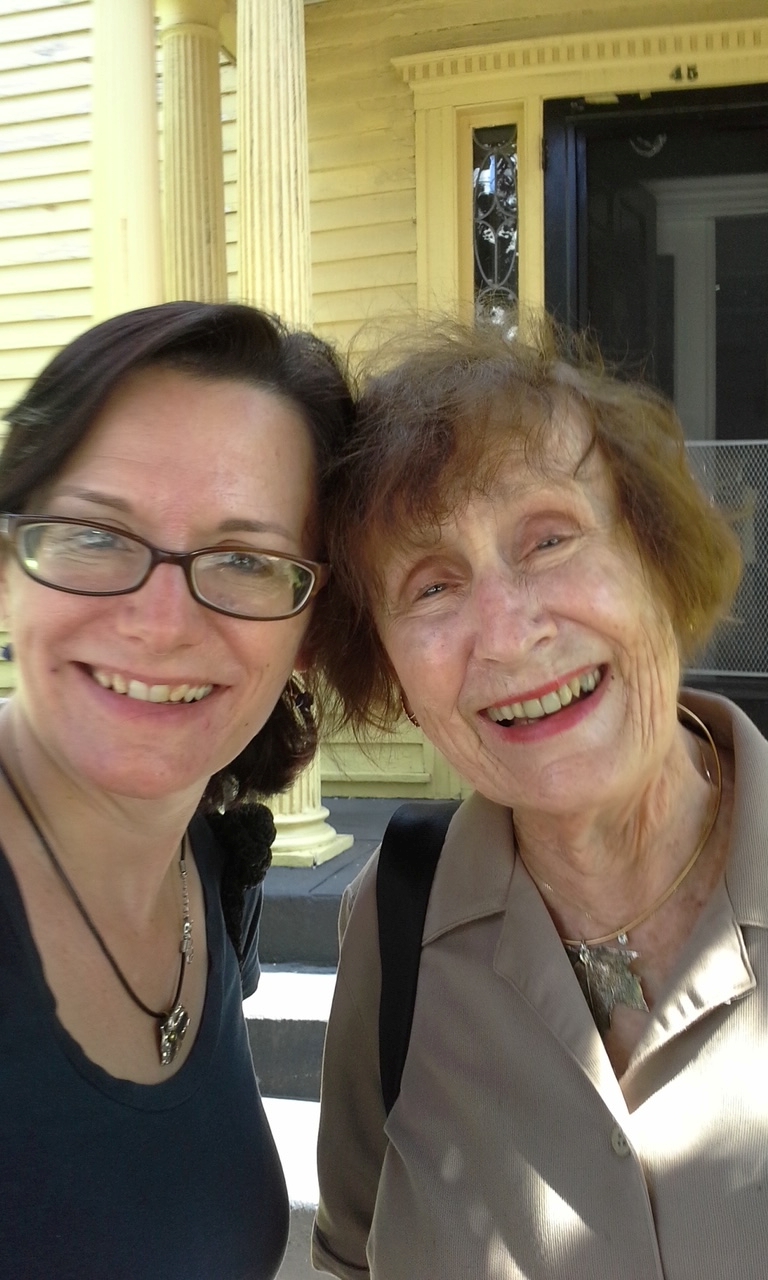
by Kate Maruyama
Kate Maruyama is an author who had the experience of being a caretaker for both her mother and father. In this special blog post, discover how she turned these experiences and the loss of her parents into “Faith,” her latest story in our [November/December issue, on sale now]
I’m having more trouble than usual writing this essay.
I am not the fastest writer of short stories. It will take me a good month to get to draft on one, but this particular story, “Faith,” took me two and a half years to get right. Grief does a number on the brain. For the process of writing, I was trying to get at something, and doing it all wrong, all the way along. I kept going back to it, no, no, this is not right. I had a determination to nail down a specific set of feelings.
When Emily Hockaday was editing this story, she pointed out that I had a lot of tense shifting in it, I was mortified because I’m usually carful very proud of handing in clean copy when submitting. But I’ve learned from grief, and writing around grief, that the brain gets fuzzy. Our brains in grief, perhaps insulating us from the truth, the sadness, get a bit blurry. The words get fuzzy. The tenses have been fixed for publication and the story is the best version of itself it can be, and I feel like I finally nailed down those feelings, but I try to give myself a bit of grace around anything having to do with these losses.
It is a singular thing to be a caretaker of an aging parent with dementia, and I happened to get that experience twice.
I always have trouble writing about my mother, Kit Reed, who died in September of 2017. The writing is important work, and keeping her name relevant in the field of science fiction, fantasy, and horror (she was self-proclaimed transgenred) is as important to me as any of my own writing. I have been writing afterwords for the books she wrote under Kit Craig for Silvertail Books and I am not a procrastinator but man, did I ever find a way to delay writing the first one of those for several months. Another essay for Locus, which I proposed has taken me another three. The house, suddenly, really needs cleaning. And as a writer who traditionally leaves the dishes until after my morning writing session, this is saying a lot.
My father started showing evidence of Alzheimer’s in his early seventies, but was still good with stories. When the disease accelerated, there was so much family lore lost, we counted on my mom, who was not only his sole caretaker, but was living a full life as an author.
Our brains in grief, perhaps insulating us from the truth, the sadness, get a bit blurry. The words get fuzzy. The tenses have been fixed for publication and the story is the best version of itself it can be, and I feel like I finally nailed down those feelings, but I try to give myself a bit of grace around anything having to do with these losses.
I called Mom daily to talk about our writing lives, I am a very, very, lucky writer to have grown up with such a talented mentor, writer, reader, and hype man. I also knew that talking about the business of writing and publishing took her out of the difficulties of caring for my father daily. It was even more fun when we became friends with each other’s writing friends. There was a joy to share, and I looked forward to our daily catch ups.
When our daily conversations started getting weird and going sideways, I sent Mom into the neurologist who had cared for my dad, and it was revealed that Mom had glioblastoma, an enormous tumor bifurcating her corpus callosum. The family stories and the literary stories, of which she was able custodian, were gone within a few weeks—we lost her five months later.
Dementia sometimes doesn’t come with a warning, it moves swiftly, and we can’t prepare. That franticness I felt to get stories out of her (larger family ones, long ago literary ones) before they disappeared was as terrifying as the fact that I was losing the person, my mother, who had always been there for me and so many others. She had a lot of writers in her life for whom she was friend, hype man, mentor, and reader.
When I was writing “Faith,” I kept trying to capture this specific space of being a caretaker, that dance around trying to get someone through their day, feeling dejected because the person who has always been there for you, taking care of you, that buffer from the great yawning gape of life is now your sole occupation, and you’re the one doing the caretaking. You lose your identity when caretaking, and as you’ve also lost your parent, maybe your hype man, well, it’s a lot. I found myself in the strange conundrum of needing to talk to my mommy about how hard it was to look after my Mom.
And watching two utterly brilliant and vital people (my dad. Joe Reed was a brilliant professor and artist who cofounded the film department at Wesleyan University and was a prolific writer himself), disappear brain first, was utterly debilitating.
There is such a specific time a kid of a parent with dementia enters, where you’re not sure what they are forgetting, you’re not sure if they even know you, and you’re suddenly scrambling to capture all the stories and you kick yourself for not asking every detail about that great Aunt you admired because you didn’t know the clock was ticking louder on the brain that held the story than it was on the body that carried it. There is this frantic feeling that you’re losing it all, and the worst part of it is, you kind of are.
In “Faith,” which was inspired by a beautiful poem from Chiwan Choi’s book, My Name is Wolf, I take my character Zaniyah from an earlier story in Analog (“Bloom” July, August/September 2022) whom we met as a young, brilliant, fierce marine biologist who is kidnapped to Mars along with her technology (a plastic eating bacteria that generates oxygen) and flash forward into her old age. I introduce her daughter, Mila, who is working in this very specific caretaker space.
For this story, perhaps in my own wish fulfillment, there is that franticness and sadness, but I give Mila an unexpected gift in this space. The result, I hope, will make caretakers of aging parents feel seen, but will also, in its own way, make folks who read it feel a bit better for all of the fraught feelings we have around caretaking.
This story was written with a lot of love, and a bit of humor and I hope you enjoy it.
 The Astounding Analog Companion