
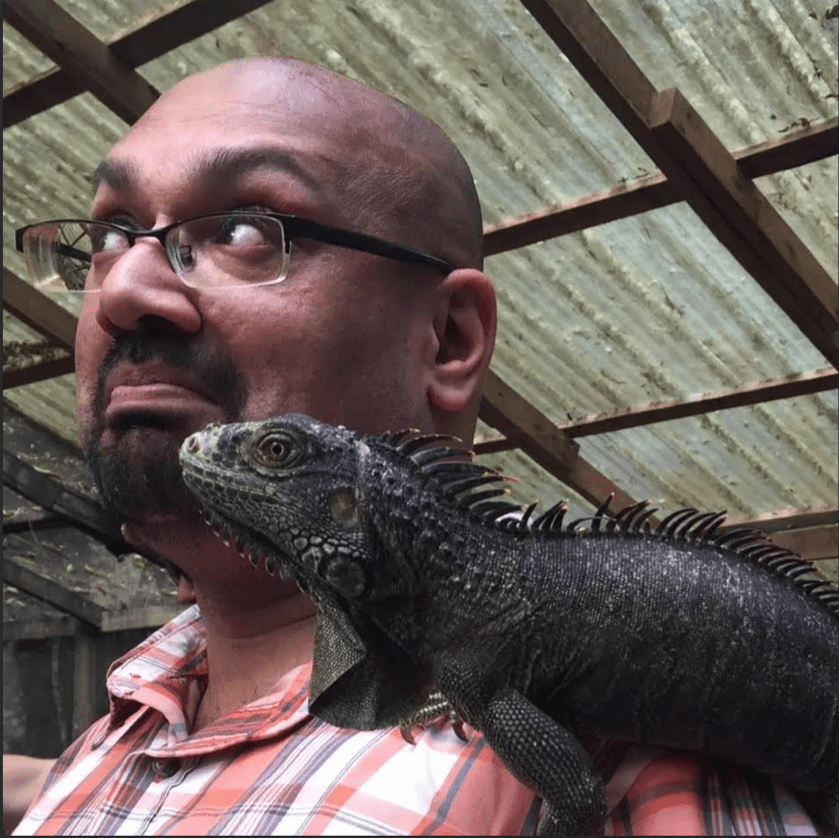
Get to know scholar and science fiction author Subodhana Wijeyeratne in this introductory Q&A where we discuss his love of Cormac McCarthy and Margaret Atwood, his research into the history of science in East Asia, and how an optimistic worldview helped shaped “Termina,” his debut Analog story that features in our [November/December issue, on sale now!]
Analog Editor: What is the story behind this piece?
Subodhana Wijeyeratne: It’s no secret that we live in challenging times, so I wanted to write a piece about how tragic humanity’s inability to see the beauty in itself is sometimes. Growing up I had a very optimistic view about humanity. Nowadays it seems like this vision doesn’t quite jive with reality—but I have faith. I wanted to explore at least partly how our descendants, far in the future, would feel about the world we bequeath to them.
AE: Is this piece part of a greater universe of stories?
SW: No! I actually promised myself a long time ago that I wouldn’t do that. I like to let my stories have room to breathe on their own. That being said, there are connections between all of my stories, for folks who fancy taking the time to look.
AE: Do you particularly relate to any of the characters in this story?
SW: Folks say that all characters are the author, in the end. I certainly feel like I relate to the main character the most. Some of what I’m trying to convey is what I find so baffling about humanity—a species capable of making wonders and committing atrocities in the very same breath. I struggle to reconcile the kindness I see with the cruelty—and the self-destructiveness. I think the main character shares some of this confusion.
AE: Who or what are your greatest influences and inspirations?
SW: In terms of style, Cormac McCarthy, Margaret Atwood, Octavia Butler, and Ursula K. LeGuin are my absolute heroes. I also love Hemingway. I also adore the work of Greg Egan, Adrian Tchaikovsky, Katherine Addison, and Nick Crowley. And I was weaned on the works of Arthur C. Clarke, Isaac Asimov, Robert Heinlein, Frank Herbert, Samuel Delaney, and Tolkien, and no one will ever convince me that they’re anything less than the purest SF gold.
AE: How do you deal with writers’ block?
SW: I work every day for 40 minutes. Regardless of how I feel, I find some time to sit down and just do some editing or writing of some sort for that period of time. This keeps the story in my head; I always write best when a scene fleshes itself out in my imagination before I commit it to paper. Forgetting about what I’m working on is the worst—that’s when writers block hits me.
Some of what I’m trying to convey is what I find so baffling about humanity—a species capable of making wonders and committing atrocities in the very same breath.
AE: What other projects are you currently working on?
SW: I’m nearly done with my second novel, A Beast Called Man, which charts the conflict between a high-tech but low-industry human tribe living in a forest and a powerful hive species that is colonising their homeland. Despite their mutual hatred, however, some discover that the two enemies have far deeper and more consequential links than either side perhaps chooses to remember. After that I’m going to get cracking on my third, The Crimson Banner of Dawn. Think of this one as a space opera set at the bottom of the sea.
AE: If you could choose one SFnal universe to live in, what universe would it be, and why?
SW: I would very much like to have been born in the United Federation of Planets sometime during the 23rd to 26th centuries. I honestly did not realise until I was older how much Star Trek’s vision of the future influenced my politics and view of history. It seems to me like we’re moving away from that goal of a united, egalitarian, outward-looking humanity, which makes it seem all the more wondrous in my eyes. I hope we get there, one day.
AE: What careers have you had and how do they affect your writing? Many of our Analog authors are interested in science. Do you have any scientific background, and does it impact your fiction?
SW: These two questions relate to each other because in my day job, I am in fact a historian of science in east Asia. My first academic piece, The Islands and the Stars, is the first comprehensive English-language history of Japan’s space program—a story of determined grandmas, rocket rickshaws, and grumpy journalists wishing they could smoke in space. It’ll be out in January 2026 from Stamford University Press. My next book, The Islands and the Deep, is about deep sea exploration. My academic and creative work go in tandem—I always work a bit on one, and immediately work a bit on the other. A lot of the issues I encounter in my historical work, like the relationship between humans and their technology, I explore in more emotional depth in stories like “Termina”. Also, swapping between the two keeps me sane—along with help from my dogs, Lady Leela and Lord Nibbler.
AE: How can our readers follow you and your writing?
SW: You can follow me on my website, subowijeyeratne.com!
 The Astounding Analog Companion