
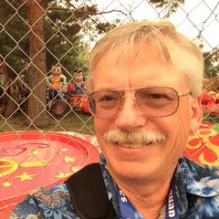
With his latest story, “Earth’s Last Library” from [November/December issue, on sale now!], James Van Pelt contributes to the rich tradition of Christmas-themed science fiction. Learn more about this fascinating sub-genre, and find out what James has been up to since his last Analog appearance, in this enlightening Q&A
Analog Editor: What is the story behind this piece?
James Van Pelt: I belonged to a writing critique group that for years exchanged manuscripts twice a month for discussion. Each year, though, at Christmas we’d have a party, and instead of bringing a story for discussion, we’d write a short, Christmas-themed one to read to the group. I love the holiday, and it lends itself to science fiction story telling because it’s such a human tradition. Surely it would be one of the many oddities in our behavior aliens might find puzzling. We are a peculiar species.
You don’t have to dig deeply to find Christmas’s rich vein in science fiction. Arthur C. Clarke’s “The Star,” James Patrick Kelly’s “The Best Christmas Ever,” Connie Willis’s “Just Like the Ones We Used to Know” (and several others—she has a collection of them), Eliot Fintushel’s “Santacide,” etc.
Science fiction themed Christmas stories have been collected in anthologies, if you want to mainline a bunch of them find the aforementioned Connie Willis’s Miracle and Other Stories, or David G. Hartwell’s Christmas Stars among dozens of others.
This story, “What’s a Douglas Fir?” is my continuation of the yearly Christmas story.
AE: What is your history with Analog?
JVP: Analog and I go way back when I started reading it in junior high. John W. Campbell was editor then. I could hardly wait for the next month’s issue to arrive. I don’t remember which was the first issue, but I can’t forget February 1968 with it’s cool cover to illustrate Dean McGlaughlin’s “A Hawk Among Sparrows.” I was obsessing about WWI aviation at the time, so the combination of biplanes, a modern jet fighter and time travel was perfect. I had just turned 14.
Years later, when I started writing for publication, I truly longed to place a story in Analog, but at the time I seemed to write mostly fantasy. Still, I occasionally sent something Stan Schmidt’s way when I thought it might work. I met him at WorldCon in Anaheim in 1996. I was part of a long line of hopeful authors who stood in a line to say hi and shake his hand.
I don’t think that had anything at all to do with him buying “The Big One” from me within the year. We went to lunch at the next WorldCon. He set up an appointment for the Analog photographer, Jay Kay Klein, to take my picture. I asked why, and he said, “When you sell your next story to me, we’ll need the picture for the biolog in the magazine.”
Yeah, right. That first sale was a lightning strike. Surely it was a once in a lifetime piece of luck.
“What’s a Douglas Fir” will be my 23rd appearance in Analog.
AE: Who or what are your greatest influences and inspirations?
JVP: For me everything truly starts with Ray Bradbury. In elementary school I found the science fiction section and never came out, but I read indiscriminately. All books were equally great it seemed until I found The Martian Chronicles. Bradbury’s stories were a revelation. The characters felt so real, and, although I didn’t recognize it at the time, his language elevated everything. He was the first author I wanted to read aloud to others.
Also, I read mostly novels. Like most kids, an assignment to write a two-page paper over the weekend seemed impossible. I admired authors, but the idea of writing a novel was the most science-fictional concept I could imagine. Bradbury wrote short, though. The first story in The Martian Chronicles is called “Rocket Summer.” It’s less than a page long. I couldn’t write a novel, but maybe, just maybe, if I applied myself, I could manage a page.
There have been many other influences along the way. I long to write stories that are as moving as James Patrick Kelley’s “Think Like a Dinosaur,” Alfred Bester’s “Fondly Fahrenheit,” Daryl Gregory’s “Second Person Present Tense,” and Connie Willis’s “Lincoln’s Dreams.”
Eventually I find so much influences and inspires that I can’t scratch the surface. I’m motivated by the talent around me. I’m inspired by music, poetry, art and current events.
I’m reminded of the line from the movie, Field of Dreams. James Earl Jones talks about the attraction of baseball when he says, “”It’ll be as if they dipped themselves in magic waters. The memories will be so thick, they’ll have to brush them away from their faces.” Except instead of memories, for me it’s ideas that crowd the air.
AE: What is your process?
JVP: Process questions are fun. What’s the formula? What’s the secret handshake that opens the creative doors? I’m always interested in what authors have to say about this.
As I explored the subject I found to my dismay that there didn’t seem to be a sure-fired approach. Some people write in the morning, others at night. Some write every day. Some go for weeks at a time without writing. Some revise as they go. Others never look back but instead rush to an ending. Some swear by long walks (or long showers or long drives). Some write by hand. Some outline while others don’t. Some listen to music while they write or go to coffeeshops or write in their bathtub. The variety baffles a curious mind.
With that in mind, here’s how I go about it.
I’m not a planner. My starting point might be an opening scene. My current work in progress is like that. An elderly married couple is looking out their living room window at their neighbor raking up his yard when a robodog trots up the sidewalk and shoots him.
Now I have a series of questions to deal with in the story. What is the personality of the elderly couple? What is their relationship to the neighbor? Why did the robodog shoot him? How has society changed to create this circumstance? How does the couple react? What happens next?
And then what happens? And then what happens? What does my main character want? What stands in the way? What of value is at stake? What actions do my main character take?
AE: I keep writing until I’ve resolved the questions.
JVP: I don’t write in a bathtub, by the way. I write on a MacBook Pro in a recliner in my living room, facing art on the walls I’ve bought at different conventions, or I go downstairs and write at a small desk in an office chair that’s better for my back, or I go to a coffee shop. I’ll often write to ambient noise from YouTube videos. Lately I’ve listened to windy, haunted forests, or pirate ships in the rain.
I write every day, at least 200 words a day, and haven’t missed a day for years.
Process questions are fun. What’s the formula? What’s the secret handshake that opens the creative doors? I’m always interested in what authors have to say about this.
AE: What is the weirdest research rabbit-hole that working on a story has led you down?
JVP: Research is so much fun! Even when I write from the low-hanging fruit of autobiography, I find myself looking facts up. Fortunately, we live in an information-rich world.
I wrote a story that takes place in Times Square on VJ Day. My character walks from the Central Union Bus Station on 43rd, through Times Square to a bar on 44th near the Claridge Hotel.
That sentence alone took an hour of research to find out what businesses existed near Times Square on August 14th, 1945. I wanted to know what ships were docked in New York harbor then, and suddenly it became important to me to find out what movies would be listed on the marquees. What songs were popular? What beers would be in the bar? I pored over all the photographs, looking for details that would become part of the story.
Research!
The weirdest rabbit hole, though, was I wanted to write a contemporary story with teenagers as the main characters. In some ways this should have been easy. I was teaching high school English at the time. Teenagers surrounded me.
The nature of my question resisted research, unfortunately. How would a high schooler interested in an intimate encounter ask the other if they were game? What is the modern equivalent of the very old-fashioned, “Would you like to come up to my room to look at my etchings?”
When I was in high school, the code phrase for asking a girl if she wanted to make out was, “Would you like to go to the drive-in with me?” Everyone knew what that question meant. But drive-ins don’t exist anymore. At the time when I wanted to ask the question, the phrase “Do you want to Netflix and chill?” which spent a short time as the new code was already passe.
The problem, and why this is my weirdest rabbit hole, is that there’s almost no way for a high school teacher in his 60s to ask a teenager that question without raising eyebrows.
It took a while, but it turns out the current answer is “Do you want to hang out?” Modern teens can be more subtle than my generation. “Do you want to hang out?” is a nuanced question and very context sensitive. “We’re going to the concert. Do you want to hang out?” could range from being an entirely innocent question between friends to being a straight up request for a date (the concept of a “date” has also changed). If the question is phrased, “My parents are gone for the weekend. Do you want to come over and hang out?” you’ve almost said in the modern parlance, “Do you want to go to the drive-in?”
AE: How much or little do current events impact your writing?
JVP: Most of the time I’d say “very little.”
However, I have to keep in mind what I told other writers about science fiction. “Science fiction always reflects the time that produced it.”
A great example is H.G. Wells’ The Time Machine. When he wrote it in the late 1890s, the political worry of the time circled around industry excess, runaway wealth for the very few, and the workers’ plight.
Wells’ imagined Earth 800,000 years into the future. The downtrodden working class had been driven into underground factories where they evolved into the brutish Morlocks. The descendants of the wealthy became the childlike Eloi on the surface. When the time traveler arrived, the Morlocks treated the Eloi like cattle, rounding them up periodically for food.
Clearly Wells reflected current events.
In 1960, George Pal produces and directs the movie based on Wells’ novel, but the fear of the worker/owner split has been replaced by worry about nuclear war. The movie covers much the same ground as the novel from the 1890s, but now the Eloi are the survivors who survived on the surface after a nuclear war, while the Morlocks are the descendants who evolved in the bomb shelters and never came back up. The movie adds the disturbing twist that the Morlock sound the air raid sirens to call the compliant Eloi to their dooms.
The movie is remade in 2002. Inexplicably, the terror of nuclear annihilation has been replaced by fears of runaway capitalism and eco-irresponsibility. In this version, unfettered exploitation of the moon (it’s being excavated for retirement housing), breaks the moon up. Huge fragments rain down on Earth, driving some underground while others survive on the surface.
It always ends up with Eloi and Morlocks, each reflecting current events.
So I’d be lying to say current events don’t impact my writing. Remember the robodog from an earlier answer? That’s a political story.
Let’s just say I don’t often consciously write stories about topical subjects, but sometimes I do.
AE: What SFnal prediction would you like to see come true?
JVP: Oddly enough, although this will sound like a continuation of the current event question, I really like the idea of the “medbed.”
Wouldn’t it be wonderful to go in for a one-stop medical appointment where your body is scanned and your ailments treated in a single visit?
Yes, I want a future where humanity can go to the stars. I want one where poverty and suffering are as well handled as they seem in Star Trek. I also would like to time travel, and while we’re on the subject, a jet pack would be nice.
But first, give me the future where I can always feel well and energetic. All other interests fade away when you’re sick.
AE: What are You Reading Right Now?
JVP: I have a large and growing collection of books on writing. It’s the teacher in me, but I think there’s so much still to learn about putting words together in a row and somehow having story arise from them.
Currently I’m reading James Wood’s How Fiction Works (tenth anniversary edition) which is a recent classic, and the Joe Fassler edited Light the Dark: Writers on Creativity, Inspiration, and the Artistic Process.
For fiction, I’m enjoying Carrie Vaughn’s The Naturalist Society. The sequel, The Glass Slide World is coming soon. If I time it right, I can segue from one to the next without a bump. Carrie is a delightful writer.
AE: Do you have any advice for up-and-coming writers?
JVP: I have tons of advice, but I think the most helpful one in a world where the means of publications, and the route to publication has evolved so dramatically since I began publishing is this:
- Writing is long road, and can become a life-long journey, so treat it that way.
- Assume that everything you write stands on the shoulders of what you wrote before. The goal should be to grow as a writer, but it’s a near given that you will change as a writer. Your interests will change. Your style will change. You can’t help becoming a different version of yourself over time. Embrace that.
- Don’t compare your beginning to someone else’s middle. No matter where you are, there will always be somebody else who made a sale you would have liked, or won an award, or wrote something that makes you seethe with envy. You’re on your own journey. Enjoy the trip.
- Ask for advice and pay it forward. I’ve found the science fiction writing community to be extraordinarily supportive and encouraging.
- If you’re serious about writing, you will write constantly. Fallow times are expected, but you will always come back to it.
- I’ve argued that to be a writer has a short list of requirements: an ability to observe, a willingness to be specific, a tendency to make connections others don’t see, a felicity with language, and having something to say. There may be other helpful qualities, but this list is a good core to start from. When I taught writing classes, I told the students I could help with all the qualities but the last one. I couldn’t give them what they wanted to say. Often times they might not know what they want to say when they start a piece, but by the end they should have a good idea about it.
AE: What careers have you had and how do they affect your writing?
JVP: I spent most of my working life as a high school and college English teacher. I loved teaching because it challenged me in all the best ways. Figuring out what was important, and then coming up with strategies to teach that importance to students in engaging and interesting ways never grew tiring.
It helped that I like both students and my subject area.
All parts of a career in English affected my writing. The obvious and most direct impact came from teaching writing and literature. To teach characterization, for example, meant I had to read closely and help students to see the techniques the author used to turn words on the page into people we cared about. Of course that helped me to think about the characters I created. This was the same for all other elements of fiction writing: plot, setting, theme, dialogue, tension, irony, etc.
But more than the subject, being in a school and a classroom meant swimming in an ocean of human behavior and story.
Every person in the school is a story. Everyone is the hero of their own story.
I’m retired now and out of the classroom, but I remember that everyone is part of a story when I go to a restaurant or sit on a bus or stand in line at a supermarket.
Many writers are not teachers, but I can’t imagine a career for myself that would have been more impactful on how I write.
AE: How can our readers follow you and your writing?
JVP: I hang out on FaceBook at https://www.facebook.com/james.vanpelt.14
My blog, bibliography and other info are at https://www.jamesvanpelt.com
My books are available on Amazon and at Fairwood Press at https://fairwoodpress.com/james-van-pelt-collection.html
 The Astounding Analog Companion