
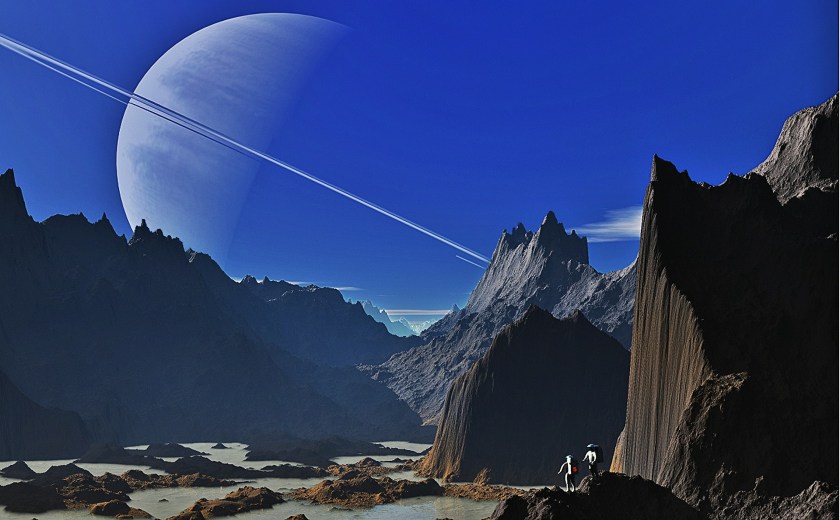
by Mark W. Tiedemann
In this absorbing blog post, Mark W. Tiedemann reflects on Apple’s Foundation series along with science fiction’s unique power to reimagine the future. You can find his latest story, “With Lanterns Borne Aloft,” in our [November/December issue, on sale now!]
Recently we watched all three seasons of Apple’s Foundation. I had given it a try when it first appeared and reacted badly. This was not Foundation. Not what I read when I was . . .
Well, like so many SF fans (especially those of us who try to write science fiction), this was one of Those Books, encountered at the Golden Age—twelve. It was not the first SF novel I’d ever read, but it was first one that opened my imagination to what was going on with this genre. The first time I ever considered that I’d like to write it.
I liked Asimov’s robot stories well enough, but it was the Foundation that really caught me. The scope, the depth of the ideas, the almost casual presentation of a future so far ahead of our own time that it could, in fact, be anything. I was sold. This was the coolest stuff I’d ever en countered.
So when I began watching the show, all I could see were what I considered betrayals. The murder at the end of the second episode drove me out of it. I dismissed it. A cliché-driven “What have they done to my Asimov?”
Fast forward and we gave it another try and I gradually saw something marvelous. No betrayals. An upgrade.
This is, in fact, what science fiction does all the time. We anticipate what the future may be and set stories within those imagined contexts. We do the best imagining we can, but the present continually carries us into futures that rarely sync with our projections. And that’s fine. We’re not in the job of blueprinting tomorrow. Just scattering the What Ifs. But as we travel forward in time, we learn more, and so the next time we sit down to write a new story in a possible next century or so, those contexts change.
As is as it should be. We eventually find ourselves writing and reading stories with details and infrastructures that look nothing like those we created before. It’s not so obvious if we never look back.
It’s stiking—and occasionally of-putting—when we go back to an old story and try to adapt it to current sensibilities.
We’re not in the job of blueprinting tomorrow. Just scattering the What Ifs. But as we travel forward in time, we learn more, and so the next time we sit down to write a new story in a possible next century or so, those contexts change.
By the end of our watch, I had come to admire what had been done. The future Asimov had imagined had largely been preserved, but the writers understood that it could not be presented the same way because we now know more possibilities than we did in 1950. Asimov knew nothing about nanotechnology. And cloning? More, though, SF back then tended to present monocultures.
This is not a criticism. Everything starts somewhere, simpler, and then complicates as it goes forward. Asimov himself was beginning to take into consideration technologies and cultural assumptions new to the world when he began to write prequels and then attempt to blend his two major storylines.
Samuel R. Delany once observed that the nature of science fiction is such that the most exciting material is always what is being published today. Quite a lot of what went befofe has not aged well. But the real classics, the truly great work, has so much latent quality that it lends itself to upgrading very well.
That’s what we all do, we who write science fiction. We’re upgrading our visions all the time. We know what we can imagine the future will be today is not what it can be imagined tomorrow. And next year? Next decade?
The process of upgrading, though, is laid out for us all to see in a succesful adaptation like Foundation. The human elements may remain the same, but the tools with which to tell that story will always change, and with those changes, the choices our characters have to deal with those futures in which we set them to live expand and complicate and revise.
This is what makes this genre such a rich place in which to create.
 The Astounding Analog Companion