
by E.L. Mellor
E.L. Mellor is a writer and amateur singer who makes her Analog debut in our [Jan/Feb issue, on sale now!] with “Silver Hands,” a short story inspired by the world of classical music and the choices we make to excel in our chosen field. Learn more about the origins of “Silver Hands” in this engrossing blog post
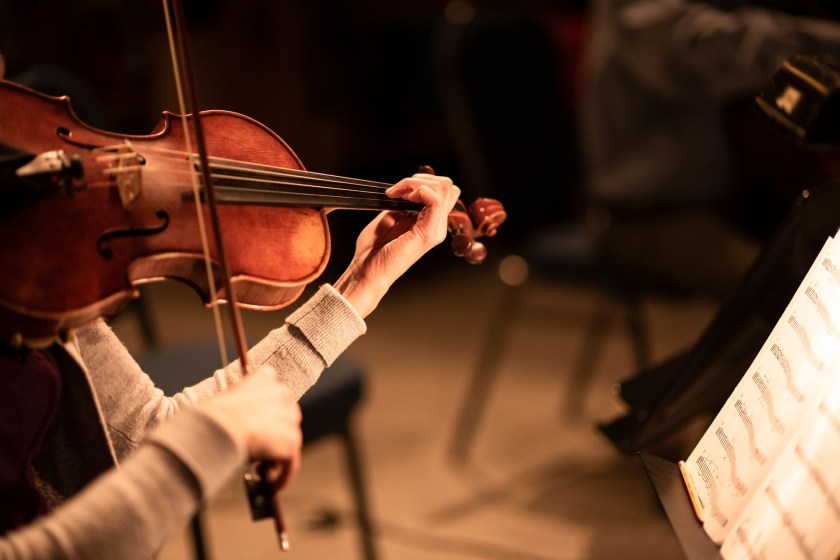
Most of my stories grow from imaginative tapestries woven of many ideas, born at the moment where I see a character in a particular situation. When the vision of a young woman holding a violin near a pair of robotic hands came to my mind, I knew immediately the decision she was facing, and that inspiration led to the writing of “Silver Hands.”
Although I don’t tend to be aware of individual threads while I’m in the middle of composing a story, I can often separate some of them out later. One thread woven into this one is the recent history of elite athlete’s objections to competing with amputees because modern prostheses supposedly give them an unfair advantage. Although there’s no evidence it’s currently true, since studies done on single amputees show their running blade strikes with less force than their remaining foot and returns less energy, I wondered what might happen if prosthetics technology developed to a point where it could give an amputee an edge over others with similar abilities. Would some be willing to submit to voluntary amputation in order to have a better chance of success?
“Silver Hands” takes place in the world of classical music because I’m familiar with it as a serious amateur singer. For professionals, the field is brutally competitive, training and instruments are expensive, and there’s no guarantee of any level of success, even for those who want to achieve it so badly they’d sell their own grandmothers. If prosthetic hands could allow for longer practice by reducing fatigue and the risk of repetitive motion injuries, while producing greater speed and agility, some instrumentalists might be tempted. On the other side, those who play strings or keyboards tend to be very protective of their hands, so many of them would feel the same reluctance and terror at the prospect of voluntary amputation that haunts Esmé.
Another thread leading to the story is the increasing corporatization of both education and violin ownership. Many old Stradivari violins are the property of wealthy investors who lend them to the best soloists, and I project this forward to a time in the future when a corporation might run a music school and invest in valuable instruments which they can lend or lease to promising students. Esmé’s violin is a Greiner because Stefan-Peter Greiner is currently one of the best luthiers in the world. He makes instruments with a combination of traditional techniques and scientific precision to recreate the sound of old old Cremona violins, so I could see his instruments being in demand as investments decades from now.
When the vision of a young woman holding a violin near a pair of robotic hands came to my mind, I knew immediately the decision she was facing, and that inspiration led to the writing of “Silver Hands.”
I called the prostheses “Paganini hands” after Niccolo Paganini, an Italian violinist of the early nineteenth century who had extraordinarily long, flexible fingers—quite likely as a result Marfan Syndrome—and who played so brilliantly people claimed he must have made a pact with the devil. It was said he could play twelve notes a second. In the world of my story, musicians who undergo amputation are given a set of hands that duplicate their own for everyday use along with silver prostheses specialized for their intrument, and the Paganini hands are designed with the sort of disproportionately long, agile fingers the violinist had.
Another influence on “Silver Hands” and the origin of the title comes from a fairy tale that is found in variations across Europe, Africa, and Asia. The version collected by the Brothers Grimm was called “The Handless Maiden.” In this tale, an old man offers to make an impoverished miller rich in exchange for what is behind his mill. Since he knows there’s only an old apple tree there, he agrees to the bargain, and the man says he’ll return for it in three years. When the miller tells his wife the presumably good news, she points out that the man was the devil and their daughter happened to be sweeping the yard behind the mill at the moment of his request.
When the devil comes for her, the girl washes herself and stands inside a chalk circle so he can’t touch her. He orders her father not to let her wash and returns the next day, but she cries so many tears her hands are washed clean, and he still can’t get near her, after which he tells her father to chop off her hands with an axe so he can take her as promised. Her father at first refuses, but the devil threatens to kill him and his wife, so he does as he’s told, but once again the girl weeps so much her stumps are cleaned and the devil gives up.
The young woman says she can no longer stay there, which seems understandable in light of her father’s choices, so she has her mother bind her wounds with clean linen and wanders off. Eventually a prince notices her beauty, gives her silver hands, and marries her. After a few more convoluted plot twists in which she ends up apart from the prince, her own actions cause her hands to grow back in some way that varies slightly beteen different versions of the story. I see this as the woman reclaiming her own competence and authenticity, which is echoed in Esmé’s journey.
Agreeing to have one’s hands amputated in exchange for musical training and the loan of a valuable instrument in order to promote a corporation’s prostheses for other musicians is not very different in moral terms from what might once have been regarded as a deal with the devil. Those who make such a bargain would end up at the mercy of the corporation, which could go out of business or withhold prostheses. Students whose family poverty gives them few other options for becoming a classical musician make attractive targets for that sort of exploitation.
In the end, Esmé faces the same kind of moral choices many of us have to make if we wish to remain fully human while surviving and pursuing our dreams in a dehumanizing world.
 The Astounding Analog Companion