
by Don Mark Baldridge
Don Mark Baldridge returns to Analog with the short story “Jiggety” Jog” in our [Jan/Feb issue, on sale now!]. Here, Don discusses a few different writing techniques he’s identified across a range of fiction, along with how they show up in his own work
Long after the fact, A. E. van Vogt gave a shockingly frank name to that canny commercial product of post-war publishing, the “Fix-up.” He’d learned (with others) to repackage ramshackle short stories into something resembling a novel —stoking a market hungry for hardcover content.
One of his own early efforts, The Voyage of the Space Beagle (1950), compiled four independent shorts, published over more than a decade —mostly in the pages of Astounding— with interstitial material and some deft rewriting.
One need not know its history to sense the book’s essentially episodic character, more a digest than a novel.
Impossible to deny its reach, however. It may have been a formative influence on the original series of Star Trek, particularly in the latter’s sometimes “monster of the week” approach. And van Vogt’s claim of plagiarism against 20th Century Fox for elements of Alien (1979) —parasitic eggs, anyone?— was settled, finally, out of court.
To this day, the fix-up remains viable in the (especially speculative) publishing industry.
Though it appeared contemporaneously with Space Beagle I have to feel Ray Bradbury was doing something rather else with The Martian Chronicles.
While it is composed of reworked shorts, neither these nor his additional materials appear ever to have been raised to molten temperature, poured into the novelistic mold. Rather, it retains the gemlike quality of the short story —only multiplicitous and manifold.
In this aspect it’s rather more like Jerzy Kosiński’s Steps (1968) —or that later book resembles this. Whatever we may think about it, or its controversial author, Steps remains an extraordinary work, described by David Foster Wallace as a “collection of unbelievably creepy little allegorical tableaux done in a terse elegant voice that’s like nothing else anywhere ever.”
Both it and Chronicles peer again and again, each into a unique crystal, finding new auguries in every angle of the light. Neither is structured much like a novel, yet each wields the novelistic impact with a certain undeniable authority.
I can’t tell you where Anaïs Nin’s Cities of the Interior (1959) —composed of five previously published novellas— lands within this context: Collage? Montage? Bricolage? Vignettes bubble into novelettes and flow into one “continuous novel” —as she called it.
But she clearly influenced the style of her friend, Henry Miller, most visibly in his “Tropics” novels —which, like holograms, contain in each part, intimations of the whole. Dip in anywhere, read six-to-twelve pages: you hold it all now, in your mind, complete.
Something like this can be said for all products of the “Mosaic” approach —a term I’m using in a narrowly specialized manner to describe, in some sense, the work of all four authors.
I could ofcourse delineate other means by which novels and stories relate: serialization gave us the adventures of Oliver Twist and Pinocchio.
Meanwhile some stories appear to be seeds. Under favorable conditions, they may sprout, grow into novels. Haruki Murakami tells us, in the preface to his collection Blind Willow, Sleeping Woman (2006):
A short story I’d written long ago would barge into my house in the middle of the night, shake me awake, and shout, “Hey, this is no time to be sleeping! You can’t forget about me, there’s still more to write!” Impelled by that voice, I’d find myself writing a novel.
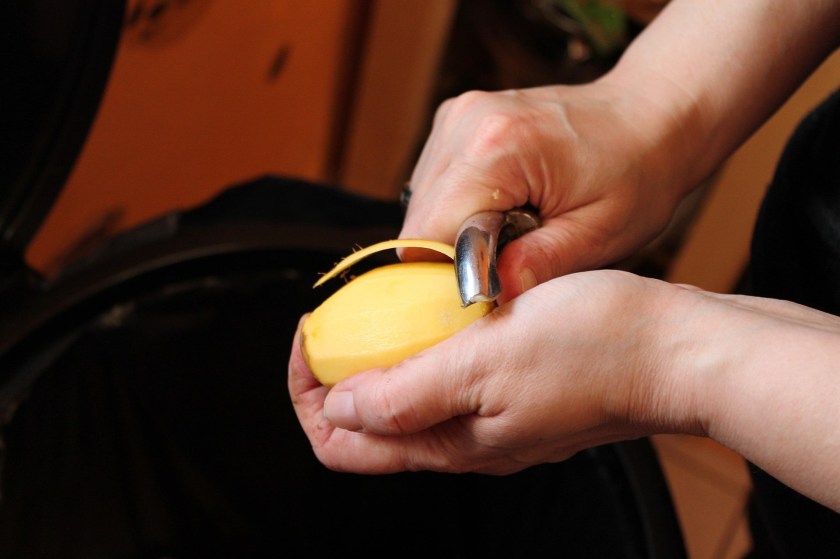
But what I want to explore is a heretofore difficult-to-trace relationship between stories and novels. Rather along Vogtian lines, I’ve named it the “Peel-away.”
Such stories are born when an author —engaged with a novel-in-progress, pre-publication— sells one or more sections of the book as stand-alone shorts.
I make a distinction between this and the familiar sale of “excerpts”, though it may not be desirable to draw too hard a line, here. In general, excerpts are sold as such —purchased from authors whose excerpted book can more or less be expected to eventually appear, often under contract.
But if the fix-up represents an economical reuse of an author’s existing works, the peel-away, as I envision it, represents the pre-sale of ideas still being worked out.
I reckon this aspect, the implications of offering process as product, obscures such attempts, historically. I’ve certainly found them difficult to identify in the literary record.
It’s too easy for critics and biographers, even authors themselves to later reverse the actual process. To say such stories “grew” or were “worked into” novels, when the opposite was true and the chapters or scenes of the novel-to-be were cut, or expanded, reworked in order to make them stand alone, qua stories.
We might look at early-career writers, known to have taken quite some time producing their first novels, whose earlier story sales seem to represent the peel-away in action.
In 1945, six years before publication of The Catcher in the Rye, J. D. Salinger sold “I’m Crazy” to Collier’s and the world met Holden Caulfield for the first time.
You’ll read that “scenes” from the story were “later incorporated” into Catcher, but, by this time, Salinger had been writing that novel for four years, at least.
Doesn’t it make more sense to see this story as peeled-away from a novel-in-progress? Especially as this is only the first example: “Slight Rebellion off Madison” (1946) opened doors for Salinger at The New Yorker and began a fruitful publishing relationship for the young author —a canny move on its own.
And I do see the practice of the peel-away as strategic, especially among first-time novelists: agents and publishers may take more notice of a manuscript when they note that parts of the work under consideration have already sold, elsewhere, as stories.
Authors of short stories attempting, for the first time, the novel, may consider such a peel-away as a proof-of-concept for the book they’re working on, giving them reason to continue when all —inevitably— seems darkest. There again, their more finely honed story skills may be brought to bear, shed light on the larger work.
Author Debbie Urbanski tells me she sold no fewer than seven stories, peeled-away from her debut novel After World (2023) while it was still a work in progress (WIP):
“My current agent contacted me in May 2019 after reading my stories in The Sun (one of her clients suggested she check these stories out). So this process did help me get an agent!”
I welcome further known or conjectured instances, edge cases or personal experience of the peel-away in the comments, below. But I think we can suggest its role in the careers of writers like Flannery O’Connor, Evelyn Waugh and . . .
Alright, I’ll cop the plea myself.
As I prepare my first novel —tentatively titled With / Was— for submission, I’ve been engaged in peeling-away parts of it for publication as stand-alone stories.
This hasn’t been at all difficult, except in cases where it’s impossible. But I tend to work in blocks of 2600 words or so —a sweet spot, as I take it, in the current story market, shortening of the attention span and wotall.
Some of the resulting stories, like “Jiggety Jog”—appearing in the January / February 2026 issue of Analog—may seem elliptical and slightly off-center. But my work, whether short or long-form, rather rings with these qualities.
To the extent they may be taken as flaws, they are at least signature flaws.
A handful of previous peel-aways from my own WIP have already seen publication, though I’m holding onto the complete list for the coming Acknowledgements page.
And I expect these pre-sales will appeal to agents and publishers for the same reason they appeal to me: they suggest I might just be . . . onto something?
 The Astounding Analog Companion