
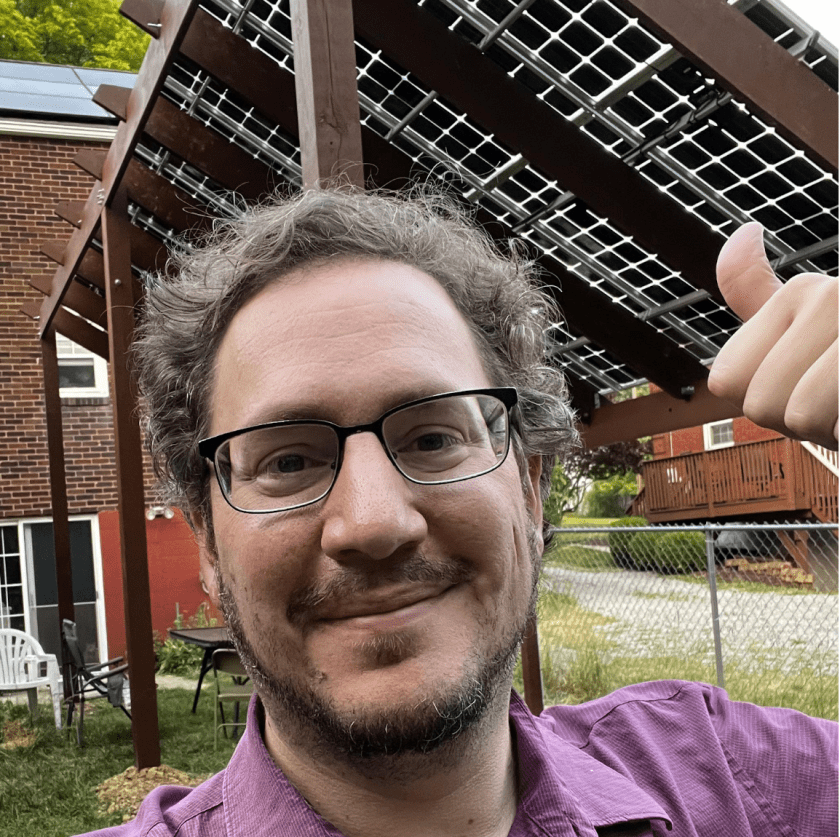
Catch up with Analog regular Tom Pike in this author Q&A, where we discus his longstanding relationship with our magazine, some of his upcoming fiction (and why he has only read a “depressing” piece of his once), and the origins of his latest work, “Conscience,” from our March/April issue, on sale now!
Analog Editor: What made you think of Analog for this story?
Tom Pike: The first draft of “Conscience” took the form of an in-universe scientific paper that was a thinly-disguised rant. My friends told me it was too thinly-disguised, so I rewrote it from scratch. It’s still not disguised, but it is hopefully more entertaining. Any time my starting place is rooted in actual science, it’s usually a good fit for Analog.
AE: What is your history with Analog?
TP: I grew up reading Analog! My grandmother bought me a subscription for, I think, my fourteenth birthday. I have read many issues of Analog at the cabin described in the story. The magazine played a big role in shaping my sensibilities.
“Conscience” is my sixth story in Analog, and three more are coming in the next year or so: “Red Ships”, “A Grove of Binding”, and “The Enshittification of Dogs”.
“Red Ships” is a novella about the death of a culture over the course of a century; one of my beta readers said it was “infused with a sense of doom”. It should be out around late 2026 or so. “A Grove of Binding”, due in 2027, is about a future archaeologist who uses an observational time machine to try to make sense of a pointless last stand fought by a Nazi platoon during the Lapland War. “The Enshittification of Dogs” is a comedic piece about a startup that develops dogs who don’t poop. It is the most depressing thing I’ve ever written. Because it is so bleak, it is the only story I have ever written that I have not read more than once. So, you have that to look forward to.
AE: What is your process?
TP: For Analog stories, my process usually starts with stumbling upon a scientific paper that makes me think, sending a flurry of messages to my friend Jim about it, and waking up the next morning realizing that what I sent Jim is actually a very bad first draft of a story. That is what happened with “Conscience”.
“Conscience” was inspired by this paper, which made me ask why the behavior of tech CEOs so uncannily resembles the extremely specific type of deluded thinking they’d need to display in order to produce a catastrophic result. The authors of the paper believe that future AI will be able to manipulate its human users into getting what it needs in order to be rid of us; what remained unexplored in their paper was the bizarre way tech CEOs today behave as if they are already being manipulated by a hostile intelligence that doesn’t yet exist. I believed this could be explained via the Anthropic Principle and simulation theory. (Jim was not convinced.)
There are other gaps in the “AI 2027” paper that you could poke at. For one thing, it does seem a bit too credulous of AI industry claims; for another, many economists seem sure we’re looking at a bubble. Those are worthy topics to consider, but they’d be separate stories. For “Conscience”, I wanted to see what happens if machines kill us all, despite never actually achieving sentience. Which is an outcome I find plausible, but is obviously not the outcome I want.
I grew up reading Analog! My grandmother bought me a subscription for, I think, my fourteenth birthday. I have read many issues of Analog at the cabin described in the story. The magazine played a big role in shaping my sensibilities.
AE: What is the weirdest research rabbit-hole that working on a story has led you down?
TP: I am currently scouring public meeting minutes from suburban municipal councils in Pennsylvania so that I can write a story about an Alcubierre warp ship.
This possible upcoming story is a climate change allegory under the working title “The Ship that Couldn’t Steer”. It is about a ship that is, contrary the title, actually perfectly capable of steering away from a decades-away collision with a planet, but whose leadership refuses to do so. Because the premise is so nakedly absurd, I am going to have to use actual quotes from climate-denying elected officials with in-line citations to the original quotes, or you wouldn’t believe people would actually say such asinine things. But they can and do. That project has me reading all kinds of extremely depressing primary sources as I try to track down quotes which I remember encountering at some point in my eight years working in climate policy.
Runner up would probably be the entire day I spent doing math to find out whether a space telescope in orbit of any planet in the solar system, including all plausible values of Planet 9, could use either their planet or the Sun as a gravity lens. The answer came back a disappointing “not really”, so no story was written. Lagrange points open the possibilities up a tad more, but realistically, you have to be super far from the Sun before you can get any good science done.
AE: Do you have any advice for up-and-coming writers?
TP: The myth of the starving artist was invented by powerful people who benefit from its perpetuation. Hollywood, for example, exploits young peoples’ passion and willingness to work for less than they are worth by branding being exploited as a kind of romantic adventure. You know what I think is romantic? Getting paid fairly for work.
Similarly, although writing workshop culture will teach you to envy those who have experienced trauma, an artist who has experienced trauma is not a better writer for it. Experiencing trauma did not make me a better writer than before. It set me back years, and I have never written a story about what I went through. I am not sure I ever will.
And stories do not have to be about “conflict”, whether literal or otherwise. Many stories are, including most of mine. But if stories were exclusively about conflict, they would not accurately reflect the lived human experience. My favorite moment in The Expanse series actually comes from one of the secondary short stories, “Auberon”, in which a character inadvertently does something that would blow up into a big marital fight in any other series, to pad out the page count. But instead, the married characters resolve it like adults in a couple paragraphs.
AE: Many of our Analog authors are interested in science. Do you have any scientific background, and does it impact your fiction?
TP: I am a climate policy analyst, but I am not a scientist. I work with scientists. My job is translating information I get from scientists and engineers into words that can become law, and law that can become action. Several of my Analog stories, from “Strange Events at Fletcher and Front!” to “Prompt Injection” to my debut “Direct Message” have been based on research I encountered on the job. There will be more where they came from.
AE: How can our readers follow you and your writing? (IE: Social media handles, website URL…)
TP: I am on Bluesky. I also have a small email list. I reach out about once a month, just when I have a new story out. You can sign up on my website.
 The Astounding Analog Companion