
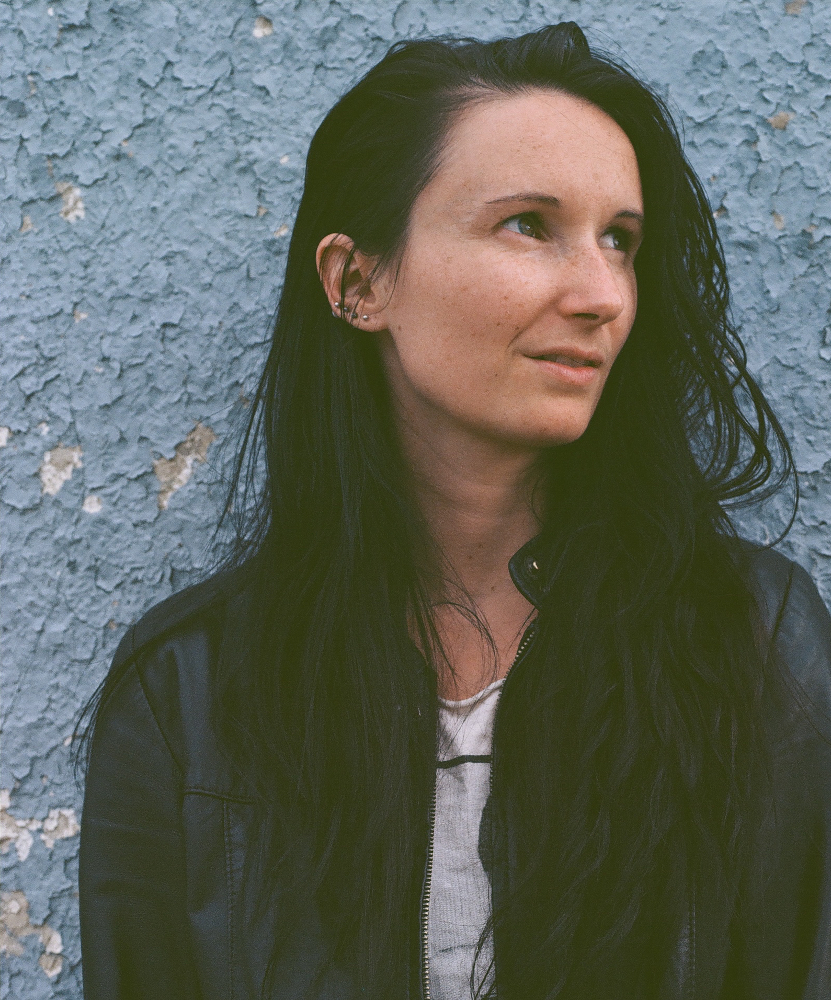
Read our Q&A with MB Valente about the inspiration for “False Light,” in our [March/April issue, on sale now!], and how her work as a translator influences her writing.
Analog Editor: What is the story behind this piece?
MB Valente: “False Light” follows a washed-up artist named Wey, who lives on a satellite that has been home to all humans since Earth was abandoned many generations before. It’s imagining a way of life that’s completely cut off from the natural world and exploring what kind of creativity is even possible—and what it means for something to be ‘real’—in an environment entirely controlled by humans. Having lived in cities for many years after growing up in rural Idaho, where it felt like all my best ideas crept out of the woods, I guess these things are on my mind.
AE: How did this story germinate? Was there a spark of inspiration, or did it come to you slowly?
MBV: The story came out of a novel draft I shelved in 2021, one thread of which was a sort of coming-of-age fantasy tale set in a matriarchal community of hunter-gatherers. I wrote that part first, then I started imagining its author as a character separate from myself, what in her life had inspired it, what itch it might scratch for her—that character became Wey. As the project got to novel length, I ended up trimming the fantasy sections down to short interludes, and in “False Light” they’re completely absent. But I like to think they’re still there in a sense, as the thing that’s missing from Wey’s life.
AE: Is this piece part of a greater universe of stories?
MBV: Yes, in the sense that, in the novel “False Light” comes from, I spent more time imagining daily life on the satellite of Stella, all its eerie and sordid corners. I wanted it to feel like a city: complicated, lived-in, kind of gross—something that novel pacing gives you more space to do. In trimming the piece down to a novelette, I shifted the focus to Wey’s inner life and cut any subplots that weren’t directly related to her unraveling sense of reality.
AE: What made you think of Analog for this story?
MBV: While I read quite a lot of science fiction and the genre has shaped my style and concerns, most of what I write is more surreal, slipstream or weird fiction than SF per se. This was one of the rare pieces I thought could fit somewhere like Analog, and I’m super proud to be a part of the magazine’s incredible history (and future)!
AE: Who or what are your greatest influences and inspirations?
MBV: When I started writing as a teenager, I was reading Neal Stephenson, Diana Wynne Jones, Kurt Vonnegut and Terry Pratchett. Purely by chance, I picked up a book of stories by the feminist SF author L. Timmel Duchamp around the same time, which really opened my eyes to what you’re allowed to do in science fiction. Some other authors who are dear to my heart and who have expanded my conception of what’s possible are Carol Emshwiller, Vajra Chandrasekera, Connie Willis, Anna Kavan, George Saunders and Kelly Link.
AE: How much or little do current events impact your writing?
MBV: For me, the best literature reacts to current events in a sidelong or abstract enough way that the work still speaks to readers who aren’t versed in the politics or culture that shaped it. Current events don’t usually impact my writing directly, but they’re always there in the background. Climate change and environmental destruction, for example, work themselves into almost everything I write, but not always literally.
This was one of the rare pieces I thought could fit somewhere like Analog, and I’m super proud to be a part of the magazine’s incredible history (and future)!
AE: Are there any themes that you find yourself returning to throughout your writing? If yes, what and why?
MBV: I mentioned climate change, especially its emotional and psychological impacts. I’m also fascinated by animal consciousness, non-human forms of perception in general, dreams, altered states, and aliens as a stand-in for truths we can’t admit or aspects of ourselves we don’t see.
AE: What SFnal prediction would you like to see come true?
MBV: In the French graphic novel SOON by Benjamin Adam and Thomas Cadène (which I translated for the Europe Comics ebook imprint), the nation-state model has been abandoned and people have come together to make some hard-core compromises in order to survive, including limiting the areas that humans are allowed to occupy on Earth. It isn’t a utopia, and not everyone agrees about everything, but it’s a vision of a world ruled by sacrifice and care which I loved spending time in.
AE: What are you reading right now?
MBV: Soma: a French feminist cyberpunk novel by Floriane Soulas, and Evil Flowers: a story collection by Gunnhild Øyehaug.
AE: What careers have you had and how do they affect your writing?
MBV: My day job as a translator definitely affects how I think about language: the kind of English I write, but also how my characters might use language or what even counts as a language. Do trees use language? Are bodily processes a sort of language? And in “False Light,” Wey gets to live out one of the intrusive fantasies I sometimes have as a freelancer working without guardrails and constantly open to self-sabotage—it can be so tempting to drop everything in pursuit of an insane, unlucrative and potentially self-damaging goal (like writing fiction).
AE: How can our readers follow you and your writing? (IE: Social media handles, website URL…)
MBV: There are links to more stories on my website: mbvalente.com. I also post about books I’m reading (and pictures of my dog) on Instagram: @mb.valente, and (occasionally) links to great stories I’ve come across online to Bluesky: mbvalente.bsky.social.
 The Astounding Analog Companion