
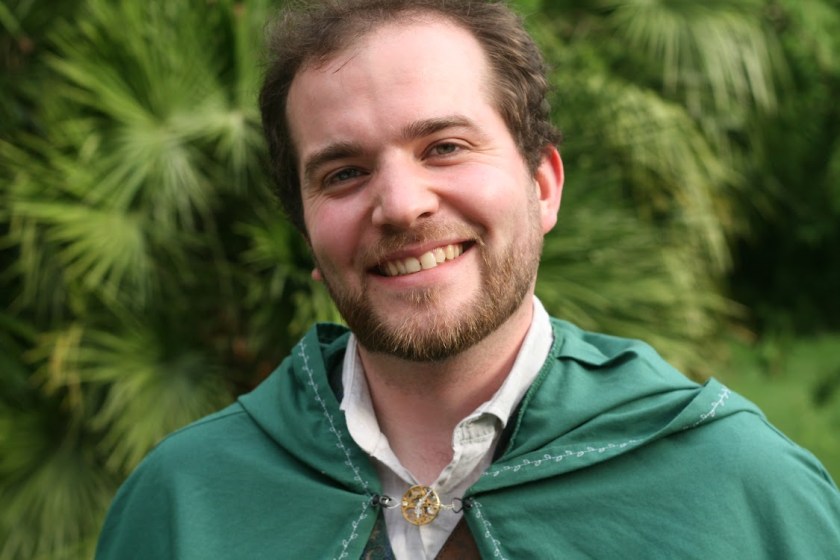
Hûw Steer makes his Analog debut with “A Vintage Atmosphere” in our [January/February issue, on sale now!]. In this informative Q&A, learn more about Steer, including his background in historical documentary research, and the Greco-Roman satire that inspired him to acquire two history degrees and write a novel.
Analog Editor: How did this story germinate? Was there a spark of inspiration, or did it come to you slowly?
Hûw Steer: As with many of my stories, it was a very brief idea that exploded into a much longer story than anticipated. The idle thought of “oxygen farmers” made me consider how exactly that might actually be done, which led to why someone might do it; and while I was on the subject of farming, what sort of futuristic farming machines could I come up with? How might a farmer’s market have evolved in the far future and the distant void? How could I make a space tractor? What sort of person would choose this lifestyle? And then I looked down and I had something like a full story.
AE: How did the title for this piece come to you?
HS: The “oxygen as wine” aspect came to me organically while I was writing: creating breathable air in space is doable now with our current level of technology, so I had to make this “farmed” oxygen somehow desirable for other reasons. Thus the different flavours, ages, and ultimately vintages—and from there, “A Vintage Atmosphere” was obvious.
AE: What is your process?
HS: I write 500 words every day (and have done for almost a decade), and then handle little details like “editing” and “plot coherency” later. I’ve tried very hard to start outlining my stories in much more detail these days, but no matter how extensive the outline, at some point I end up hacking my way through the jungle of ideas in search of the lost temple of conclusions. It normally works out fine in the end.
AE: How do you deal with writers’ block?
HS: I cheat: I write about writer’s block. Articulating how it feels to be struggling to write opens up the taps and lets me get something down. Even if I don’t end up writing much more on my current project after that, at least I’ve flexed my creative muscles.
AE: What inspired you to start writing?
HS: I had an excellent English teacher in secondary school, who apart from broadening my reading by lending me everything from Raymond E. Feist to Ken MacLeod, was extremely encouraging of my creative writing. It didn’t take many school assignments before I’d seriously started on long-form projects of my own—all of which were read and critiqued by him. So thanks, Mr Preston. Wouldn’t be where I am today if you hadn’t gotten me going.
I’ve tried very hard to start outlining my stories in much more detail these days, but no matter how extensive the outline, at some point I end up hacking my way through the jungle of ideas in search of the lost temple of conclusions. It normally works out fine in the end.
AE: What is the weirdest research rabbit-hole that working on a story has led you down?
HS: I once read a piece of Greco-Roman satire, and ended up with two history degrees and a novel. Lucian’s True History is (as I managed to convince my university professors) essentially Star Trek but for the 2nd century: an intrepid crew of explorers hop from weird islands to the Moon and back, encountering monsters and societies that are all satires of aspects of contemporary Roman society. And there’s a bit where they go to the Moon, run into some space-elves who ride around on giant three-headed vultures, and merrily go off to fight a war against aliens from the Sun and their giant ants. It’s absolutely wild . . . but, being written in that brief classical style, is somewhat light on content and description. Thus, Ad Luna; my novel-length version of that Moon “episode” of the True History. It was years in the researching but a lot of fun to make.
AE: If you could choose one SFnal universe to live in, what universe would it be, and why?
HS: Stick me in Iain M. Banks’s Culture any day. Living essentially forever in a post-scarcity universe where literature and the arts are the focus of society? And there are very cool spaceships which are generally content to ferry people around the wonders of the cosmos. Sign me up right now.
AE: What are you reading right now?
HS: My darker SF kick continues, after reading Ken MacLeod’s Engines of Light trilogy (for the fourth or fifth time), in the form of the Eisenhorn and Ravenor trilogies—again rereads but this time in audio form, which is great for getting me in the mood for my homebrewed mess of a 40k RPG. But I think a palate cleanse is in order with a bit of higher fantasy: The Children of Hurin beckons again.
AE: Do you have any advice for up-and-coming writers?
HS: Write a lot. Don’t agonise over quality—get your ideas down, as many as you can, and then refine them later. The more words you write, the more of them will be good ones!
AE: What careers have you had and how do they affect your writing?
HS: Working for a while in historical documentary research let me gather a lot of story ideas: there are all sorts of weird war stories and slices of domestic history that are absolutely begging for a science-fiction reimagining—I won’t tell you exactly which ones here as I’m still working on them! And then my current job, working for a children’s charity, led me to actually try writing for said children. Several of them said they liked it. I just wish I could adequately explain leaving reviews to 8-year-olds . . .
AE: How can our readers follow you and your writing? (IE: Social media handles, website URL…)
HS: Regular updates and rambling blog posts can be found at huwsteer.wordpress.com; aside from that, I’m @huwage on most platforms, including BlueSky and the artist formerly known as Twitter, as well as various writing-related Discords.
 The Astounding Analog Companion
Vintage Atmosphere is a superb story, told by the actions of the characters. I found the details of how the Oxygen farm worked to be totally fascinating and very plausible. The market reminded me of markets of the medieval era or even a community farmer’s market of today. The “twist” happening at the market caught me totally by surprise, being very well-written. We all have to breathe. I very much enjoyed the story, curious if there might be a sequel (or prequel). Looking forward to future stories by Huw.
LikeLike
I enjoyed the novella, it is a nice mix of a future space eploration and a mundane rural life not even from today, but from the past. And it all fits!
LikeLike