
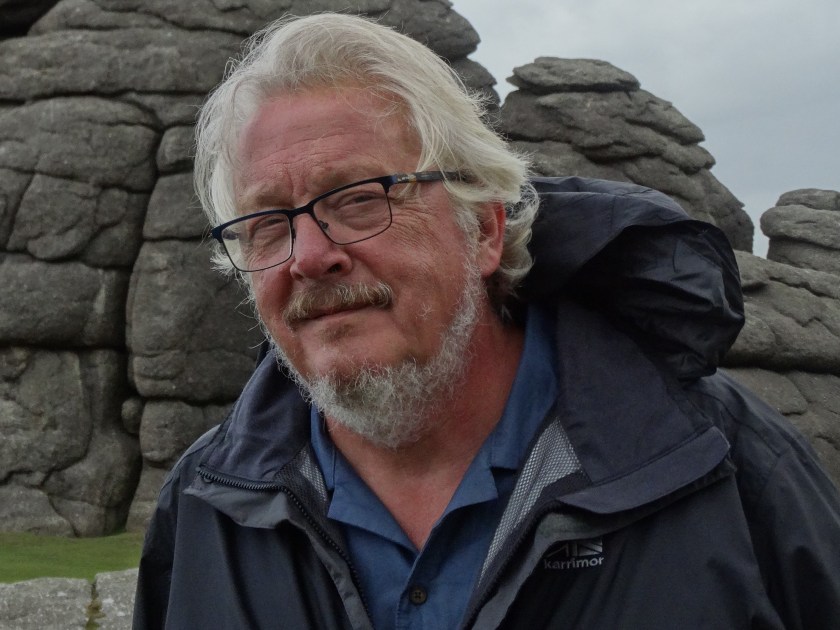
by Hayden Trenholm
Hayden Trenholm recounts his long and continuous journey through science fiction and progressive politics. Read his latest story, “Carter’s Refugio,” in our [September/October issue, on sale now!]
The Greek philosopher, Heraclitus, said: The only constant is change.
I feel seen.
I have lived in eight communities in six provinces and territories in Canada. I have degrees in two completely different fields. I have had at least five distinct careers and something like fifty different employers, including myself. I was the worst boss. I’ve even been married four times—though I seem to have finally got that right.
Through all this, there have only been two constants: my love of and engagement in science fiction and my belief in the power of progressive politics. I’ve always felt the two things were connected though I may be biased. Certainly not every science fiction fan or writer thinks that way.
I can’t remember precisely the first science fiction novel I read—it may have been Robert Heinlein or Isaac Asimov but there is a good chance it was Andre Norton; she was certainly one of my early favorites and I still have a first edition copy of her Witch World. I was about ten in any case, because I was getting most of my books from the Lay Library in Amherst, Nova Scotia, which was replaced by a new modern facility before I turned 12.
I remember climbing the stairs and browsing the stacks and seeing a whole row of books with little pink stickers of rocket ships on the spine. It was my first experience with the genre ghetto (though I certainly didn’t think of it that way). The librarian and my parents were just happy I was a voracious reader, not just of science fiction, but of any other book I could get my hands on.
Science Fiction was my first and deepest love and I read everything from Mary Shelley to HG Wells to the pulps of the 30s, the Golden Age of the 50s and the New Wave of the 60s. Harlan Ellison, Ursula LeGuin, Phillip Jose Farmer, Samuel Delaney, Octavia Butler, Michael Moorcock and a host of others, influenced my taste and stimulated my thinking about the future.
As a teenager, science fiction and its relatives, fantasy and comic books, drove a lot of my decisions, not all of them good ones.
My lust for more and more books made me into an entrepreneur. I picked and sold berries, mowed lawns, shovelled snow, anything to get money. By fourteen, I was selling greeting cards and novelties door to door and probably knocked on half the doors in my town of 10,000. And almost all of it went into books and comics (and chemistry sets and telescopes). By 16, I had a regular part-time job working at the best of all possible places—the public library.
I’m pretty sure I wouldn’t have done any of it if it weren’t for science fiction, because, if truth be told, I am an incredibly lazy person by nature. But human nature can’t defeat science or, it appears, science fiction.
Science fiction also drove me, at the age of 13, to regularly hitchhike 50 kilometres (keeping it a close secret from my parents) to visit the United Book Store in Moncton to buy used paperbacks and search through the stacks of old comics for gems at a nickel a piece. I actually bought Journey into Mystery #83, the first appearance of Thor, which, apparently, is now worth about $200,000. I wish I still had it but . . . well, I mentioned the previous marriages, right?
It also led me into my only criminal act. I was in a bookstore and there were 3 SF books I absolutely had to have, but I only had money for two. So, I bought two and stole the other one. It was so easy I did it once again, but then my conscience got the better of me. Sort of. I wanted to go back and pay for the stolen books but was too embarrassed. It is a stain I shall carry to my grave.
Science Fiction was my first and deepest love and I read everything from Mary Shelley to HG Wells to the pulps of the 30s, the Golden Age of the 50s and the New Wave of the 60s.
On the brighter side, science fiction stimulated my interest in science. As a kid, I had several increasingly complex chemistry sets, a microscope, two telescopes, electronics kits and stacks of science books. Many were presents from my working-class parents; the rest I bought myself. My father would also use his pocket knife to donate blood and skin cells for me to examine with my microscope and to make crude drawings of the result.
I excelled in school, especially in math and science, and went on to take a B.Sc. in Chemistry, under full scholarship. That led to my very first publication—not a science fiction short story but a co-authored paper in the Canadian Journal of Chemistry. A career in chemistry seemed on the horizon but it was not to be.
I mentioned my belief in the power of progressive politics, quite a leap of faith growing up in the most conservative place in Nova Scotia. I served on my first NDP (our social democratic party for American readers) constituency executive at 14, helped organize a student strike at seventeen and attended my first provincial political convention later the same year. I took political science and sociology courses as my “arts” electives and, in my fourth year, I switched from Chemistry (though I did finish my BSc) to Social and Political Thought and then went on to do my Master of Arts in the same area. I was accepted to do a Ph.D but change, change, change.
Instead of studying politics, I ran for office—twice. Although I didn’t win, the experience started a decade of involvement in electoral politics, unionism, and a wide range of social causes and government work.
Even though I spent my twenties enmeshed in politics and public service, I didn’t forget my first love. In 1979, I attended my first science fiction convention in Halifax where I met Spider and Jeanne Robinson and Theodore Sturgeon. My first Worldcon was in Baltimore in 1983 where I had a brief encounter with Isaac Asimov. Since then, I’ve attended dozens of conventions across Canada and the USA and nine WorldCons, as well. I started as a fan and con volunteer and organizer but, as I started writing my own stories in the early 90s, I graduated to panelist and, even Guest of Honour at a couple of smaller conventions. Along the way I met mentors who became friends, indeed some of my closest friends came to me through science fiction, including Robert Sawyer, Matt Moore and of course, my wife and sometimes writing collaborator, Liz Westbrook-Trenholm.
It somehow seemed inevitable that I would take one more step in my ever-changing relationship with science fiction. When the opportunity came to buy the publishing house that had nurtured my first novels, I seized it and spent 8 years as publisher and managing editor running, with Liz and Mike Rimar, Bundoran Press. I did that while still working on Parliament Hill for 15 years, advising an indigenous Senator from the Northwest Territories.
But what does it all mean? All this change; all this constant engagement in science fiction and progressive politics. I said I think they are connected. The connection is the future. Science fiction at its best, like politics at its best, is always about the possibility of a better world. Even when science fiction delves into dystopia and the real world seems to be following its lead, there is always a light somewhere, the belief that people of good will and determination can find a way through, the crisis can be solved and the disaster averted.
Maybe that seems jejune. Maybe I only have hope and faith because I’ve lived a charmed life. Or maybe not. My father died when I was 24; my mother fell into dementia. I participated in the wreck of three marriages. I have twice been so broke, I didn’t know where next week’s meals were coming from. I was an eyewitness to the murder of Corporal Nathan Cirillo at the War Memorial in Ottawa. I have fought for causes that failed. I have lost family and friends to death and dispute.
But I still believe that tomorrow can be better than today. I still believe that I can write a story or a polemic that will make a positive difference to someone somewhere. I still support causes, even seemingly lost ones, with my voice, my vote and my money.
I still believe and do those things because science fiction told me that that is the way the world can work. Science fiction fundamentally believes in the future. Therefore, so do I.
To finish with a quote from another philosopher.
The future’s so bright, I have to wear shades.

