
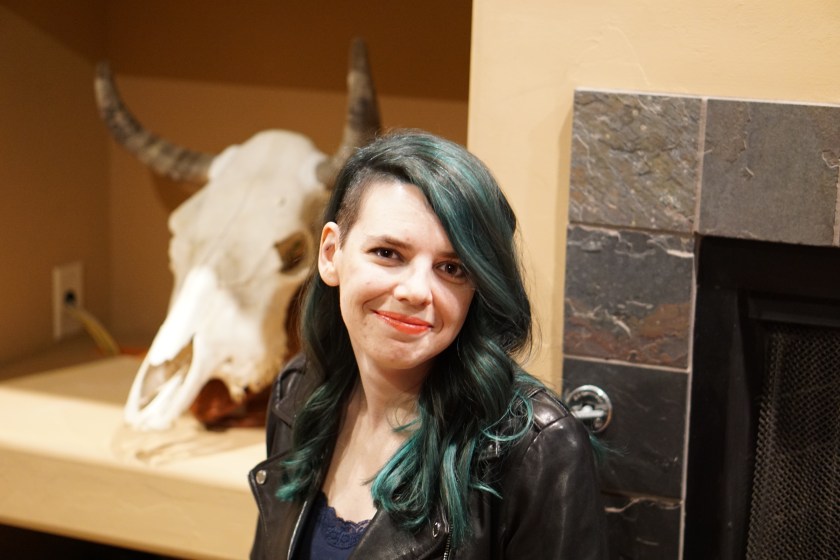
Tiffany Fritz makers her Analog debut with the short story “North American Union v. Exergy-Petroline Corporation” in our [May/June issue, on sale now!]. In this extensive interview, you’ll learn about Tiffany’s background as a writer and educator, while she also goes over how one of her poetry professors convinced her to submit “North American Union…” after she had thought it was “too weird” for publication.
Analog Editor: How did this story germinate? Was there a spark of inspiration, or did it come to you slowly?
Tiffany Fritz: So this was a weird story because it actually came to me all at once. Usually I’m the kind of person to do a lot of brainstorming and prewriting, but with “North American Union v. Exergy-Petroline Corporation,” I just sat down and cranked it out in like a six-hour marathon.
But sitting down to write felt like purging ideas that had, conceptually and emotionally, been percolating for a while, like powerlessness in the face of inadequacies in the bureaucratic and governmental systems that are supposed to protect us and make society function. A lot of structures have been failing lately, or acting too slowly to prevent harm, and the decisions are coming from people totally removed from the consequences. So when I finally sat down, I just imagined the quintessential example of too-little, too-late responses to preventable disaster.
AE: What made you think of Analog for this story?
TF: After I wrote this particular story, I immediately trunked it—I thought it was too weird to be publishable. But a few years later, I mentioned it to a poetry professor, and he was like,
“That sounds awesome!” So, thank you, Joe Harrington, for encouraging me to send it out.
Analog was actually my first thought. I’d followed the magazine for a few years, but felt skeptical about whether I’d ever personally write an Analog story, since the magazine has a reputation for very hard sci-fi. I had (have) a lot of hang-ups about hard sci-fi, to the point it seldom occurs to me to approach ideas from that angle. It’s like my internalized sexism constructed this kind of invisible mental block of pre-conscious self-rejection. But now here I had a story about the future of how science impacts litigation and legislation. What’s harder than that?
AE: How much or little do current events impact your writing?
TF: We’re so inundated by the endless news cycle of doom scrolling social media that I think it always comes through unconsciously. But in this story, which I wrote in September 2020, it was very conscious. It was the hottest September on record, and Trump was finishing his first term with talk of OPEC and energy jobs.
The Supreme Court had just halted construction on the Keystone Pipeline some ten years into the project. It hadn’t leaked yet, but indigenous peoples and climate advocates had been objecting to it for years. I have family in North Dakota, which made for a lot of heated conversations about it, especially after I read Cadillac Desert: The American West and its Disappearing Water and learned this wasn’t the first time that U.S. infrastructure projects destroyed reservation land.
Then news of the settlement for the people of Flint, MI came out. I was gobsmacked. Six years to settle a poisoned water supply, which had only just been cleaned up. The lead pipes tainted the water into 2019, but the settlement terms required adults to provide proof of a related personal injury, as if anyone could live there unaffected. That exigence all directly informed this story, from the timelines on the climate disaster, to the milquetoast response from the Supreme Court.
AE: Are there any themes you find yourself returning to throughout your writing? If yes, what and why?
TF: Usually, I focus on really personal stories that use fantasy elements to explore complex trauma and the ways it resists tidy resolution and closure, so this particular story is actually pretty far outside of my comfort zone. I love reading society-level storytelling like The Expanse and Brave New World, but I’m afraid of getting it wrong with the nitty-gritty of government and trade and industry and science. Historical fiction and hard sci-fi readers intimidate me: they know more than I do, so I’m afraid of disappointing them.
But this story was the start of my tendency to experiment with form. I’ve been inspired by stories like “STET” by Sarah Gailey, “Four Glass Cubes (Item Description)” by Bogi Takács, and “Welcome to Your Authentic Indian Experience” by Rebecca Roanhorse. I love when stories hide inside the structure of other writing genres–hermit crab stories, they’re called, which I think is very cute.
AE: What is your process?
TF: Mostly rage. I’m kidding, but not entirely. All writing comes from strong feelings, and for me, that’s often a sense of injustice. When I was younger, I was always asking, “Why is the world like this?” in a rhetorical, accusatory sense. During my MFA program, a professor described a story of mine as “polemical.” I’ve never wanted to write something preachy or hamfisted, so while that question is still my starting point, I try to pull back and slow down during prewriting to ask more genuinely: “Why is the world like this?” That question suggests a theme or conflict, and from there, I develop a character whose arc grapples with it. Occasionally, like with this story, the form asserts itself above all of that. Those are usually my favorite stories.
AE: What other projects are you currently working on?
TF: When this story comes out, I’ll be defending my MFA thesis, which is a very queer, very disabled fantasy novel told via court documents from a magic council hearing about the misconduct of a monster hunter. Since one element of that misconduct is a sapphic enemies-to-lovers romance with a demon, I feel like framing it through court documents really illuminates the ways that queer and disabled people have to stand trial and defend our rights to live and love.
Most chapters are transcriptions of the first-person oral testimony from witnesses, including the defendant, who is the protagonist, telling her story. But her account is mediated along the way by other sources of evidence, so some chapters are documents like forms and receipts and an autopsy report. They’re not for flavor, though: they actually move the plot in some places. Instead of hearing about the protagonist uncovering a plot reveal, the reader can experience it with her by reading the document for themselves. I have no idea how I’m going to find an agent for it.
I’ve played a lot of tabletop, including through text-based mediums, so I’m really interested in the opportunity for prose to do something pseudo-interactive. Film projects like The Boys have deployed this kind of strategy via promotional campaigns, and video games are famous for this with, like, finding newspapers on the benches at abandoned ferry landings. But I think prose writers can really immerse readers in the world by presenting a realistic piece of fictional rhetoric with depth to analyze.
All writing comes from strong feelings, and for me, that’s often a sense of injustice. When I was younger, I was always asking, “Why is the world like this?” in a rhetorical, accusatory sense.
AE: If you could choose one SFnal universe to live in, what universe would it be, and why?
TF: I’m just now realizing how many science fiction stories feature fundamentally broken worlds that are incredibly hard to survive in! I think my best odds are probably in Star Trek. Everyone’s got their basic needs met and human rights assured. Steer clear of StarFleet Operations Division, and you’re fine, right? On the other hand, I’d probably feel most at home in the Nine Houses of the Locked Tomb series.
AE: What are you reading right now?
TF: I just wrapped up Kate Elizabeth Russell’s My Dark Vanessa, which rewired my brain (affectionate). Next up is either Nghi Vo’s The Brides of High Hill, which I’m leading a virtual book club on via the Gunn Center for Science Fiction in April, or Neon Yang’s upcoming fantasy novella, Brighter than Scale, Swifter than Flame, which I lucked into getting an advance copy of.
AE: Many of our Analog authors are interested in science. Do you have any scientific background, and does it impact your fiction?
TF: Some trivia: my first declared college major was biochemistry because I’d always excelled in math and science. That changed when calculus happened, but I think my love of the physical sciences still manifests in how I conceive second world ecosystems and how I conduct research. I recently spent an entire writing day calculating how far away a fictional mountain range would be visible, then another charting out various creatures’ travel speeds and distances.
My main scientific love is psychology. I lean on it really hard with critical trauma studies, but all writers really benefit from studying it. For some reason, I don’t know that we always regard it as science-y enough for science fiction on its own. It’s obviously integral to science fiction in many ways, but Kafka’s Metamorphosis still has supernatural body horror, and Le Guin’s “The Matter of Seggri” still has intergalactic second worlds. The Handmaid’s Tale is still set in the near-future. Even the psychological what-ifs of Severance are premised on a new medical technology.
AE: What careers have you had and how do they affect your writing?
TF: After biochemistry didn’t work out, I gave up being a rich doctor and asked myself a question that feels very millennial now: if money weren’t real, what would I do every day? My answer was reading, writing, and teaching. So after I graduated and escaped the bowels of retail hell, I taught English at a public high school. I taught through national teacher strikes, Covid lockdown, and hybrid before finally burning out.
When you meet and work 4-5 hours a week with 150 new people every year, you really get an idea of how your culture and historical context inform the way you approach the world. But I also think good teaching, like good GMing, is a lot like good writing. A guiding hand is necessary, but students, readers, and players all need to feel like they worked for it and got there on their own. So we have to become invisible. The very real and immediate audience of both teaching and tabletop has also helped me with clarity: these audiences have a practical need to understand you, but they’re easily bored and will disengage if you don’t deliver well.
AE: How can our readers follow you and your writing (I.e., social media handles, website URL…)?
TF: Right now, I’m most active on Bluesky at @tifawrites.

