
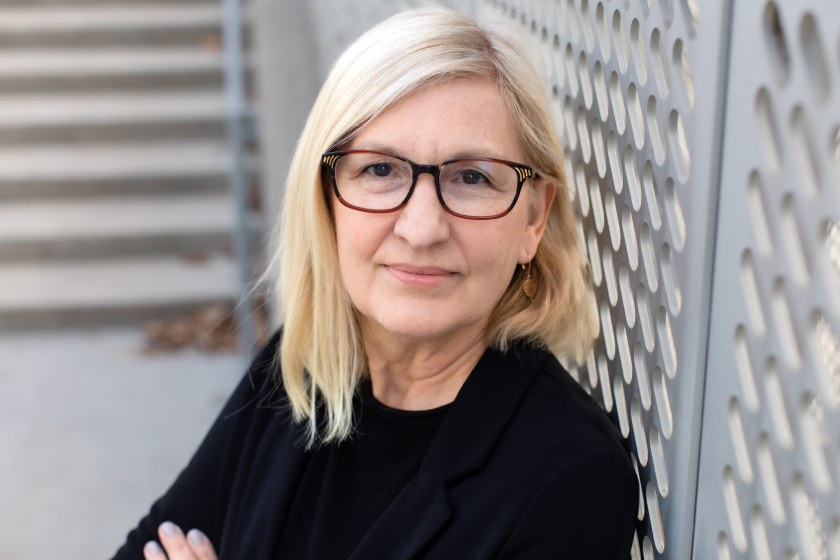
Lettie Prell returns to Analog with “Conversations With Callie, or The Synthesis of Disdain and Love” in our [July/August issue, on sale now]. In this interview, she digs into the inspiration for the world she’s created, and the title and the idea behind the story.
Analog Editor: How did this story germinate? Was there a spark of inspiration, or did it come to you slowly?
Lettie Prell: I used to be a serious amateur photographer, with my own darkroom and everything, and perhaps as a result, that spark of inspiration for me often comes in the form of a strong visual image. In this case, I saw an old couple sitting in front of a television and watching a young girl on the screen. I understood the girl was their daughter from long ago, and her mind had been uploaded into a computer. I felt the parents’ loss, not having their child with them anymore, even though they’d saved her life. Then I started thinking of how an uploaded child’s mind might behave in a computer environment, versus an adult mind. The story took off from there.
AE: It’s an interesting title. How did it come to you?
LP: I always liked reading stories and novels where at some point, the title appears in the narrative. There’s a satisfying feeling to that. In this case, “Conversations with Callie” is the name of the documentary the father makes about his daughter. Yet that title seemed incomplete to me, too generic. What comes after the or in the title also appears in the story, farther along, and that, I hope, carries a bit of strangeness that’ll interest the reader and draw them in. In any case, “Conversations With Callie, or The Synthesis of Disdain and Love” is absolutely my longest title to date, not that I’m trying for a record or anything.
AE: Is this piece part of a greater universe of stories?
LP: Yes, this is the same world as “Baby Steps” (Analog November 2015), “Uploading Angela” (Analog May/June 2021), and “Live Update” (Clarkesworld September 2022), at different stages in my PHI Center’s future. I was actually writing a novel version of Callie’s story when “Baby Steps” came out. The novel never worked, no matter how many times I revised it. Yet somehow, I couldn’t let it go. I’m glad I was finally able to tell her story well.
AE: That’s a long span of time to be writing in a world. Who or what are your greatest influences and inspirations?
LP: That’s usually one of the most awkward questions for a writer to answer, but in my case and on this particular sfnal subject, the seed of inspiration was planted when I read an interview with Ray Kurzweil in Omni Magazine in—brace yourself—the 1980s. It introduced me to the concept of uploading one’s mind into a computer, and I had a strong visceral reaction to it. On the one hand, I was utterly fascinated, and on the other hand I found it all deeply disturbing. These two opposing forces simply stretched me. I’d already started to write as a creative outlet from my statistics and research career in the Iowa justice system, and I tinkered with a story or two along these lines. Then in the late 1990s or early 2000s, I came across a copy of Kurzweil’s The Age of Spiritual Machines in a used bookstore and grabbed it, and that launched a thought experiment that spawned worlds of story.
AE: So uploaded human consciousness is a theme that runs through your writing?
LP: Yes indeed. The PHI Center is one of the worlds I created to explore the technological singularity. I also have stories out featuring people being instantiated into synthetic bodies. My story, “Artifice of Eternity” (Analog May 2016) is one of them, and it features a court case. I have another justice system story out in the world as well, by the way. Perhaps I’ll come back to the justice theme at some point. After all, I made a thirty-plus year career in justice system research, and social science fiction is rich territory for viewing our present-day society through a different lens. And there I go with a camera analogy. I’m still thinking like a photographer, I guess.
AE: While we’re on the topic of writing, do you have any advice for up-and-coming writers?
LP: Don’t wait for some ideal time to write. Start today. When I was working fulltime, I’d often write in the evening after supper, or even later.
Be patient, don’t get discouraged, and get out there. I started writing science fiction and fantasy in my late 20s, and made my first professional sale in my early 40s. Before then, I had stories published in smaller publications. In the 1990s there was a whole zine scene, with these often-free little home-grown publications going around everywhere. I had a lot of stories in those. Be on the lookout for even the small places that publish what you write, and submit to them. Also, go where the writers are. Go to science fiction and fantasy conventions, and get on the program. I was talking about science fiction at WisCon years before my first pro sale.
Finally, know you’re going to have ups and downs with writing and publishing. I had a two-year period in which six of my stories saw publication, and of those, half were reprinted in “best of the year” anthologies. Then there was the year and a half where I didn’t sell anything at all; that dry spell ended with a story published in WIRED magazine of all places.
AE: What are you reading right now?
LP: Death of the Author by Nnedi Okorafor. Before then it was a fantasy novel, The Winter Boy, by Sally Wiener Grotta, which thankfully broke a reading dry spell I’d been in.
AE: How can our readers follow you and your writing?
LP: My website, Lettie Prell, contains an occasional blog post, a list of my publications (many with links), a list of my appearances, and more. I’m on regularly on Facebook (lettie.prell), and less often on Bluesky (@lettie-prell.bsky.social), Instagram (lettie555), and Threads (lettie555).

