
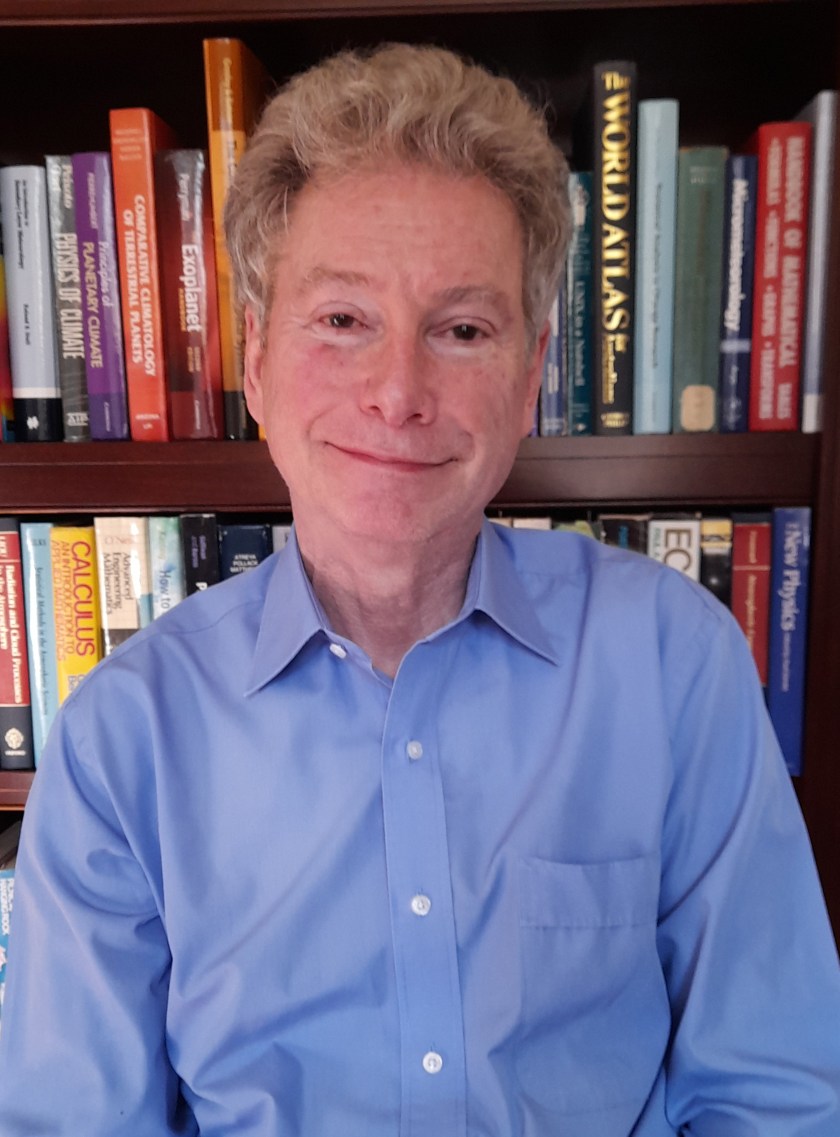
Climate scientist Kevin Walsh has been contributing fact articles to Analog for over twenty years. Now, in our May/June issue, he makes his fiction debut with the short story “Nirvana and Mr. Sparks.” Learn all about how this story came to be in this exciting Q&A
Analog Editor: What is the story behind this piece?
Kevin Walsh: When I was a carer for my late wife, I began to think about what it would mean if a life of service were intrinsic to someone’s very nature, and what might happen when that ability to serve was taken away. Also, I was reading about the upsurge in adventure tourism to Antarctica and thought that setting the story on Mars in the not-too-distant future was a natural extension of that concept.
AE: Do you particularly relate to any of the characters in this story?
KW: Strangely enough, the robot. I’m not sure what that says about my personality.
AE: What is your history with Analog?
KW: I’ve been a contributor of science fact articles since 2005, with sixteen articles accepted. They are about the environments of extrasolar planets, and while they are based on recent scientific results, they also contain a fair amount of speculation on what those results might mean. I also try to incorporate relevant references to science fiction. More recently, I started to write some fiction myself, and “Nirvana and Mr. Sparks” is my first story to appear in Analog.
AE: How much or little do current events impact your writing?
KW: I don’t incorporate many ideas from current events, as I prefer to focus on issues that have been around ever since humans started using tools. Recent scientific developments are crucial sources of inspiration too, but I’m cautious about using ideas that might become dated (I know, that’s often impossible to guess).
AE: Are there any themes that you find yourself returning to throughout your writing? If yes, what and why?
KW: One recurring theme is how individuals and groups deal with a challenge, either physical or mental. I like to write about characters who find themselves in strange environments and situations where they don’t immediately know what to do. That sometimes forces them to make bad choices. I also like to write about why humans often make decisions that are not motivated by logic.
AE: How did you break into writing?
KW: In 2004, I read a paper by Sean Raymond about some fascinating new simulations he had performed of planetary formation. These produced worlds of different sizes, climates and water contents. I had been reading Analog since I was in high school, so on impulse I wrote a science fact article based on the paper and sent it to Stanley Schmidt when he was editor there – by snail mail in those days (my, how things have changed). To my complete surprise, he liked it and published it.
I also tried writing fiction some decades ago, but those short stories were pretty one-dimensional. In the past couple of years, I decided to try again, using various internet tools to find places to publish. So far, I’ve had four short stories accepted by paying markets, with Analog the best known of these.
AE: What inspired you to start writing?
KW: I started writing non-fiction because I was thrilled by new scientific results that finally enabled us to say something concrete about the environments of extrasolar planets.
I started writing fiction seriously in the last few years, in between my duties as a carer. I was experiencing quite a bit of emotional turmoil at the time and decided that writing fiction might be a good outlet, and a worthwhile activity that I could do while still being an attentive carer.
AE: What other projects are you currently working on?
KW: I have a few short stories out there for consideration, about half science fiction and half fantasy. Some of the science fiction stories are set in a universe where humans are settling the galaxy for the first time and encountering serious challenges in doing so. The fantasy stories are mostly set in a republic where witchcraft largely replaces technology, but not entirely and not easily. Conflict arises from this tension between technology and witchcraft. I’m also revising a novel set in that universe.
But I’m still learning! Fiction is a lot harder to write than non-fiction. Non-fiction is largely about telling people stuff in a way that is clear and compelling. You don’t have to worry about characters, plot, pacing, all of things that make fiction interesting and exciting to read. But I do like a challenge.
AE: What SFnal prediction would you like to see come true?
KW: Faster-than-light travel to other stellar systems. Currently, there is the glimmer of a theory that enables this, but no practical method. There may never be one if it requires too much energy. Archimedes once said, correctly, that if he had a lever long enough and a fulcrum in the right place, he could move the Earth. The problem isn’t the theory: the problem is building the lever.
AE: Many of our Analog authors are interested in science. Do you have any scientific background, and does it impact your fiction?
KW: After degrees at Harvard and M.I.T., I did a PhD in meteorology at the University of Melbourne. I worked there for about fifteen years, teaching and doing research on tropical meteorology and climate, with the occasional foray into planetary science. I’m still a full professor there, but currently I have a post-retirement fellowship. Basically this means that the university gives me an office and some facilities in exchange for work that benefits both of us.
As a working scientist, I like my stories to have characters whose actions are based on what they know, and how they use that knowledge to solve problems. Even in my fantasy stories, the characters work within a large knowledge base of witchcraft that is derived from fundamental principles resembling those of science.
AE: How can our readers follow you and your writing? (IE: Social media handles, website URL…)
KW: You can find my list of articles and stories here.

