
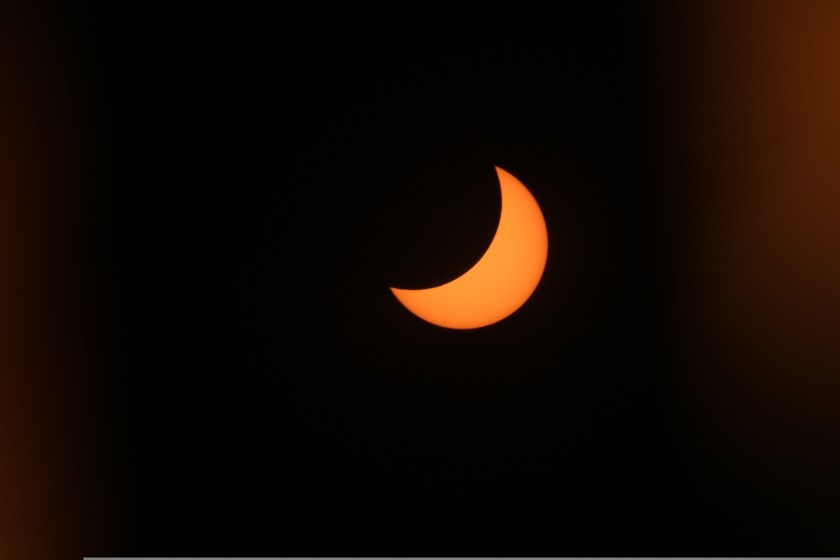
Michael Johnston talks about experiencing the 2024 solar eclipse and how that impacted his story “Lessons in Orbital Mechanics”, published in our [May/June issue, on sale now!]
By Michael Johnston
People who write science fiction don’t often get the chance to experience the things they write about. I did. In 2017, I published a novel titled Soleri (Tor), about an ancient sun-worshipping society whose culture revolved around an annual eclipse. At the time, I’d never seen one. I assumed, correctly, that they were rare, and, not so correctly, that I’d never get the chance to witness the event.
Fast forward to April 2024, when an eclipse would be visible in much of the United States. As it happened, the path of totality would pass directly over my childhood home in rural Ohio. Given that, you might think I was planning to see it, but I live in California now, and the eclipse was pretty low on my list. Fortunately, I have a brother who works at NASA and had taken up solar astronomy during the pandemic. He told me I needed to fly home to see it. He planned to show up with a carload of equipment, including a hydrogen-alpha telescope that would allow us to look directly—well, through a screen—at the Sun. I took the advice.
What I experienced will make more sense if I tell you more about the novel, Soleri. Inspired by the mechanics of the Egyptian calendar, I envisioned an ancient society that revolved around a yearly eclipse. Total eclipses are relatively rare. If you live in one place, as some ancient people did, you might never see one. Being in a location where it happened yearly, and at roughly the same time, would have a fairly dramatic effect on the people living there. I imagined that the constant spectacle would be the defining trait of the civilization.
In April 2024, I had a chance to test out the idea, or at least a part of it. We set up two telescopes that day. One was connected to an SLR camera, and the other was the hydrogen-alpha telescope, which we viewed on a laptop. We also had a colander. The tiny holes would act as pinhole cameras, casting images of the solar eclipse on the ground. The weather was good, the skies clear. The eclipse came in stages, moving more slowly than I’d guessed. At the start, we experienced something similar to sundown, but the whole thing was compressed into a few minutes. It was truly uncanny. The animals thought it was strange too. Dogs barked. Birds sang, thinking night had come. Then it happened. The sky turned a twilight shade. It wasn’t night, but instead some hazy in-between, an indeterminate twilight hour that doesn’t exist in our normal experience. The Sun went from a blazing sphere to a silvery ring. And briefly, everything was quiet. The neighbors gasped. Some scattered clapping echoed in the distance. A hush fell over the hilltop. With the Sun blocked out, minor phenomena came into view. Red jets of flame, visible to the naked eye, erupted from the edge of the Sun. That alone was jaw-dropping.
Somewhere in the middle of it all, I realized I’d missed the mark in my first novel. The eclipse, and the experience of seeing it, was far more profound than I had imagined. For me, seeing the Sun turn dark was the closest I had come to witnessing magic.
What do I mean by that? Here, magic isn’t a sufficiently advanced technology (sorry, Arthur C. Clarke), but it might be a sufficiently rare phenomenon, something most people never experience.
The eclipse, and the experience of seeing it, was far more profound than I had imagined.
I’d learned something, and I wanted to write something new.
Lessons in Orbital Mechanics isn’t epic fantasy. It’s set in the near future rather than the distant past. And instead of a novel built around a vast and ancient culture, it’s a contemporary story revolving around two characters. From when they met to what might be their last day, their lives have, in one way or another, revolved, like the civilization in Soleri, around the experience of seeing an eclipse.
There are actually two eclipses in Lessons in Orbital Mechanics, one at the start, and another at the end. The story is what happens between. They’ve seen something magical. For them, magic is real. Not as something mystical, though. The characters are scientists. Magic is that sufficiently rare phenomenon: stuff that just doesn’t happen to normal people, events so unlikely that we assume we’ll never experience them.
In the time between those two eclipses, the characters have grown up, left college, found jobs, had a family, and experienced a terrible loss. They’ve lived through their share of sufficiently rare phenomena—some good and some bad. As the story mixes scenes from the past and present, we visit the pair at every stage of their lives, contrasting their past against the present where they face one final, and completely impossible, decision. For anyone else, their decision process might have been different and more rational. But for these two characters, for these people who have seen an eclipse, they know that sometimes things that seem impossible can and do happen. They believe in a kind of magic and take a chance, hoping to achieve the impossible and survive.
They are people who have seen an eclipse and were changed by it. I’m one of them.

