
Zach Poulter reflects on advances in technology, the consequences, and how that compares to the current push of AI. Read his story “Imprint” in our [May/June issue, on sale now!]
By Zach Poulter
Rumination One.
In 1897, Princeton Mathematics professor Charles Hinton invented a device that promised to revolutionize America’s pastime. The “mechanical pitcher”—essentially a large-bore gun that fired baseballs—was capable of adjustable speeds up to seventy miles per hour, could pitch both fastballs and curveballs, and terrified every batter who stared down its barrel. Although primarily used for practice, the machine reportedly pitched several innings in a 1900 game between the Memphis Chicks and the Nashvilles, striking out two players and allowing three hits. (Not an amazing record, but hey, it was a rookie at the time.)
Today’s pitching machines—sans gunpowder—can throw almost every conceivable pitch, at speeds well in excess of a hundred miles per hour, with the practical upper limit being only the safety of batters. Pitching machines are widely used for recreation and training, from youth leagues to the pros. They’re almost everywhere. But not in games. (With the exception of some youth leagues, where machine-pitch creates a safer experience for batters while their pitching peers develop their control.) Because the use of pitching machines is relegated to a specific purpose, with clear limits for user safety, the technology serves to greatly enhance training and recreation, rather than stifle it.
In case you didn’t guess where I’m going with this: I consider this approach a best-use case for Artificial Intelligence. Implementing AI to enhance human pursuits, with clear guardrails for user safety, has tremendous benefits. And it’s already happening.
Rumination Two.
My grandfather was born in 1909 in a home without running water. For most of his working life, he ran a small family farm in Southeast Idaho. Decades later, Grandpa told me fondly of his father’s giant Percheron draft horses that pulled plows and wagons, and of harvest times when the whole community came together to bring the crops in. To my surprise, Grandpa was far less positive about the days when tractors became part of farming. “Put a lot of good men out of work,” he’d say sadly.
Yes, those good men largely found other work, eventually. People adapted and society adapted and the world greatly benefited from innovations in agriculture and food production. (This era is often termed the Third Agricultural Revolution, or Green Revolution.) But it was a difficult transition, and despite trillions of dollars’ worth of increased agricultural profitability, it wasn’t family farmers who got rich (and certainly not farm workers). As users of the technology, they became wildly more productive. . . but the profits from their productivity flowed mainly to the top of the economic food chain.
This is also AI; the price of progress, as they say. It’s already happening. I suspect we ain’t seen nothing yet.
Technology can get better while also working within limits to promote the safety and well-being of its users.
Rumination Three.
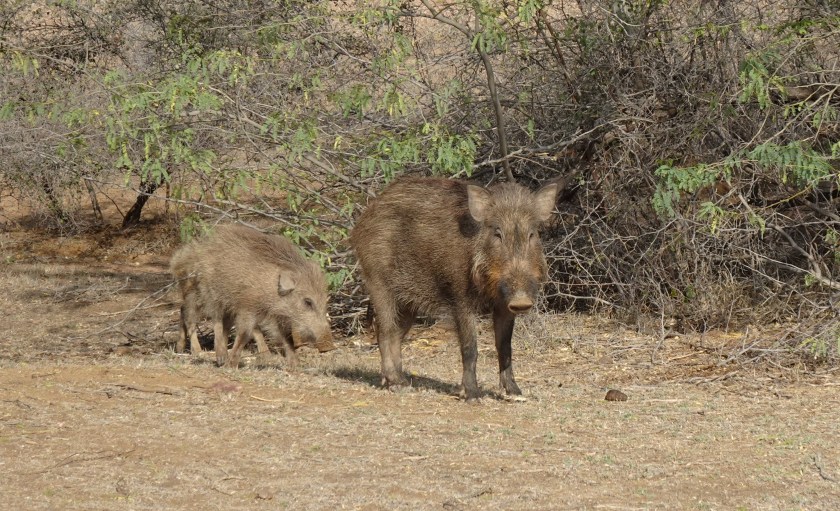
Feral swine exist as invasive species almost everywhere in the world. Canadian ‘super pigs’ were originally crossbred in attempts to enhance cold-climate pork production. In India, the swelling wild boar population likely came from animals let loose for hunting. On every continent except Antarctica, feral swine are decimating crops, fouling water supplies, and harming native flora and fauna. They are difficult to kill. They are aggressive toward humans. They are spreading.
Like the venomous cane toad in Australia, the gluttonous lionfish in the Caribbean, and countless other invasive species, the spread of feral hogs is the unintended result of intentional human action. In an effort to solve a problem, we inadvertently create a far greater one, which we can only curtail with tremendous difficulty, if at all.
This is also AI. It’s happening already, but we’re mostly in the early stages where it all seems manageable. The benefits! The BENEFITS! THE BENEFITS! (the cost)
RUINATION?
Artificial Intelligence arguably holds more promise than any previous technology. It will enhance human performance and disrupt every industry. Its arrival is faster and more widespread than any invasive species. But a technology that promises to alter the way humans work, recreate, interact, and think doesn’t come without costs. And the costs of AI? You can’t get far in any discussion of them without realizing they are potentially disastrous to the way we work, recreate, interact, and think. And, yes, even survive.
CHANGE, we are told (by those selling it), is inevitable. “We must because we can,” is a seductive rationale, but a damning one. Progress and change aren’t the same thing. Healing is change. So is cancer.
It brings to mind the old song about the Old Lady Who Swallowed a Fly. Then she swallows a spider to catch the fly. And then a bird to catch the spider, and a cat to catch the bird. And so on and so on, with each refrain echoing “perhaps she’ll die.” Until she does.
The AI hawkers insist we have to swallow everything because we’ve already swallowed the fly. But we are allowed, individually and collectively, to pause and think. To decline the next course, or insist on better options.
If AI can do all that’s claimed, it’s imperative that we decide NOW which parts of our lives it’s allowed to disrupt. It’s essential that governments and industry help people retrain and prepare. It’s vital that limits to AI’s power are set and enforced.
All of which, if we believe the people selling it, is impossible.
But when was the last time you saw a gunpowder pitching machine play in the World Series? A mob of unemployed farm workers? Technology can get better while also working within limits to promote the safety and well-being of its users. (Conversely, can we consider a technology improved if the net effect harms its user? Should “building a better mousetrap” involve sticks of dynamite?)
The AI age is being thrust upon us. The good news is that we’re only one verse in, and can still choose what comes next. But not for long.
There was an old lady who swallowed a fly.
I don’t know why she swallowed a fly.
Perhaps she’ll die. . . .

