
In this special post, Kelly Lagor interviews renowned SF author Adrian Tchaikovsky on a range of topics, from his background in zoology and psychology, to the biological concepts that inspire his work, to the value of presenting science accurately in speculative fiction, and much, much more! You can read Kelly’s analysis of Adrian’s 2024 novel Alien Clay in our Sept/Oct issue, on sale now!
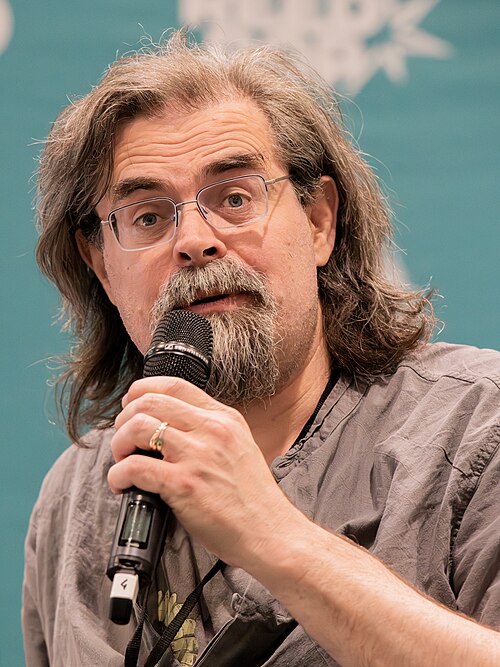
Kelly Lagor: I wanted to get your thoughts on biology as metaphor. Did you find you started writing about biology pretty early on in your writing career, because you found so much inspiration in it?
Adrian Tchaikovsky: I started off as a fantasy writer. I did a ten-book epic fantasy series called Shadows of the Apt, but all of the different types of people in that setting are types of insects and spiders and things like that. There are mantis-people and insect-people. They are human, but they have abilities they draw from these things. So, even with my fantasy work, I’m very much doing bug science.
KL: You studied zoology initially?
AT: Yeah, zoology and psychology.
KL: That’s a great combo. What drew you towards zoology?
AT: I grew up with David Attenborough, nature documentaries, Gerald Durell, that kind of thing. I’ve always been fascinated by the natural world since as far back as I can remember, and certainly, the biological sciences were always enormously interesting to me, very much in a way the degree course unfortunately didn’t satisfy. I was the standard kid who loved dinosaurs, as many of us were, and that didn’t go away. I’m also the kid that liked bugs. I became fascinated by things like the Cambrian explosion and Stephen Jay Gould’s Wonderful Life and things like that.
KL: Why did you study psychology?
AT: I’d become interested in psychology as a discipline a few years earlier—it felt like a natural extension of my interest in biosciences via animal behavior. I’d also read books like The Man Who Mistook His Wife for a Hat by Sachs, and that sort of (in retrospect sometimes lurid and sensationalist) account was very interesting. There is a side to psychology that retains a bit of the Victorian sideshow designed to fascinate more than educate. As it happened, the course content at university didn’t really tick any boxes for me, and I came out of it rather disillusioned by the discipline.
KL: You have an apparent fascination with intelligence, particularly distributed intelligence. Where did that come from?
AT: I . . . honestly would find it remarkable, and a bit disturbing, for people not to be interested in the nature of intelligence. I’m not sure what could be more interesting! Distributed intelligence has been around both as a science-fictional concept, and more recently as a real area of study (drone swarms, etc.), so it’s a model of intellect very different to our own that’s also supported by scientific thought. Plus there’s the way it ties into things like social insect behavior, moving it right into my wheelhouse.
KL: Would you say your interest in the natural world informed your love of science fiction? Or did you get interested in them around the same time? Or was it the other way around?
AT: They were very much, I think, around the same time. In science fiction, I was always fascinated by the aliens and the monsters and things like that. And with the biological sciences, I was always fascinated by the creatures that other people generally didn’t like, like spiders, insects, so forth. That then very much came together when I started to put a lot of thought into evolving the alien, as Stuart and Cohen had in Evolving the Alien (2002).
KL: You’ve become one of my new favorite writers, because I also have a biological background, and you’re one of the few writers out there who’s writing about biology in such a crunchy but also metaphorical way. One of the things I’ve noticed is you clearly have a fascination with evolution, like the factors that determine emergent traits in species. I particularly loved the thought experiments in your Children of Time series where you took different Earth species, put them in different environments, and examine how intelligence and culture could evolve. I’m curious, was Alien Clay your first book where you designed an alien ecosystem from the ground up, or had you dipped your toes in before?
AT: It’s certainly not the first time. There’s a reason you don’t get to see as much of it as you do in Alien Clay, but there’s a reasonably detailed alien ecosystem on the planet Nod in Children of Ruin, the second book in that series. There’s also an alien world in the Expert Systems novellas. Alien Clay is, I think, the first book I’ve written where that is actually the main focus of the book, in the sense of the alien ecosystem as it exists without human meddling.
KL: I find it fascinating that in the in the billions of years of history of life on this planet, symbiosis happened successfully only once to create all eukaryotic life. So I’d like to talk about how you wove symbiosis into Alien Clay.
AT: There are a couple of major directions I’m going in here. First of all, it’s a reaction against the pop-sci view of evolution as Darwinism, as people generally interpret it, which is this sort of ‘nature red in tooth and claw,’ inherently zero-sum game competition, which is certainly the way evolution has been taught. The idea that the bigger, stronger thing survives and the other thing doesn’t. It’s also, as the book touches on, a view of evolution as manifest destiny that has been politically interpreted in various fairly damaging ways over time, pretty much from the moment Darwin started writing about it.
So, I wanted to challenge that by constructing a plausible evolutionary system that didn’t work by that kind of Darwinian competition. The other shoe is that people genuinely do not realize how interconnected life is on Earth. The incredibly complex interrelations that species have, and a number of them I include in the book when Arton is discussing ecology.
But we have this idea that even people who are aware of and accept the colossal damage we as a species are doing to our own world, we get fixated on “Save the whale” or “Save the panda.” Or even worse, the idea of reintroducing extinct species that aren’t even really the same as the thing that died out, like reintroducing a not-in-any-way-dire-wolf thing. It’s an utter scam that particular company is perpetrating by claiming they have recreated an extinct species. The idea that you can bring a species back and you have saved it is ridiculous, because as Arton says at one point in the book, “The unit of life is all life.” Certainly the unit of life in a given area is the ecology. We could probably do a halfway good job of recreating something that was mostly like a mammoth, but it wouldn’t be a mammoth because it wouldn’t be entering into a traditional mammoth lineage that would be passed down from mammoth to mammoth, like elephants do today. Having the genetic code does not create the creature. The creature is made by its interactions with other species, so you need all those species, too, because that is the environment it has evolved to be a part of.
Otherwise you are making, at best, something new, but probably making something rather sad and pointless. It’s this rather limited view that many people have of what the natural world is, and what it is to be a species, and how life works that I’m trying to explode by dialing it all up to 11, as we find on Kiln.
KL: Biology, above other sciences, I would argue, lends itself to social metaphor so much more strongly than math or physics. I really love how, in Alien Clay in particular, the biological and social themes dovetail particularly well. Can you tell me a bit about how you approached writing that?
AT: There was actually a lot of serendipity in that because the way I construct books a lot of the time is I have an idea for half a book. Then at some other point, another idea will glom onto it and, between them, they will make a book.
If I’m lucky, those two things will actually complement each other, which is what’s happened in Alien Clay. I had an idea where I wanted to do a straight-up evolutionary experiment with this weird world where everything was sort of a Lego of symbiosis. Then I had an idea to revisit the idea of an academic who’s been sent to a camp for political dissidents, but in this case, in a full-on space-faring science fiction world, rather than the kind of science fantasy I had in Cage of Souls.
Those two ideas clicked together. And obviously, what you have there is the Mandate, a tyrannical state that is very, very doctrinally dogmatic, who has the idea that we are able to define everything: this is this, that is that, and there is no gray area between them, which is obviously a thing we are seeing a great deal of in the real world.
There’s an enormous amount of stuff Arton gets into about the idea of why people need to justify what they do. If they’re not using religion to justify what they do, they’re using science to justify what they do, which is absolutely how you see evolution being taken out of context with different races, so to speak; of humanity being higher or lower on this sort of forward marching line, all of that old Victorian racism, which we are still very much the heirs to. I won’t overstate my creative gift by saying this was the plan all along, but it became very clear that the way the Mandate tried to enforce their reality on a much more fluid, real world was going to absolutely come across when it runs into Kiln.
Because, of course, on Kiln you cannot do what the Mandate wants to do with life. You can’t be Space Linnaeus and just taxonomize everything and get your nice sort of sort of tree of Kilnish evolution, because Kiln doesn’t work like that. It doesn’t work to the precepts that the Mandate demands.
Of course, you can have your ruins, but it doesn’t mean you have anything like people who built them, as Arton does with his lampoon of the world in the dinner scene. So really, it was very fortunate, or possibly just my subconscious earning its back pay, that those two halves of the book clicked thematically as neatly as they did. But once I realized that, of course, I made a lot of hay out of it and leaned into it very strongly when writing about it.
It does mean that Arton, being simultaneously ecologist and political activist, is the perfect person to bring them together.
KL: How do you approach the biological side of your research for your novels? Do you do a lot of reading on your own? Do you have biologist friends you like to bug? Do you reach out to professors, that kind of thing?
AT: Where there is real, real, real science of any kind, whether it’s biological or otherwise, if I can find someone to talk to, I will, because that is by far the most efficient way of getting up to speed because you can ask very targeted questions. So, for example, Shroud has a lot of planetary biochemistry in it, and I do not know my planetary biochemistry, but I absolutely found the person who did.
For Children of Time, by a very weird series of coincidences, I am close friends with the brother of the head of the entomology department of the Natural History Museum in London. So I was able to kind of get a day’s worth of their time just chatting through the logistics of giant spiders.
Conversely, I’ve got a book coming out with mantis shrimps, which is the new Children book in a couple of months. There is absolutely a guy who is the Mantis Shrimp Guy—the global acknowledged person—especially for mantis shrimp behavior. He retired a couple of years ago, and I could not track him down for love nor money. So I had to read 40 years of his research. I gained a lot of incidental stuff that went into the book, but that was a very big time sink when I’m trying to get books out as quickly as I do.
When it’s evolution, I’ve got a pretty good grasp on it. I’m very good at running thought experiments, I think, and working out a plausible alien ecosystem or uplifted Earth ecosystem and sociology, similarly.
There’s a real net to working out what are the bits of the equation you don’t know because it’s not necessarily obvious. For example, I have someone who is a submarine engineer, who is usually my go-to for any kind of engineering and mechanical stuff. I got him to advise me on the logistics of the water-filled spaceships in Children of Ruin, for example, for which there are implications of something that’s 1000 times the weight of an air-filled spaceship. There are obvious ramifications in what you can do with it, with inertia and momentum, and so forth. Then there are also books where I’m not really that concerned about the science because I’m writing more in a space opera format, like the Architects books.
At that point, it’s more to do with “Does it come across as being credible science on the surface?” and that’s really all you need. So you cut your cloth to suit your purse is what I’m trying to say there.
KL: What inspired your choices of the rest of the animal species in the Children series?
AT: Children of Time was inspired by Fiona Cross’s research into the Portia labiata jumping spider, so the species was chosen for me (albeit I was reading the research because among other things I love spiders). From there, the species I focus on are those that seem to have a natural potential to become more intelligent via natural evolution. Species that would have a use for it, and are already very smart in their native state.
KL: Speaking of strange organisms you’ve included in your fiction, I loved the microbial metaconsciousness from Children of Ruin. I wanted to ask, was there anything in particular about creating a microbial life form that you saw as a challenge or was it something that just interests you?
AT: It is, it is tricky, because one of the problems science fiction has is there’s a lot of science fiction out there where alien life is very, very Earth-like. And because there’s that kind of logic going on, you then run into, ‘This thing can parasitize humans, even though it comes from another world entirely.’ Or you go down to the world and you catch the Venusian flu, or whatever, even though parasites and diseases tend to be enormously specialized things. The way the popular view of aliens or biology goes, it just doesn’t really make any sense.
So the challenge, if you want to do alien microbial life that is going to have any impact on a human element of a story, is to ask, “Why does it make any sense?” I’ve had a crack at it from a number of different points.
You’ve got the things on Nod. That whole business comes from a bizarre thought experiment. What if you could put a computer in between the halves of someone’s brain and have it intercept people’s thoughts and then add to them? I was just doing that on a biological basis. But the idea if you’ve got something that’s able to think at the level the colonial Nod organism can, then it can get in on the act of being human in this weird kind of way. That develops throughout the series, but also, you have the logic of how bacteria work, and the fact that things like amino acids are molecules that arise quite spontaneously outside living systems. This suggests you can then get the Kilnish system where you get the “lock pick” analogy, where the Kilnish life makes molecule after molecule until it finds a way to get into whatever it has encountered because it’s evolved to be that sort of cooperative, so to speak, even if you don’t particularly want it to cooperate with you.
Even though the biology of Kiln is very different, there is that meeting point at the molecular level. In the Expert Systems books, the idea that we come to quite an Earth-like planet, and it’s got a thriving ecosystem, except that it is absolutely inimical to Earth life to the extent that you will die of extreme allergic reactions quite quickly when you encounter it. How humans try and deal with that is the underlying logic you discover during that series of books. If there such a thing as a microbe, it’s not going to be a virus, it’s not going to be a bacteria, it’s not going to be anything that you recognize. It will have a different DNA. It will have a different biochemistry. It might poison us, but it won’t infect us. What can you do with it on a narrative level?
KL: I had an entertaining conversation, long ago now, with Geoff Ryman about whether or not science in science fiction needs to be accurate. He took the line of, first and foremost, the story needs to be entertaining. It’s something I’ve thought about a lot since then, like what amount of detail is appropriate. You could have all the detail but then the space you can play in narrows significantly, but within them, you might find additional creativity.
AT: My take on that would be I get extremely annoyed when there is a big blockbuster film, and it’s all very spectacular, but the plot doesn’t make sense. Because the thing is, those are not the opposing poles of a magnet.
You can have a plot that makes sense. It will cost you a tiny fraction of what your special effects budget is. It’s not going to make your film more expensive. It’s not going to take anything away, but you can have sense as well as all the other stuff. It is a vastly undervalued thing in certain types of film.
Similarly, if you’re writing in that hard science fiction sphere, and really only if, I don’t think getting the science right will detract from anything. It will just mean that for other people who know the science, it will make them happier. In the same way as if you’re writing a historical book, getting the historical period right is important to a small but significant portion of your readership who will not like the book if you get it wrong. There’s also the point that if you can convince your readership that the science is solid, the book can have a much more significant impact.
I could have written Children of Time as magic psychic space spiders. It probably would have been simpler on the surface because I wouldn’t have had to worry about communication or anything like that because you just hand wave magic mind powers or whatever. I don’t think the book would have been remotely as satisfying as a book which says, ‘This is the thing that could happen. Here is the science.’ I mean, there’s a lot of exposition in that book, and exposition is sometimes not the bad thing people make it out to be if people come away from the early part of the book thinking, ‘This is all reasonable.’
I mean, I will absolutely say behind the scenes, there is some magic wand waving going on, but it’s not to do with the spiders. The spiders are absolutely my best shot at, ‘This is a course of evolution that could happen.’ It would just have to take a lot longer. The hand waving is the way the virus speeds things up, which is my Big Lie for that book. The ostensible scientific credibility of the book, I think, makes it land much better with readers than if I just kind of, oh look, planted giant spiders, why not?
KL: I get touches of Le Guin in your fiction, and also a bit of Ian Banks sort of flipped on its head. Can you tell me about your reading history and heroes?
AT: I’ve always read science fiction and fantasy, so it’s often hard to say specifically this or that author. I will say, from a science fiction point of view, I think Le Guin is definitely one of the big touchstones. Certainly, she’s better known for her novels, like the Hainish Cycle sequence, but she does so many social science thought experiments in her sci-fi short stories. That’s definitely been a huge influence on pretty much almost all of my actual sci-fi work.
I think the Children series is as close as I’m ever going to get to Banks. Certainly, it’s a reasonably utopic multi-species science fiction. Obviously my focus is different from his, but I feel, ideologically, we’re seeing eye-to-eye. I’ve actually read a surprisingly little amount of golden age classic science fiction.
I went through a fairly long fantasy reading period in my teens and on from there. I think Diane Wynne-Jones is probably one of the biggest influences on my writing at a writing and structural level, rather than at a thematic level.
Beyond that, there’s also Gene Wolfe, who is a very weird outlier. He falls into that category of, “This is a writer I would like to emulate, because he’s doing stuff that I know I can’t do.” Basically, he’s doing this crazy, multi-layered, deep narrative stuff I don’t think anyone else I’ve come across has really done. It’s always nice to have someone who is doing stuff that far beyond you, so you have something to aspire to.
KL: I’m curious, there was a popular science book Zoologist’s Guide to the Galaxy (2020) written by the zoologist Arik Kershenbaum. Have you read that one at all?
AT: I haven’t. I’ve got to say, for that sort of book, the one that really worked for me was, it had a couple of titles: Inventing the Alien by Cohen and Stewart, the two guys who also did all the Science of the Discworld books. And I think it’s also going out under What Would an Extraterrestrial Look Like? That’s a really good one. It’s looking at what sort of principles we could generalize elsewhere in the galaxy. They look at a lot of science fiction examples, and they talk about what seems to keep evolving on Earth. You could probably expect eyes, for example, but lord knows I have written a number of settings with no eyes. Obviously, we don’t know if these things happened multiple times on Earth purely because of some particular feature of Earth biology that you might get elsewhere. But you can start to see what the niches are where things could exploit.
The ecosystem on Shroud is the weirdest one I’ve written yet, because it’s working with very non-Earth conditions, but then I’m using that same logic to think, right, so what are the niches? Where is the energy coming from? What sort of things, what sort of structures would evolve to take advantage of what there is there? You use the same basic logic, even when you have a very different starting point.
KL: Robert Charles Wilson’s BIOS (1999) deals with microbial life that induces massive allergic reactions, as well. It’s in conversation with some pre-golden era sci-fi classics, like Star Maker (1937) by Olaf Stapledon and includes ideas of planetary consciousnesses. I was wondering if that had been an inspiration for Alien Clay.
AT: I tend to have conceptual problems with planetary consciousness, as is often shown, because it tends to become something like God. You end up with this very literal interpretation of the Gaia hypothesis, where the planet is actually a living thing. So I’m kind of converging on that with Kiln and Alien Clay, from a different kind of logic, just that you have this planetary consciousness, which is an emergent feature of the way the life on this world and all its weird symbiosis works.
KL: Who’s writing about biological themes today that you enjoy?
AT: Kameron Hurley, certainly in her earlier work, has done a lot. And again, I’m biased because it’s bug-related, but I think the ecology in Chris Beckett’s Dark Eden (2012)is absolutely fascinating. Sue Burke’s Semiosis (2018), that’s definitely up there. As is Ray Naylor’s The Mountain and the Sea (2022) and EJ Swift’s The Coral Bones (2023).
KL: I did ask some of my biologist friends from grad school, who are also big fans of your work, if they had any questions for you. They wanted to know how you write so many books so fast? They have a whole theory about you being visited by a time-traveling version of yourself from the future.
AT: It does feel like that sometimes. Honestly, I don’t have a particularly good answer. Mostly, I would say, other than really enjoying writing (I’m basically writing every day), I do a lot of world-building. And I think having your world very solidly set out means you can then write a manuscript that doesn’t need a lot of hacking about afterward. So I save a lot of time on the second draft, I think.

