
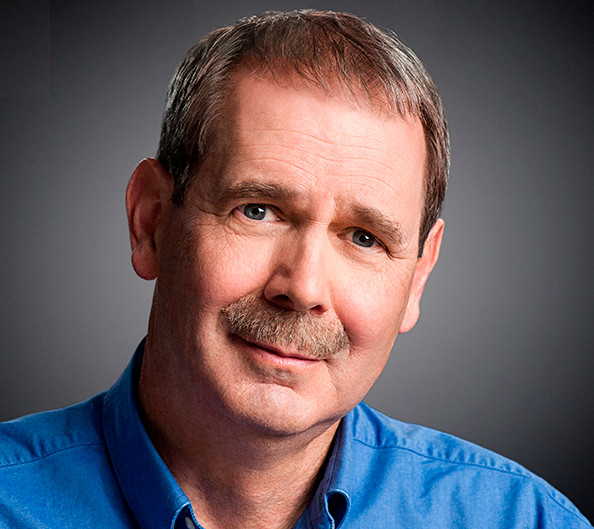
Learn all about the long, fascinating path of how R.R. Corvi—a self-described “child of Sputnik”—went from an amateur writer and Ph.D astronomer to science fiction novelist! Don’t miss his Analog debut novelette “Septo’s Taj” in our Sept/Oct issue, on sale now!
The Analog editor suggested a pile of questions about me and my writing. I have lumped these into a few super-questions that seem to be related, in hopes of imposing some continuity on the answers. So here we go.
First, history and qualifications. How did I break into writing? Do I have a scientific background, and does it impact my fiction? What careers have I had, and how did those impact my fiction?
I didn’t really break into writing. It was more like I found writing’s back door unlocked, stole a cookie from the kitchen, and wandered out again. The cookie was a fluff piece called “The Ethics of Trade,” published under my true name Timothy M. Brown in Worlds of If Science Fiction in 1970. I was nineteen years old.
It was gratifying to be recognized. (And paid—$50, which even at the time didn’t impress me as a lot of money.) But it wasn’t life changing. I was a child of Sputnik, fascinated by all things technical. In college I quickly found my way into astronomy—mostly instrument building, observing, and data analysis. I got degrees, and a job, and son-of-a-gun! I found that not only did I love it, but I was pretty good at it.
So for the next fifty years, though I published a lot, none of it was intentional fiction. That was the point, of course. Through those decades, to the best of my knowledge at the time, every line I published was the truth, the whole truth, and nothing but.
I retired from astronomy in 2022, driven out by, as much as anything, the unequal competition for funding and attention between rafts of smart, dedicated astronomy graduate students and my own slowing mental processes. From formal retirement, I slid with no delay, and without much thought, straight back to my beginning. Writing fiction. Telling lies, not truths. To separate facts from fiction, I adopted the pen name R.R. Corvi.
Did my science impact the fiction? Well, sure. How could it not? But the direction of the push wasn’t quite what you might expect. I spent most of my science career, thirty years of it, working at the National Center for Atmospheric Research (NCAR). There, due to an accident of history, I was one of a small group of astronomers surrounded by crowds of tropospheric meteorologists. So while I probed the interior of the Sun, and tried to do the same with Sun-like stars, and helped find and characterize the first extrasolar planets, I couldn’t ignore other things that went on around me. During my time at NCAR, those same meteorologists first predicted, and then began to measure, and then confirmed and refined their understanding of human-driven global warming. And they watched with controlled but mounting frustration while Earth’s “decision makers” worried about anything else but our degrading climate.
Fifteen years after leaving NCAR, I set out to write my first novel. And not too surprisingly, the subject was not astronomy—my science—but rather that of the meteorologists. Climate change. Not just its physics, but also how its effects are enabled and aggravated by people’s delusions concerning it. And how, if society is to survive, we will have to learn to do a lot of things differently.
Hence, my first book, The Brangus Rebellion, which I self-published in 2023, and its two sequels, Sibs Underground and The Sibs Revolution, which are coming out more or less as I write this. In these books, I put the flashy stuff of characters and plot up front. Played, as it were, by the violins and horns. But in the background, the basses and cellos saw softly along with a through line that ponders one of science fiction’s oldest questions: In a technological society (meaning roughly one that understands both machine guns and municipal sewage treatment), on a finite planet, are human beings capable of managing their own affairs? If so, how might they do that? If you want my take, read the books.
I was a child of Sputnik, fascinated by all things technical. In college I quickly found my way into astronomy—mostly instrument building, observing, and data analysis. I got degrees, and a job, and son-of-a-gun! I found that not only did I love it, but I was pretty good at it.
The second of the editor’s meta-questions directly involves my recent story in Analog, called Septo’s Taj. This yarn is unusual for me in that it had a birth moment that I can identify. I was walking solo in the woods near Boulder, Colorado. (Outdoor hiking is a great source of inspiration. But you knew that.) I was thinking about one of my favorite topics, which repeatedly finds its way into my writing, namely timescales. More precisely in this case, how cosmic timescales are so absurdly longer than human ones that it is hard to find plausible ways to relate them. And thus, the question triggered by my walk in the woods: if you had a self-contained gizmo and you wanted it to operate continuously for, say, a hundred Hubble times (a trillion years, more or less), what would you use for a power source?
An elegant answer that came to me is that you could use the Hawking radiation from a diminutive black hole. I went home and worked out the numbers, and sure enough, a black hole containing a small asteroid’s mass would put out a megawatt of power for millions of gigayears.
Swell. This notion became the story’s starting point and, as it were, its center of attraction. But a scientific oddity isn’t a story. Making the black hole into a human-scale story required bridging the aforementioned gap between two very different timescales. The central problem then became one of motivation. Yeah, with enough effort and resources you could build a mechanism that would run effectively forever—but why would anybody want to do such a thing?
As I worried with these issues, the story evolved away from the initial idea, so that the black hole itself became a secondary plot point. The mystery driving the finished story is not a howdunnit, that staple of early SF, but rather a whydunnit. What did the creators of my tiny black hole have in mind when they built their singularity, and what might their reasons suggest to the solo starship pilot who finds it? For that matter, why does anybody do anything, and how can we ever know their motivations? Thus, straight from rigid astrophysics to squishy philosophy. I guess that’s my territory.
Is Septo’s Taj part of a larger universe of stories? No. It has no connection to my novels, nor to anything else I’ve written, published or not. Its protagonist and his circumstances suggest possible follow-ons along the lines of (say) Larry Niven’s Louis Wu, but I have no plans for such. Well, almost none.
Why did I send this story to Analog? As usual, there’s the good reason, and there’s my reason. The good one is that Analog’s slant toward real science aligns with my own preferences, and with the vibe of the story. My real reason is that my father had a subscription to Analog when I was a kid; I’ve read from the magazine on and off since I was about nine years old, and I’ve wanted to publish there since before I published anywhere. (As documented above, that’s a long time.) Landing a story in the pages of Analog is, for me, a validation, and I’m happy about it.
Another reason is that, while the authors I admire include the likes of Neal Stephenson, Ursula K. Leguin, and William Gibson, my biggest writing influence is still Robert Heinlein. It’s true that by the time I started reading Heinlein he was no longer among Analog’s stable of regular contributors. But so what? That connection was long established, and it influenced me. Several people have told me that my style is reminiscent of early Heinlein, and I suppose that might be true. If so, it isn’t conscious mimicry. It’s just that I read so much of his work, at such an early age, that I must have internalized his concerns and habits as those of the ideal author. If that makes me a throwback, then (a) I’m only a few years from eighty. Who’s surprised? and (b) So be it.
Finally, the editor wants to know how much or little current events impact my writing. Well, it depends. “Septo’s Taj” is almost completely disconnected from the headlines. Some of my unpublished stories relate to real-world stuff, but most don’t. My novels, however, are set on a future Earth that is profoundly scarred by war and climate change. This makes these books unavoidably political, and they are indeed intended to promote my own science-based worldview. I try to do this with good humor, without hectoring, and avoiding stepping on the action. Anybody who has read Ayn Rand knows how tedious the contrary behaviors can be. But the books do air future solutions to present problems, in hopes that readers might think about our real world in ways that are new and productive. In the meantime, I’m enjoying being an indie author, with nobody telling me what to do. If somebody gets pleasure from what I’ve written, so much the better.

