
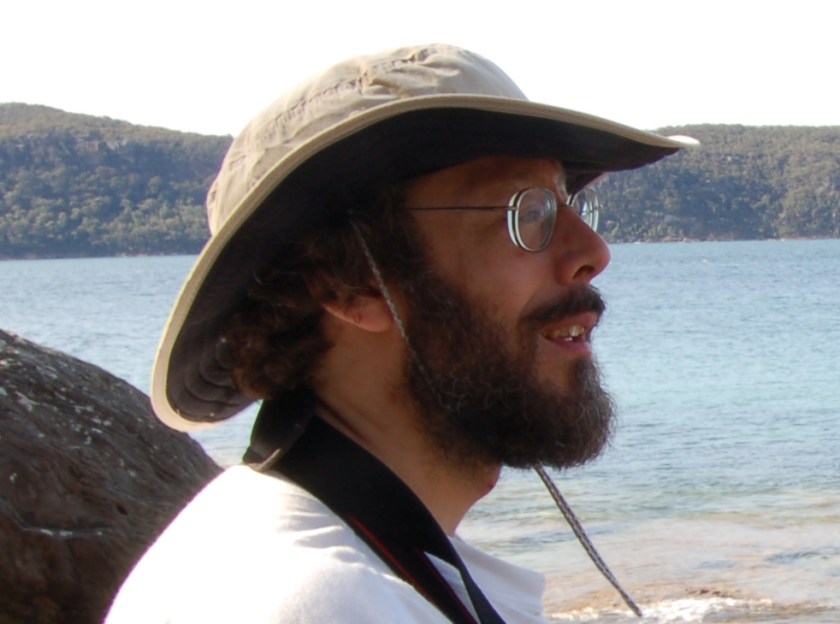
Learn all about Geoffrey Hart’s latest story—from how it drew inspiration from a role-playing game, to its optimistic roots in Star Trek—in this expansive blog post! Don’t miss “Socrates” in our Sept/Oct issue, on sale now!
In a previous story, “Monkey Trap” (Analog Jan/Feb 2026), I worked within a noir-ish context in which humans are mostly alone as sentient beings, the galactic civilizations that preceded us having destroyed each other millennia in the past. They’ve left behind a legacy of mysterious ruins, many of which turn out to contain deadly traps. I call that series the “Survey Crew” universe, as the protagonists have mustered out of the Navy’s Planetary Survey Corps, put a down-payment on a ship with their combined savings, and gone adventuring in the hope of someday paying off the mortgage with proceeds from whatever treasures they can discover—including habitable planets—in dusty, unexplored corners of the galaxy. The “us against the universe” vibe is strong, since their former employer keeps an eye on demobbed former “employees.” The series is inspired by the atmosphere of the classic Traveller role-playing game, mixed with the many “free trader” stories by Andre Norton and with Larry Niven’s science-based puzzle stories. Although there’s a large tip of the hat to these older stories, I’ve tried to retain the spirit of these classic tales but with modern elements, such as a post-colonial perspective.
For a few words on that story universe, check out my article “How the monkey ended up in that trap” in the Analog blog
“Socrates” is my third story published in Analog, with a fourth story about the Survey Crew coming in a few months. However, “Socrates” is set in a far more optimistic story universe, with clear antecedents in Star Trek and a dash of Alan Dean Foster’s “Flinx” stories thrown in. I call this story universe my “First Contact” series, since the stories focus on humans meeting a range of interesting and complicated aliens and having to figure out how to deal with their non-human cultures. In this story universe, humans are just taking a trepidatious first step into a broader multispecies universe, aided and impeded by the race of aliens who have been appointed as their mentors—aliens who are distinctly on the “frenemies” side of the mentoring spectrum. It’s a far more innocent world, with most of the plots driven by the kinds of misunderstandings that will bedevil any real future first contact. Some are inspired by my own cross-cultural travel experiences, some are pure shaggy dog stories, and some are more serious.
“Socrates” falls more on the serious end of the scale, but the overall feeling is nonetheless one of optimism and the sense that if we can communicate with real aliens if we’re patient and forgiving both of them and of ourselves, maybe we can apply the same skill to our fellow humans. The title hints at the concept of a species that communicates via Socratic dialogues, but it’s also a species that doesn’t truly understand the human concepts derived from Socrates. Still, there’s hope for reaching a modus vivendi.
I occasionally dip into social critiques in my stories, but it’s hard to do without getting preachy. Most of my stories begin with a visual image (in “Socrates,” a tardigrade) and continue with an effort to approach that image from an oblique angle to tell a somewhat new story or an old story with a somewhat new twist. If possible, I try to work in an ecological element, as my university training was in forest ecology and plant physiology and I continue to love these fields of study. Sometimes I’m motivated by a story, such as Kipling’s At the End of the Passage. The central image of that story is a bunch of British expats in India who gather together periodically to re-immerse themselves in being British and prevent themselves from “going native”—something of a horrible thought to a certain type of Victorian Brit of that period.
What started out as a short story about a complex social situation worked out through a dinner party suddenly underwent a Shakespearean “sea change” (“into something rich and strange”) and acquired a life of its own. From a longish short story, it grew into a 120,000-word-and-counting novel entitled A Taste of Home. I’ve almost finished the novel, which builds on the dystopian aspects of the “Survey Crew” stories without being part of that story universe. It’s my post-colonial response to the traditional “planetary romance”, in which courageous (mostly white and male) explorers conquer new worlds for the benefit of (mostly white and male) humans, and never mind the needs or rights of the planet’s original inhabitants. Of course, finding ways to define those aboriginals as sub-sentient makes things much easier because it lets you conquer their planet without any ethical qualms. Most of the story’s protagonists abhor that notion, and therein lies the conflict that drives the story.
“Socrates” falls more on the serious end of the scale, but the overall feeling is nonetheless one of optimism and the sense that if we can communicate with real aliens if we’re patient and forgiving both of them and of ourselves, maybe we can apply the same skill to our fellow humans.
Taste has a hefty ecological component based on my belief that growing human-friendly crops on an alien planet (here, the misleadingly named Halcyon) with a very different ecology and environment is going to be far more challenging than most authors understand. This complexity turns out to be significant after the original colonists give up and go elsewhere, leaving a small group of humans behind to manage the human presence on the planet. But since Halcyon is no longer a viable colony, those who are stranded there start running out of food and have to bootstrap enough agriculture to survive until the next supply ship happens along. (This story began life long before Andy Weir’s The Martian, but has a similar “science the fuck out of it” esthetic.)
Designing the alien ecology required me to dive deep into the rabbit hole of how plants protect themselves from predators, how those responses dovetail with their environment, and how difficult it proves for humans to remove the poisons that protect the plants and that also, unfortunately, prevent the humans from eating them. Many plants produce defensive chemicals that slowly kill any herbivores that rely on them. For example, the acorns of oak trees contain chemicals called tannins that bind to proteins, and if a herbivore lacks the enzymes required to detoxify the tannins, they can gorge themselves on acorns and still starve to death from a protein deficiency. It turns out that there are some kinds of defensive compounds that are nearly impossible to detoxify, such as the aesculin produced by horse-chestnuts. So what do you do if most of the plants on your planet are heavily loaded with such chemicals—and the departed colonists took all their agricultural tools with them? You try to figure out how to subvert that alien biochemistry while you watch your food supply dwindle. Great idea, but it took a fair bit of work to turn this research into a story rather than a scientific monograph on plant toxins.
I’ve spent most of my career (closing on 40 years) working as a scientific editor and technical writer, which is problematic for my fiction because both those former jobs emphasize concision and simplification. So my stories tend towards the Spartan. I’ve had to work surprisingly hard to relax the bonds of concision and let my stories “breathe” a little. Like with wine, that greatly improves the bouquet.
As I noted earlier, the story worlds I create tend to be heavily influenced by ecology, but because I’ve read much history, they also contain a mixture of dark and light human elements. On the whole, the SFnal world I’d want to live in would probably be the Star Trek universe, which achieves a balance between hope and “bad things happen to good people”. I love that esthetic, but tend to write a much darker version of Trek. In a more fantastic vein, I’ve found myself writing a surprising amount of horror, presumably reflecting my feelings about our current times, but still try to find the light in darkness. In that sense, I’d probably say I someday hope to achieve something like Charles de Lint’s Newford urban fantasy stories, which achieve amazing emotional depth and an appealing “found family” vibe minus the technology.
The biggest form of writer’s block that I encounter arises from how I get story ideas: the images that launch the writing process often initially lack a clear connection to the characters who must deal with the consequences of those images. That is, my most difficult stories to write start with the great image or idea, not with a great character. (There are, fortunately, increasingly many exceptions in which the character drives the story. There’s a learning curve, see?) So what often happens is that I write a great description of the image and context, and then run hard into a wall trying to figure out who I’m going to write about in that context. The solution that works best for me is generally to relax and step away from the story for long enough that my subconscious has time to gnaw at the story for a while. I find it particularly effective to remind myself of the character and problem they must solve as I’m falling asleep, and ask my subconscious to think about it. I’m fortunate that this doesn’t lead to insomnia; most often, it leads to a solution that is obvious in hindsight.
I don’t yet have much of a presence in social media, but since I’m hoping to retire next year, I’m planning to find more time to build one. In the mean time, my main authorial presence is my Web site:
https://geoff-hart.com/fiction/index.htm
You’ll find a few novels there and a link to many of my short stories. Or, if you’re curious about my technical writing, you’ll find several hundred articles on editing, technical writing, and related things:
https://geoff-hart.com/articles/bibliography.html

