
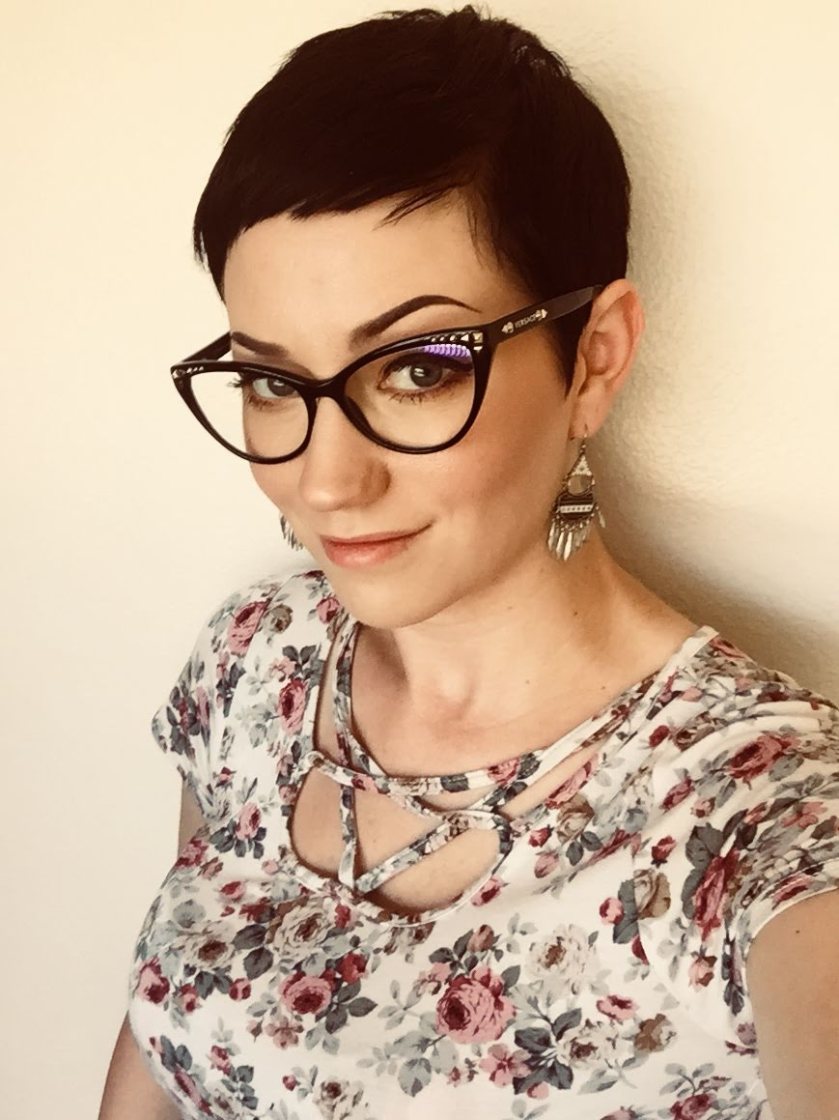
Jody Rich is a writer and artist from southern California who makes her Analog debut in our September/October issue with the short story “Bright Points on the Quiet Sun”! Get to know Jody in our first Q&A with her, and discover how “Bright Points . . .” was written during the height of the Covid-19 pandemic and inspired by a striking image of the sun’s surface!
Analog Editor: What is the story behind this piece?
Jody Rich: This story was largely written over several months during the height of the Covid-19 pandemic. There was a sort of sense of anticipation of a shared demise among people at the time, and it made me think a lot about people who are unrelated in any way who end up having the same end. That a person’s life is just a stack of moments, fantastic and mundane events, one leading up into the next until the end, and then roll credits—and how we have no way of knowing when that last moment might be or how it might be shared in either cause or event, or both. That’s sort of the frame of mind I had when I started outlining this story.
AE: How did this story germinate? Was there a spark of inspiration, or did it come to you slowly?
JR: he idea of looking into a crowd of strangers and wondering if they all may end up sharing the same end, sparked the idea of being able to actually see that, literally, in real time. It was interesting to explore what that would feel like to a person, to be suddenly able to see that and be certain they are right–and further, how they would navigate doing something about it, or not. It was also important in this context that the protagonist with this ability was not a white man, to add to the anxiety of being in an airport with this important information and what kind of personal danger and sacrifice that might entail to choose to try and relay it in order to save others.
AE: How did the title for this piece come to you?
JR: I was on the NASA website browsing photos, and one of them was a recently released photograph from the Solar Swedish Telescope of the solar surface and what they refer to as granules in high resolution. The granules are actually hot columns of rising plasma, surrounded by cooler columns of descending plasma, that from a distance creates the illusion of texture. In the cooler regions are bright, white-hot dots that are regions of concentrated magnetic fields that are constantly present on the sun’s surface regardless of the magnetic solar cycle and sunspot formation. It was a striking photo, and the caption was “bright points on the quiet sun.” The name sat in my notes folder for awhile before I connected it with the story itself. The story has a theme of looking to the future and the past from the present, and the concept of both of those things being relative and, ultimately, illusory.
AE: Who or what are your greatest influences and inspirations?
JR: I have always been very influenced by the narrative style of Kurt Vonnegut Jr., with whom I share a birthday! Other big influences and inspirations include the novels of Chuck Palahniuk, the poetry of Sylvia Plath, and the character focused science fiction short stories of Ray Bradbury. As far as media, all iterations of Star Trek but particularly The Next Generation, and the contrasting whimsical science fiction universe of Doctor Who.
AE: Are there any themes that you find yourself returning to throughout your writing? If yes, what and why?
JR: I find myself often returning to the theme of parallel worlds and multiple timelines. The branching effect of chaos theory on a common person’s perception of life and time, the concept of the very large and very small both ensconced in the same existence. I am strongly enamored with the sciences of both particle physics and cosmology, and often find those things appearing in my work even when it’s unplanned. The mechanizations of the universe and how we still manage to interact with them.
AE: What inspired you to start writing?
JR: I’ve been writing since I was very young. In fact, I would write little books and illustrate them long before I could actually spell words properly, so my parents have these stories I wrote just sounding out words as best I could. I would write stories longhand up until I got an electric typewriter when I was a young teenager that had a memory function and a tiny little screen that held a few words at a time. I can remember writing my first novel on a stack of graph paper I had left over from math class during the summer between elementary and middle school. There were a lot of wildfires that year, so something about the smell of wildfire smoke in the summer always reminds me of lying on my bed writing that first long story. It was a horror story about a rock band and vampires; I believe I was about eleven. I suppose I’ve just always had stories in my head that I wanted to share.
AE: What other projects are you currently working on?
JR: I have a few stories in the works as well as a novel. I mainly write science fiction, but I also have a writing partner, author C.E. King, with whom I write historical stories, and we’re currently polishing up our first novel for publication—the first in a planned trilogy of books, a romance between a WW1 veteran bootlegger and a disillusioned police officer set in 1920’s Los Angeles.
AE: What SFnal prediction would you like to see come true?
JR: I would be so thrilled to witness the breakthrough in energy that would make interstellar travel a truly viable pursuit. Antimatter energy drives? Lightspeed warp? Sign me up!
AE: What are you reading right now?
JR: I just started a novel called Sea of Tranquility by author Emily St. John Mandel.
AE: Do you have any advice for up-and-coming writers?
JR: My advice for any writer is to not let yourself get stuck in draft mode. Just get words on the page to start with and to go back and work it, edit it, add or subtract, but it has to exist first before you can make it read the way you envisioned it. Nothing springs from your fingers to the page in perfect form, so getting stuck there on a first draft I think stands in the way of a lot of writers who want their first draft to be the final form. To that end, I think reading your draft aloud will also help writers find parts of their prose that need editing in a way that reading silently off the page just doesn’t. I also suggest changing the font of a draft when you’re reading through it for editing, because your eyes get so used to reading the same lines over and over they don’t really see them anymore. Changing the font makes it look different from what your eyes have memorized, so it forces you to really read it over again and see it anew. It’s just kind of tricking your brain, but it works!
AE: How can our readers follow you and your writing? (IE: Social media handles, website URL . . .)
JR: I’ve just started a Substack! It’s at jodyrich.substack.com, and if any readers want to follow me on Instagram and see mostly pictures of desert sunsets and my dogs, I’m at @nemesiswalnut. I will be updating there as well when there are new things to read!

