
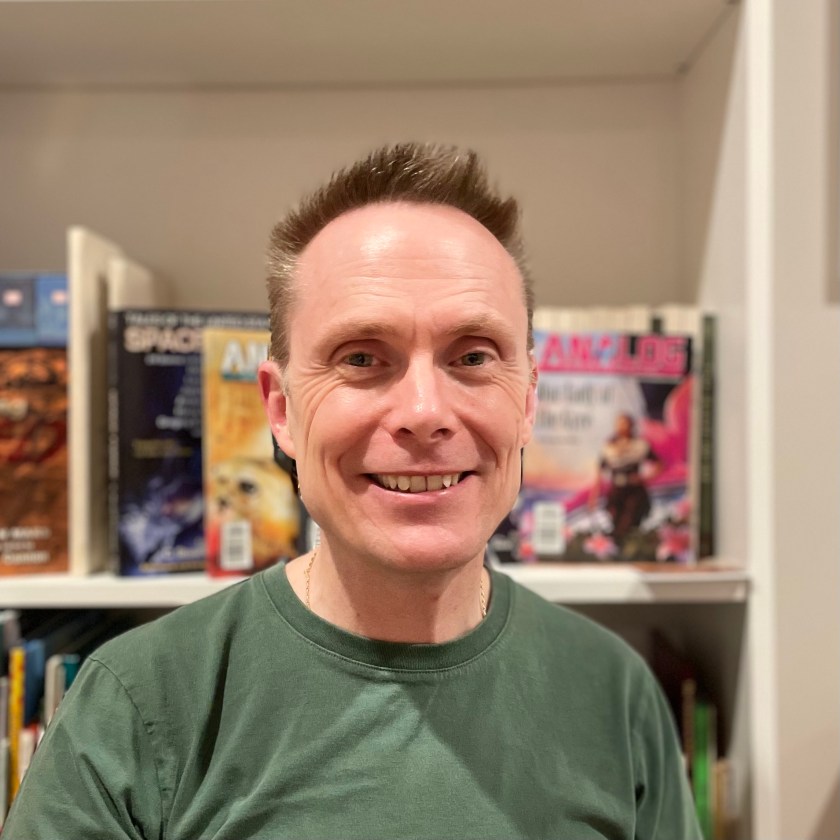
M.T. Reiten returns to Analog for the fifth time in our November/December issue with “Xmas in Derbtown”! Here he discusses everything from his experiences submitting stories for Stan Schmidt, to the logistics of Santa delivering packages to a lunar colony, and much more!
Analog Editor: How did this story germinate? Was there a spark of inspiration, or did it come to you slowly?
M.T. Reiten: My daughter was in grade school and Christmas was approaching a few years ago. I was fascinated by the role that Santa Claus plays in the center of the American consciousness. This was in a broader multi-cultural context. It’s amazing how everyone mostly participates and there is an understanding even among strangers on this topic. I remembered stories my dad told me, growing up as an only child on an isolated farm in North Dakota. The excitement of the holidays. His experience was different than mine in details, but not in emotions. In deep December under a clear night one experiences the isolation and frigid near moonscape during winter (ignoring the occasional tree.) I wondered how Santa would deliver gifts to a lunar colony. What purpose does Santa serve in a technology heavy society? What will my daughter pass on to her children? This spark had to smolder for a long time before it finally coalesced. I took three years from inception to completion to submission.
AE: Is this piece part of a greater universe of stories?
MTR: Yes. “Xmas in Derbtown” shares a common universe with several of my short stories. “The Defense of Waygo Port” appeared in Tales of the United States Space Force and “Last Resort Pioneers” appeared in Building Red. “St. Cyrus Ray and the Lunar Yumbies” is set in a slightly sillier parallel universe, sharing much of the same backstory before mutation and Lunar zombies, and is in the anthology Houston, We’ve Got Bubbas. I have a few other unpublished pieces seeking a home that are connected to Derbtown and this version of lunar settlement by the desperate rather than the wealthy.
AE: What made you think of Analog for this story?
MTR: “Xmas in Derbtown” is a story of struggle and hope with real (or at least plausible) science central to the plot. How could I not think of Analog? Especially for the Nov/Dec issue. Ho ho ho.
AE: What is your history with Analog?
MTR: “Xmas in Derbtown” is my fifth story to be published in Analog. I may eventually believe that it’s not by accident. I’ve read Analog for decades. My first submission to Analog was over thirty years ago. Stan Schmidt rightly rejected it. That was in the era of sending physical manuscripts in a manila envelope and waiting for a SASE to appear in the mailbox. It was a form rejection. So I tried with my next solid SF story and got a personal rejection. With gentle fingertips, one could feel where the ballpoint pen had pressed into the paper. I continued to write and submit, collecting 18 rejections for submissions that I felt were Analog-worthy stories before finally achieving one of my major life goals. Trevor Quachri accepted and published my first story in Analog.
MTR: Are there any themes that you find yourself returning to throughout your writing? If yes, what and why?
AE: In my earliest work, vocational crises were a common theme which was obvious even from a superficial read. Perhaps I’ve matured out of that having had a variety of careers along the way and finally understanding that there is more to life than a job. I’d like to think that now my recurring theme is a matter of characters finding their place and way in the strange world that they live in. The world is getting stranger for all of us, so I hope my stories can provide alternate perspectives to make the path to that unique place a little less lonely.
AE: Which leads to bonus question on the role of children as POV characters.
MTR: Children are dropped into the future by their parents. They have no choice as the world gets thrust on them. Perhaps that is why a child as point-of-view character works well in science fiction. I’d say it is especially suited for short stories where much of the world building has to happen quickly and much just has to be hinted at and accepted.
There is a universalness about the acceptance and the fundamental human experiences that we share. Whether it’s a little girl and her beloved caregiver robot or a son and father who are economic refugees on the Moon, the kids see everything as new but, at the same time, simply how it is. Child characters grow up every single day in that new world that the author created. Their whole job is making sense of the world. Who better to greet the story with interest rather than cynicism? Who better to ask the question “Why?”
I recall some of these stories I loved. “A Pail of Air” by Fritz Leiber, Have Spacesuit Will Travel by Robert Heinlein, or a boy getting into a flying saucer with his pet chicken. The Wonderful Flight to the Mushroom Planet (thank you Google) which is clearly not as famous. I learned about gaseous diffusion, the insulating properties of vacuum, and surprisingly that sulfur compounds make egg yolks smelly.
If done well, the belief that things were knowable and the young POV character had some control over their decisions pulls the reader in. But this authorial decision can’t be used as a shortcut to tension by simply endangering the child character or squashing their agency. The kid cannot just be along for the ride.
Everyone who reads stories has at one time been a child. Many grownups read SF when they were young. It was about exploring the imagination and the limits of what it might could possibly be. Along the way, we slough off the sense of wonder as adults. Some of us eventually have children of our own who help us pull the dusty shoebox from under the bed and let our wonder back into the world.
So the child as POV character in SF reverts us grownups back into that mode of trying to make sense of the world. Even if the world is the one on the page.
AE: Do you have any advice for up-and-coming writers?
MTR: Be the most interested person in the room. You never predict what you’ll learn through engaged listening.
AE: Many of our Analog authors are interested in science. Do you have any scientific background, and does it impact your fiction?
MTR: Earlier in my life, I earned my living as a practicing scientist, working in research labs in universities, industry, or finally at a major national laboratory. I hold a PhD in Electrical Engineering, but my expertise was in spectroscopy and electromagnetics which is much closer to physics. But through a strange series of events, I have found myself funding that R&D work that is performed by other scientists and engineers as a program manager. I now get to see all the interesting developments, problems and solutions without turning the wrenches or running the simulations myself. This is the natural progression of researchers. I believe that all lived experiences—personal, cultural, environmental—shape the author’s voice. My experiences impact my fiction, because the voice of the scientist and engineer needs to be part of the conversation, too. It is one of my voices, formed by seeking out facts, and is more important than ever with the erosion of our consensual reality.

