
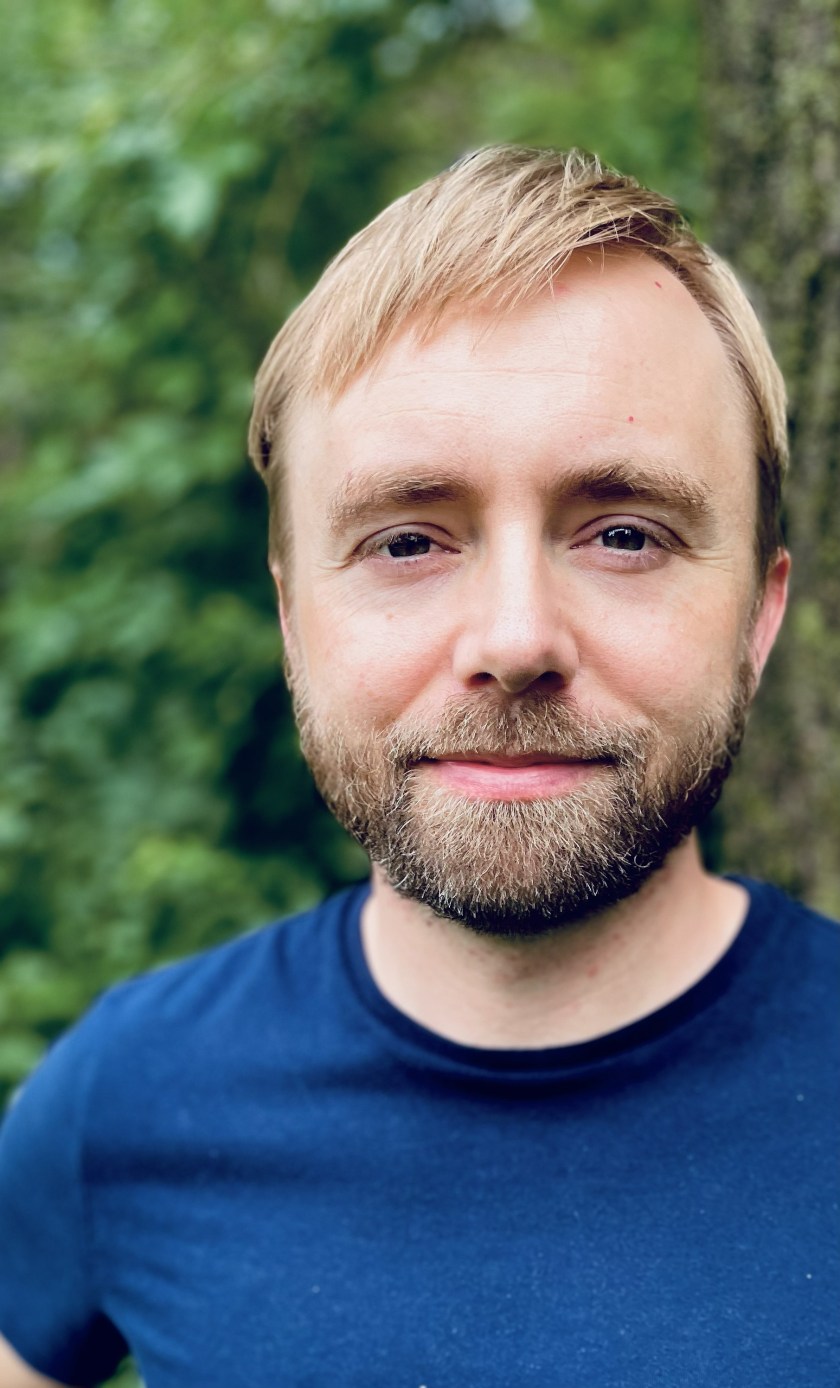
J.R. Dewitt returns to Analog with “Preggo Bomb,” a story dealing with pregnant mechas, in our September/October issue! In addition to his writing career, his love of CJ Cherryh, and more, here he discusses how his becoming a father and the period leading up to it helped inspire this latest piece
Analog Editor: What is the story behind this piece?
J.R. Dewitt: It’s a story about empathy and how to weaponize it. It’s not a unique concept in sci-fi by any means (I’m looking at you, Point of View gun). But instead of weaponizing empathy against a person, it’s about weaponizing empathy against a weapon.
AE: How did this story germinate? Was there a spark of inspiration, or did it come to you slowly?
JRD: I love mechas. I’ve been enamored with them ever since I saw Macross playing on one of the mounted tube TVs at my home town’s Chuck-E-Cheese rip off (RIP, Rock City Pizza). Throw in a heavy dose of Gundam and some Heavy Gear and Mechwarrior games, and I’ve been wishing since I was about eight that I could hop into a cockpit and blow some stuff up.
Then I got older. I had kids. I started watching the news and seeing what happened to kids in buildings blown up by things far worse than mechs. And somewhere in that cross-section between the realities of parenthood and that still-strong love for mobile suits, this story came to be. Of course, there’s a lot of other inspirations as well, one big one being Kafka, another being the “The Inner Light” from TNG, both of which force the reader or watcher to suddenly be transported into another perspective. But unlike those, this story isn’t about switching the perspective of a person (not at first, at least). It’s about switching the perspective of a weapon.
All of this came to fruition just before my second son was born, when my wife was nine months pregnant and certain world events were broadcasting the kind of urban decimation you hope to never have your son born into. But when I started writing it, it didn’t work. I tried it one way. Then another. And then finally I got tired and chucked it into the “never-to-be-finished” pile. Fast forward a year later, and I’m on my staggered paternity leave. I dig the half-complete story out of the pile, and then suddenly I see it: the rest of the story. The remainder came together during a series of nap times, never one of which ever seemed long enough.
AE: What is your process?
JRD: There is no process–not anymore, at least. I’ve got two little boys. They’re wonderful. And they’re crazy in all the best sort of ways. But they keep me busy. I have to steal time at odd hours, usually at night. Which is good in some ways. It makes you less precious about things when writing is relegated to small bits of time. And that keeps you focused.
When I start a short story, I usually start from a feeling or some kind of line that intrigues me. I wish I could start from concepts (I’ve got a million of them). But the concepts typically don’t take shape until the story’s nearly completed itself. As Hegel says, the owl of Minerva takes flight only at dusk. So too with writing. It’s not until I look back that I see what I’ve written and realize what I was trying to say the whole time.
AE: How did you break into writing?
JRD: By writing a lot of really bad stories. A lot of them.
AE: What inspired you to start writing?
JRD: I love words. I love stories. I love characters. Honestly, it really doesn’t get much more complicated than that!
AE: What other projects are you currently working on?
JRD: A book! I started it at the beginning of the year, and I’m several chapters in now. Unfortunately it means my short stories have taken a bit of a backseat. But I hope to get back to them soon.
AE: What are you reading right now?
JRD: Some C. J. Cherryh. I love her books. There’s a viscerality to her works that really claws into you. Plus she’s got some cool aliens, my absolute favorite being the knnn. I try to read the Pride of Chanur every summer now.
AE: Do you have any advice for up-and-coming writers?
JRD: I still feel like an up-and-coming writer myself so it’s a hard question to answer. Plus I’m still in need of advice! That said, I’d say try to embarrass yourself. Write weird things. Write goofy stories about mechas becoming pregnant. Also, always remember: “make it, then make it good.” In other words, it doesn’t have to be anywhere near perfect when you write it. All you need to do is get those words on the page. You can deal with making them behave later.
AE: Many of our Analog authors are interested in science. Do you have any scientific background, and does it impact your fiction?
JRD: I don’t, but I love science and engineering. I love it so much I married a rocket scientist (love you, Kirsten). I’d say the lack of scientific background actually helps me in a lot of ways. I have this desire to understand concepts that are way beyond my expertise, and that drives me to synthesize them into a digestible unit that’s typically well-suited for implementing into a story that needs to maintain narrative pace without getting bogged down in the details.
AE: What careers have you had and how do they affect your writing?
JRD: I’ve had a few, but the biggest one is being a lawyer. You see a lot of characters. You deal with a lot of difficult situations. It’s a great breeding ground for stories.
AE: How can our readers follow you and your writing?
JRD: I try to keep my website fairly updated, so that’s a great place to start: https://www.jrobertdewitt.com/. Otherwise, I’m occasionally on Bluesky (@jrdewitt.bsky.social), but with everything going on in my life, I tend not to get onto social media much.
J. R. Dewitt is a sci-fi writer whose only claim to fame is that Buzz Aldrin rode in his car. He likes birds. And robots. And the awesome, cinematic experience that is the 1956 film Rodan. He lives in Minnesota with his wife and two kids. His fiction has appeared in Analog, Escape Pod, Fusion Fragment, and more.

